


Antique Wooden Flatware Box
An antique wooden flatware box keeps silver orderly and looks proper on a sideboard.
Antique Wooden Flatware Box
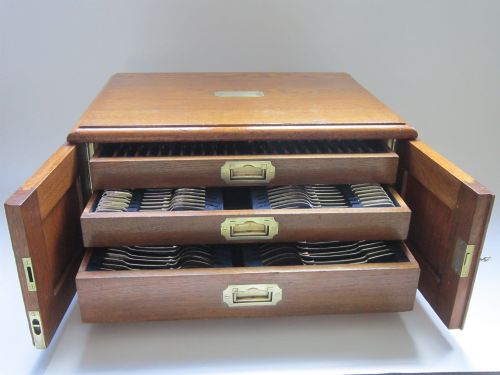
When you search for an antique wooden flatware box, you are looking at fitted canteens, knife boxes, and cutlery trays designed to house silver service. The pieces on this page span the Georgian, Victorian, and Edwardian periods, alongside later twentieth century examples.
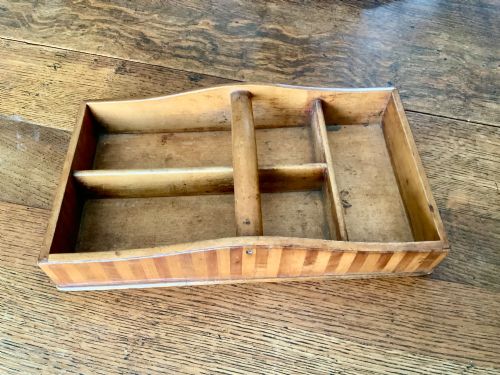
You will most commonly meet mahogany and oak boxes, often shaped with serpentine fronts or fitted with brass handles and velvet linings. Forms range from rustic pine trays to large cased canteens holding extensive cutlery sets.
How they were made
Carpenters built these boxes using timbers such as mahogany, oak, walnut, and pine, frequently adding brass fittings and brass handles for lifting. Interiors were lined with velvet to cushion silver flatware and prevent scratching during storage.
Construction methods include fine inlay work on Georgian serpentine fronts and sturdy joinery on 19th century Scandinavian rustic pine trays. Makers also produced fitted compartments to secure specific cutlery patterns neatly inside.
Periods represented span from Georgian and George III through Victorian, Edwardian, and Art Deco up to 1930.
What varies in quality
Quality depends upon the selection of timber grain, such as figured mahogany or walnut, and the precision of the cabinet work. Sharply executed serpentine fronts and well-fitted interior partitions separate finer boxes from simpler vernacular trays.
The sophistication of the brass hardware and the preservation of the original velvet lining also mark the distinction between standard utility boxes and superior examples made for wealthy households.
Walker And Hall
The Antique Wooden Flatware Box Glossary
- Serpentine front
- A curved furniture front featuring a convex centre flanked by concave sides. This shape demands high skill from the carpenter.
- Canteen
- A fitted chest or box designed to hold a complete set of cutlery. These interiors keep each fork and spoon in a dedicated slot.
- Fiddle pattern
- A traditional nineteenth-century flatware handle shape widening slightly at the end. It appears frequently in complete Victorian services.
- Knife box
- A specialised upright or sloping container historically used for storing dining knives. Georgian examples often display dramatic wood figures and inlaid details.
Antique Wooden Flatware Box: Frequently Asked Questions
What is an antique wooden flatware box?
It is a specialised storage chest or tray built from timber to hold dining cutlery.
These pieces range from simple pine trays to elaborate mahogany canteens fitted with velvet linings.
How were these boxes used?
Households used them to protect silver flatware from tarnishing and damage between meals.
Servants kept them on sideboards or in butler pantries ready for formal dining.
How do I date a wooden cutlery box?
You look at the timber choice, construction style, and hardware such as brass handles.
Georgian pieces often feature serpentine mahogany shapes, while Edwardian and Art Deco boxes show later proportions.
Can I use these for modern cutlery?
Many boxes accommodate modern knives and forks if the internal slots match standard sizes.
However, some older canteens were shaped for specific flatware patterns like Fiddle pattern.