


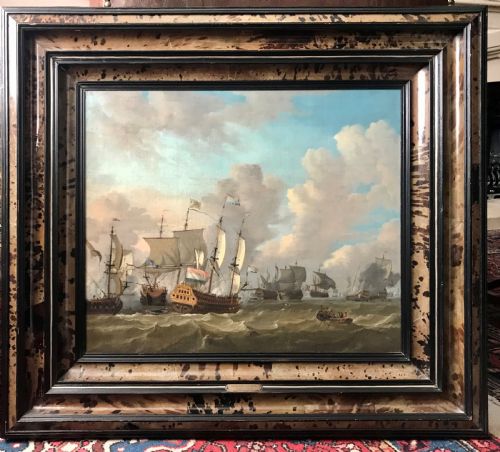


Antique Warship Painting
An antique warship painting brings the raw power of naval history onto your wall, capturing great battles and historic vessels in oil, gouache, and watercolour.
Antique Warship Painting
When you search for an antique warship painting, you are looking at maritime art that spans from seventeenth-century sea battles to early twentieth-century naval vessels. These works record historic warships, galleons, and ironclads through the eyes of contemporary artists and later followers of marine traditions.
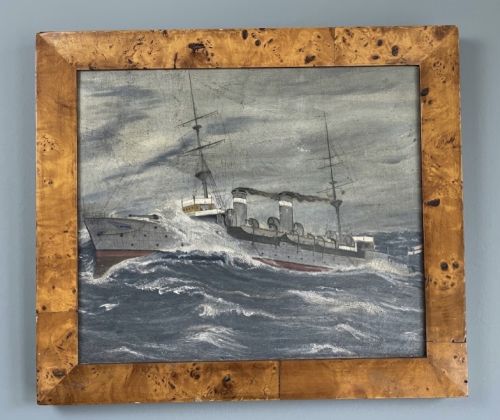
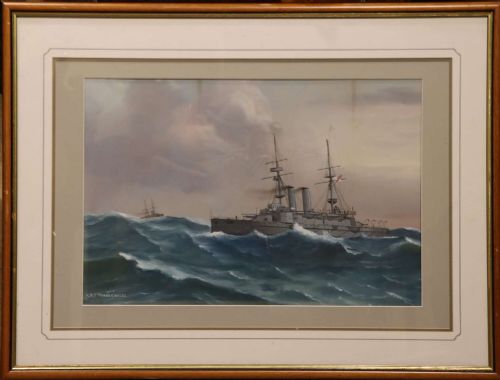
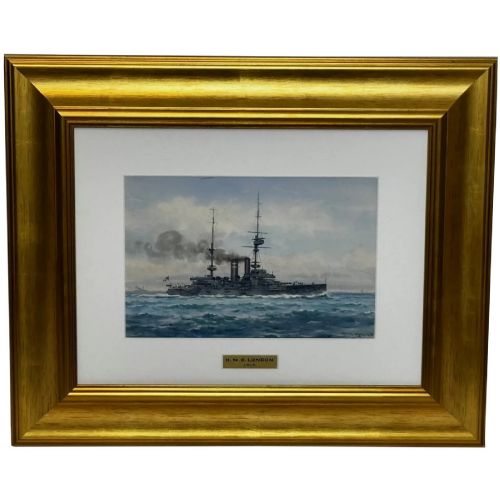
The most common examples encountered on this page date from the Edwardian era and the early twentieth century, often capturing specific Royal Navy cruisers, battleships, or harbour scenes. Alongside traditional canvas and panel works, you will also find detailed gouache and watercolour paintings on paper, capturing the intricate rigging and gunports of historic fleets.
How they were made
These maritime works rely on traditional painting supports, using oil on canvas, oil on panel, and watercolour or gouache on paper. Artists handled these mediums to capture the tumultuous spray of the sea, billowing canvas sails, and the dark iron hulls of steam warships.
Framing plays an integral role in the presentation of these pieces, frequently incorporating gilded wood to complement the maritime subject matter. Many works are preserved behind glass to protect delicate watercolours and gouache pigments from atmospheric damage.
Antique Warship Painting Retail Price Guide 2026
Typical asking prices for warship painting among the pieces listed under this phrase on Sellingantiques today, from the lower quarter to the upper quarter. They describe what is for sale here now, not the wider market.
Listings feature periods from the 17th century through the Edwardian era, utilising oil, gouache, and watercolour on paper, panel, and canvas.
What varies in quality
Quality in these maritime works rests on the artist's command of perspective, technical accuracy in rendering naval architecture, and the vitality of the sea itself. Superior pieces demonstrate a precise understanding of rigging, cannon placement, and hull construction, whereas lesser works generalize these complex nautical details.
The choice of medium and the condition of the surface also define the tier of the piece. Well-preserved works maintain vibrant pigments and crisp detail in the handling of smoke, water, and sky, while lesser examples suffer from fading or heavy-handed later restorations.
James Hardy·Frank Watson Wood·Vincenzo D Esposito·Charles Dixon·Abraham Storck
The Antique Warship Painting Glossary
- Gouache
- An opaque water-based medium that allows for rich, saturated colour and fine illustrative detail on paper. It was frequently employed by marine artists to depict the crisp lines of naval vessels.
- Panel
- A rigid support for oil paintings, often made of wood, providing a smooth and stable surface that preceded the widespread adoption of stretched canvas.
- Ironclad
- A steam-propelled warship protected by iron or steel armour plates, appearing frequently in art from the latter half of the nineteenth century onwards.
- Galleon
- A large, multi-decked sailing ship used for war and commerce from the sixteenth through the eighteenth centuries, characterised by high raised structures at the bow and stern.
Antique Warship Painting: Frequently Asked Questions
What periods do these paintings cover?
The works span several centuries of naval history, ranging from seventeenth-century sea battles to early twentieth-century Dreadnoughts and Edwardian cruisers. This timeline reflects the changing technology of naval warfare from sailing galleons to ironclad battleships.
Earlier examples often depict romanticized engagements with raised sails and cannon fire, while twentieth-century pieces frequently document specific named vessels of the Royal Navy and French Navy.
How do I identify the ship in the painting?
Many works include clear inscriptions, titles, or flag signals that name the specific vessel, such as an Edwardian cruiser or a historical galleon. Researching the named ship often reveals its operational history and the naval campaigns it participated in.
If the title is general, clues such as uniform details, hull design, and the style of masts can help narrow down the nation and era of the depicted fleet.
How should I display maritime art?
These works require placement away from direct sunlight to prevent fading on paper, canvas, and fragile gouache pigments. Maintaining stable room humidity protects both the wooden panels and the gilded frames often associated with marine art.
Pairing the painting with appropriate period lighting enhances the textures of the oil or watercolour surface without generating excessive heat near the artwork.
What is the difference between oil and gouache marine paintings?
Oil paintings on canvas or panel offer a textured, luminous depth that handles the dark tones of stormy seas and metallic ironclad hulls effectively. They are typically more robust and historically were varnished to protect the pigment.
Gouache and watercolour works on paper offer a matte, highly detailed finish that excels at capturing sharp rigging and architectural precision, though they require protection behind glass.