




Antique Red Glass Jug
An antique red glass jug brings a rich flash of colour to a table, combining utility with deep Victorian and Edwardian tones.
Antique Red Glass Jug
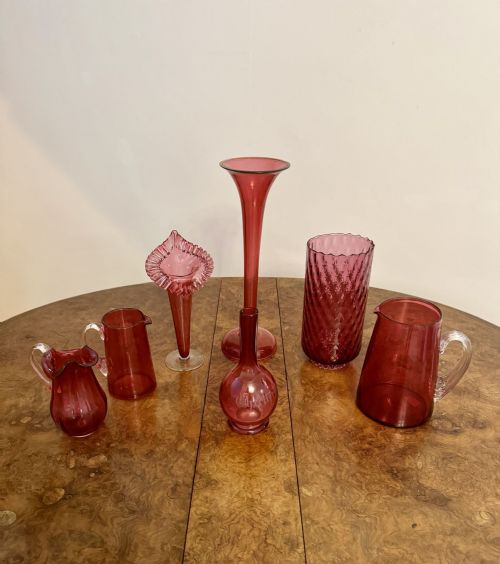
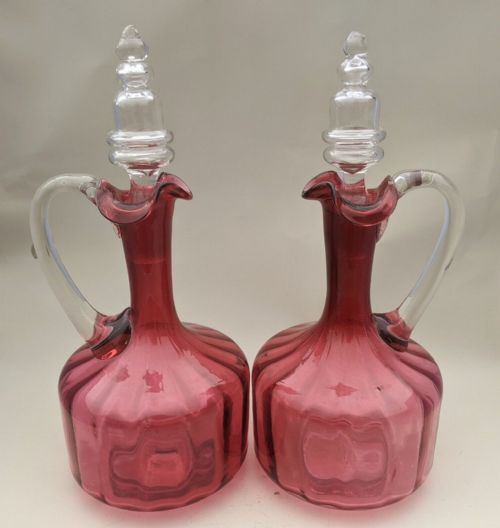
An antique red glass jug appears across several forms on this page, including water jugs, claret jugs, cream jugs, and wine decanters dating from the nineteenth century into the early twentieth century. Buyers seeking an antique red glass jug often encounter cranberry glass and ruby glass variations, frequently styled within the Victorian and Edwardian periods.
The selection ranges from large pitchers to smaller cream jugs, sometimes accompanied by bowls or matched in pairs. English examples from around eighteen sixty sit alongside later Edwardian pieces, showing how makers adapted these vessels for wine, water, and table service over decades.
How they were made
Many pieces utilise cranberry glass or ruby glass, achieved through the addition of gold salt additive to the molten material during production. Artisans shaped these vessels while hot, sometimes incorporating clear glass handles or silver plate mounts.
Decoration on these items includes engraved motifs such as fruiting vines, alongside applied white piping on specific cream jugs. Crystal glass variants demonstrate careful cutting and shaping typical of nineteenth-century glasshouses.
Listings feature items spanning the Victorian and Edwardian eras, predominantly utilising cranberry glass, ruby glass, clear glass, and silver plate.
What varies in quality
Quality in an antique red glass jug rests on the depth and evenness of the colour achieved through the glass chemistry, alongside the crispness of any engraved details like fruiting vines. Simpler cream jugs with basic white piping differ substantially from larger, heavy decanters featuring complex forms and matched pairs.
The integration of secondary materials such as silver plate mounts also distinguishes standard table pieces from more ambitious vessels. Better examples show superior handling of the hot metal during creation, resulting in balanced proportions and clean rims.
The Antique Red Glass Jug Glossary
- Cranberry Glass
- A transparent pinkish-red glass created by adding gold salt to the molten batch. It became extremely popular during the Victorian era for tableware and decorative items.
- Ruby Glass
- A deep red glass variant used for decanters and water jugs. The rich hue is achieved through specific metallic oxide additions.
- Claret Jug
- A vessel specifically designed for serving red wine at the table. These often feature glass bodies paired with silver plate handles and mounts.
- Decanter
- A stoppered bottle used for holding and serving wine or water. Victorian examples frequently utilise cranberry or clear crystal glass.
- Gold Salt Additive
- The chemical agent introduced to molten glass to produce the characteristic pink and red tones of cranberry glass. Its inclusion dictates the warmth of the finished colour.
Antique Red Glass Jug: Frequently Asked Questions
What is cranberry glass?
Cranberry glass is a pinkish-red transparent material made by adding gold salt to the molten batch. It gained widespread popularity in the Victorian period for tableware.
Artisans shaped this glass into jugs, decanters, and complete sets, often combining the rich colour with clear glass handles.
How do I date an antique jug?
Dating relies on stylistic markers, manufacturing techniques, and recorded periods such as Victorian or Edwardian eras. Pieces from around eighteen sixty often display distinct engraving styles.
Later Edwardian items around nineteen hundred show subtle shifts in form and mounting details compared to mid-nineteenth-century examples.
What were these jugs used for?
These vessels served various functions at the dining table, ranging from water jugs and cream jugs to dedicated claret jugs and wine decanters. Larger pitchers accommodated drinks for gatherings.
Smaller items like cream jugs were part of broader table service sets alongside matched bowls.
Are ruby glass and cranberry glass different?
Ruby glass and cranberry glass both offer red tones, but they utilise different chemical recipes and produce distinct depths of colour. Cranberry relies specifically on gold salt additives for its characteristic pink-red shade.
Both materials appear frequently across nineteenth-century glassware and decanters.