



Antique Pointer Dog Statue
An antique pointer dog statue captures the poised energy of the field sport, offering a handsome bronze or spelter study for the desk or library.
Antique Pointer Dog Statue
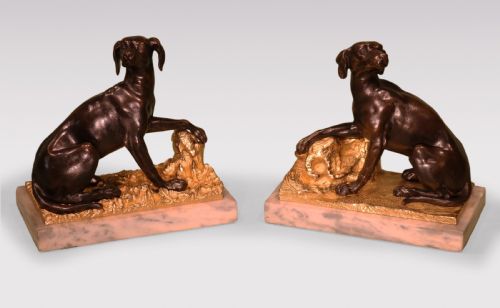
An antique pointer dog statue brings the focus of nineteenth-century field sports directly into the home through sculpted figures in bronze, spelter, cast iron, and porcelain. These pieces range from realistic bronze casts mounted on marble bases to domestic table lamps and fireside figures produced in France and Britain.
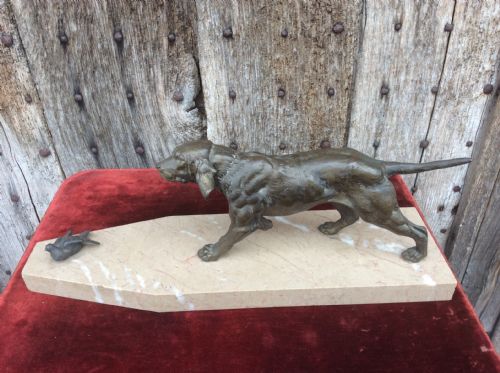
You will most frequently encounter nineteenth-century Animalier bronzes and Victorian compositions showing the dog resting, working, or flushing game alongside pheasants. Later examples stretch into the early twentieth century, taking the form of Art Deco spelter figures on plinths and Edwardian porcelain models.
The objects recorded here encompass freestanding sculptures, sculptural groups with game, and functional table lamps that integrate cast metal hounds with brass and marble mounts. Each form reflects the period fascination with sporting dogs and the naturalistic representation of animal anatomy.
Materials and construction methods
The finest figures utilise the lost-wax casting method for bronze, allowing sculptors to render the taut muscles, ribs, and expressive tails of working hounds with precision. This hot-cast metal is frequently paired with heavy green or white marble bases to provide stability and visual contrast.
Alternative materials include spelter finished with a dark patina to imitate bronze, alongside durable cast iron suited for heavier fireside ornaments. Ormolu and brass mounts provide decorative accents, while porcelain pieces from factories like Royal Dux employ traditional ceramic moulding and hand-painting.
Antique Pointer Dog Statue Retail Price Guide 2026
Typical asking prices for pointer dog statue among the pieces listed under this phrase on Sellingantiques today, from the lower quarter to the upper quarter. They describe what is for sale here now, not the wider market.
Several hounds are accompanied by remarkably unimpressed pheasants that appear entirely unfazed by the impending chase.
Distinguishing quality in sculpture
The integrity of the base is equally telling, as superior works employ solid polished marble or fitted ormolu mounts rather than lightweight substitutes. The relationship between the dog and any accompanying game, such as pheasants, should feel dynamic and anatomically convincing rather than stiffly posed.
Pierre-Jules Mêne·Delabrierre·C Masson·Auguste Nicholas Cain·DUBUCAND·Royal Dux
The Antique Pointer Dog Statue Glossary
- Animalier
- A nineteenth-century artistic movement dedicated to the realistic portrayal of animals, particularly working and hunting dogs. Practitioners mastered the accurate depiction of muscle and movement.
- Spelter
- A zinc alloy commonly used as a cost-effective alternative to bronze during the late nineteenth and early twentieth centuries. It is typically painted or electroplated to resemble darker metals.
- Ormolu
- Gilded bronze applied as an ornamental mount or decorative base for sculptural figures. The technique involves treating brass or bronze with a mercury-gold amalgam.
- Lost-wax casting
- A traditional foundry technique where a wax model is melted out of a ceramic mould and replaced with molten metal. This process permits intricate undercut details in bronze.
Antique Pointer Dog Statue: Frequently Asked Questions
What is an Animalier sculpture?
An Animalier sculpture is a nineteenth-century work focused on the realistic depiction of animals, particularly hounds and sporting dogs in active poses.
These pieces were produced primarily in France and Britain, capturing the musculature and behaviour observed in the field.
How do I date a bronze dog figure?
Dating relies on the style of the casting, the signature of the founder or sculptor, and the material of the base. Nineteenth-century examples often feature heavy green marble plinths and naturalistic patination.
Twentieth-century pieces tend to incorporate geometric marble bases or shift into the stylised forms associated with Art Deco design.
Are spelter and bronze the same?
Spelter and bronze are distinct metals; spelter is a softer zinc alloy while bronze is a durable copper and tin mixture. Bronze figures generally command greater weight and finer surface detail.
Spelter was utilised as an affordable substitute and requires careful handling to preserve its applied surface finish.
Where should I place a heavy bronze statue?
A heavy bronze or cast iron statue sits best on a sturdy wooden desk, side table, or mantelpiece where its weight is fully supported. Ensure the piece is placed away from direct heat sources that might affect the underlying marble or patinated finish.