


Antique Plaque Ring
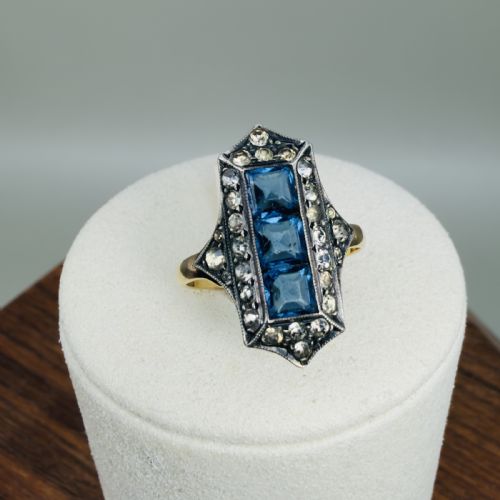
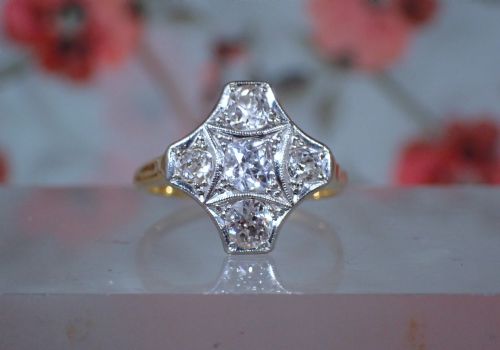
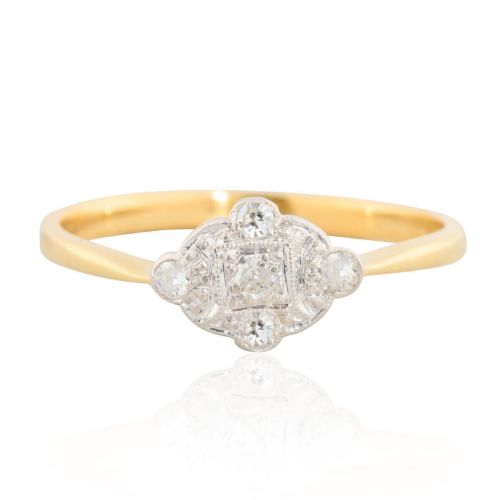
An antique plaque ring delivers a flat, geometric face of diamonds and coloured stones on the finger, dominated by the linear geometry of the Art Deco and Edwardian eras.
Antique Plaque Ring
An antique plaque ring centres on a flat or slightly curved face, often pierced or openwork, that spreads across the finger in a geometric, oval, or rectangular silhouette.
Most examples encountered here belong to the Art Deco and Edwardian periods, stretching from the early twentieth century through the 1920s and 1930s with occasional Victorian and Georgian forerunners.
These pieces function primarily as dress rings and cocktail rings, designed to create maximum visual impact through wide, flat surfaces rather than high-set solitary stones.
Materials and construction
Platinum and 18ct gold, including white and yellow variants, form the structural skeleton, often pairing platinum tops with gold shanks to hold intricate metalwork securely.
Diamonds combine with sapphires, rubies, emeralds, and black onyx, set using pavé, cluster, and panel arrangements that cover the face of the design.
Old cut, rose cut, and transitional cut diamonds are hand-set into milled or pierced metal settings that emphasise the flat plane of the plaque.
Some antique plaque rings pack so many tiny diamonds and sapphires into a single face that the metal completely disappears from view.
Distinctions in quality
The finesse of the openwork pierces the metal with clean, sharp geometry, distinguishing finely pierced plaques from heavier, less articulate castings.
Stone matching dictates the harmony of the face, where uniform diamond cuts and evenly saturated sapphires, rubies, or emeralds create a balanced visual plane.
The Antique Plaque Ring Glossary
- Plaque ring
- A ring featuring a flat, ornamental face that sits wide across the finger. It typically showcases symmetrical metalwork and dense stone settings.
- Art Deco
- A design style spanning the 1920s and 1930s characterised by strict geometry, clean lines, and stylised motifs. It heavily influences the profile of these rings.
- Edwardian
- A stylistic period from the early 1900s known for delicate garland motifs, platinum work, and lighter, lace-like metal settings. Pieces from this era often precede the bolder geometry of the 1920s.
- Old cut diamond
- A diamond cut by hand before modern machinery, featuring a smaller table, higher crown, and deep culet. These stones catch candlelight with a softer, broader twinkle.
- Pavé
- A setting technique where small stones are positioned closely together and held by tiny metal beads. This creates a continuous surface of gems with minimal visible metal.
Antique Plaque Ring: Frequently Asked Questions
What is an antique plaque ring?
An antique plaque ring is a finger ornament featuring a wide, flat decorative panel covered in gemstones. The design creates a broad surface area that sits low against the hand.
These pieces rely on geometric metalwork, openwork piercing, and tight clusters of diamonds paired with coloured stones like sapphire and ruby.
How do I date an antique plaque ring?
Dating relies on stylistic markers and metal combinations, such as the platinum-topped gold typical of the Edwardian era or the sharp, architectural geometry of 1920s Art Deco.
Cut of the diamonds also assists, as old cuts and rose cuts point to early twentieth-century workshops rather than modern production.
Were these rings worn daily?
Original owners wore them as dress and cocktail rings for social occasions and evening events. The flat profile made them practical for active wear despite their wide surface area.
Today, many buyers select them as alternative engagement rings due to their distinct historical character and low profile on the hand.
What stones are common in these rings?
Diamonds form the primary brilliance, frequently supported by deep blue sapphires, rich red rubies, and green emeralds. Black onyx also appears as a contrasting backdrop.
Coloured stones often frame the central diamond in checkerboard, cluster, or panel layouts that define the geometric face.