

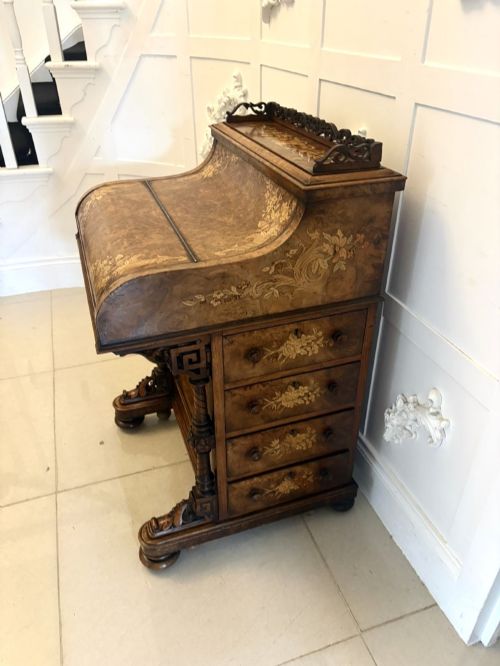


Antique Piano Cabinet
An antique piano cabinet brings ingenious Victorian and Edwardian workspace design into the home.
Antique Piano Cabinet
An antique piano cabinet primarily encompasses pop-up Davenport desks and piano stools originating from the Victorian and Edwardian eras. These pieces combine compact writing surfaces with hidden stationery compartments or adjustable seating designed for musical performance.
The version most commonly encountered on this page is the Victorian burr walnut pop-up Davenport desk, dating roughly from the 1850s to the 1870s. These forms utilise a sloping desk lid that conceals interior drawers and stationery wells activated by a clever mechanical pop-up mechanism.
How they were made
Cabinetmakers constructed these pieces using dense timber carcases of walnut, burr walnut, mahogany, and rosewood, often applying intricate floral marquetry inlay across the writing slopes. The warm grain of the wood provides the primary decorative surface.
Functional hardware relied on cast brass fittings and leather inserts for writing surfaces, while seating variants incorporated upholstered velvet lift-up seats. Internal mechanisms allowed the stationery compartments to rise smoothly as the writing lid opened.
Antique Piano Cabinet Retail Price Guide 2026
Typical asking prices for piano cabinet among the pieces listed under this phrase on Sellingantiques today, from the lower quarter to the upper quarter. They describe what is for sale here now, not the wider market.
Current listings span the Victorian and Edwardian periods, featuring woods such as burr walnut, mahogany, and rosewood alongside brass and velvet.
What varies in quality
The standard of timber selection and the complexity of the marquetry inlay distinguish finer examples from simpler workshop production. Richly figured burr walnut veneers and precise floral patterns demonstrate superior craftsmanship.
The execution and smooth operation of the internal pop-up mechanism mark the difference between standard production and higher grade execution. Well-fitted mechanical components ensure the stationery compartments function reliably over time.
The Antique Piano Cabinet Glossary
- Davenport desk
- A compact writing desk featuring a sloping top and drawers opening to the side. It was originally named after a Captain Davenport who commissioned the initial form.
- Pop-up
- A mechanical system within a desk that raises interior stationery compartments automatically when the main lid is lifted. This clever action maximises storage within a small footprint.
- Marquetry inlay
- Decorative patterns formed by fitting contrasting pieces of wood veneer into a prepared surface. This technique creates detailed floral motifs across the writing slopes.
- Burr walnut
- Timber taken from a growth deformation on a walnut tree, yielding highly figured and swirling grain patterns. Cabinetmakers prized this wood for high-status Victorian furniture.
- Fall front
- A hinged writing flap or panel that drops down to a horizontal position for use. It conceals internal pigeonholes and small drawers when closed.
Antique Piano Cabinet: Frequently Asked Questions
What is an antique piano cabinet?
An antique piano cabinet generally refers to specialised Victorian and Edwardian Davenport desks and piano stools. These items combined practical music storage or compact writing spaces with clever mechanical interiors.
They reflect the ingenuity of nineteenth-century cabinetmakers who sought to maximise utility within domestic music rooms and parlours.
How do you date these pieces?
Dating relies on observing the prevailing timbers, structural styles, and mechanical innovations associated with specific decades. Victorian examples often feature burr walnut and rosewood, whilst Edwardian pieces frequently utilise mahogany.
Construction methods and hardware styles further help assign items to periods spanning from the 1850s through to the early twentieth century.
How were pop-up Davenports used?
Pop-up Davenports served as compact writing desks where the upper stationery section rose automatically when the writing lid was opened. This kept writing materials organised and accessible within a very small floor footprint.
They allowed Victorians to write letters and store documents efficiently without dedicating space to a full-sized partner desk.
Where should I place a piano stool?
Piano stools suit living spaces, studies, or music rooms where their lift-up upholstered seats provide both seating and discreet storage. Their compact proportions make them easy to position beside other period furniture.
Care should be taken to place them away from direct heat sources to protect the polished wood and fabric upholstery.