




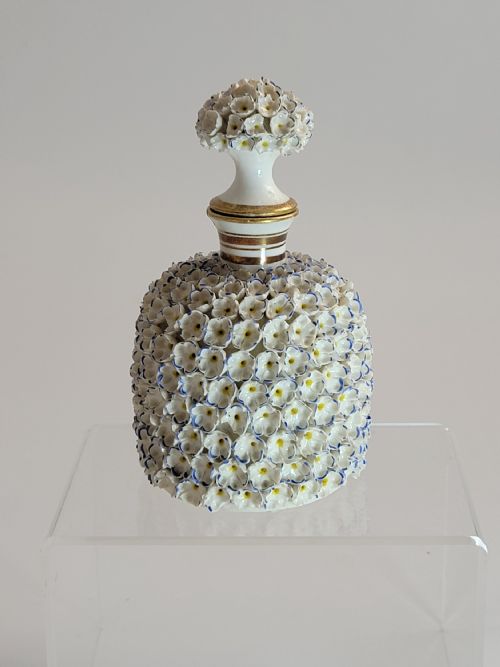


Antique Perfume Stopper
An antique perfume stopper completes a dressing table bottle, offering sculptural glass and silver detail from Victorian and Art Deco makers.
Antique Perfume Stopper
When you search for an antique perfume stopper, you are looking at small functional closures designed for scent bottles, decanters, and spirit flasks. The pieces here span the Victorian era, the Edwardian period, and the Art Deco years, showing how scent container designs evolved across a century.
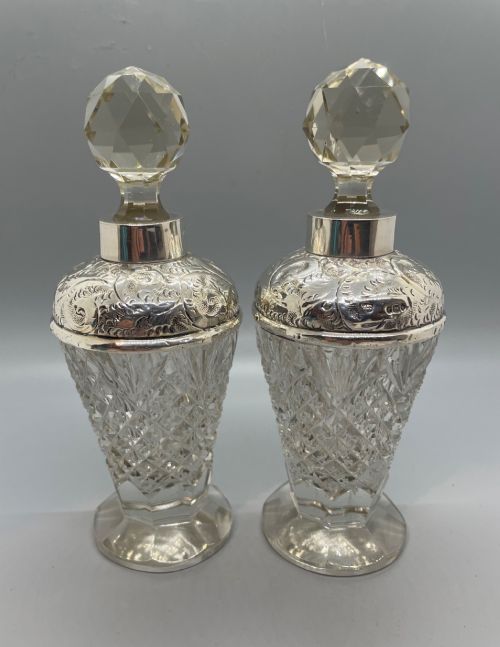
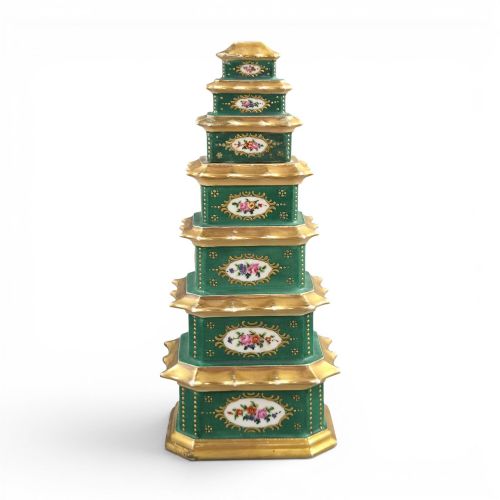
You will most commonly meet stoppers attached to glass bottles featuring silver collars or mounts, alongside porcelain examples and moulded designs. Many items combine a distinct stopper with its original vessel, while others highlight the closure as a sculptural object in its own right.
Origins range from English silver workshops to continental European glasshouses, including notable output from French and Czech makers. The forms shift from restrained Victorian cut glass to the bold geometric lines and opalescent finishes of the nineteen-thirties.
Materials and construction
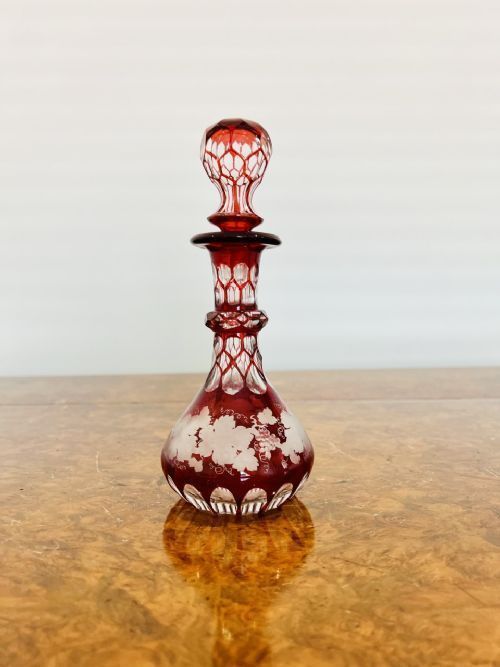
Glass forms the primary body of these items, appearing as heavy cut crystal, frosted material, or opalescent moulded glass. Makers shaped these vitreous elements through pressing, blowing, and intricate hand-cutting to achieve light-catching facets and textured surfaces.
Precious metals and ceramics complement the glass components, with sterling silver collars, gold leaf accents, and enamel decoration adding colour and contrast. Porcelain bodies also occur, occasionally paired with original matching stoppers and delicate hand-painted motifs.
Listings span eight distinct production periods, from eighteen-fifty Victorian wares through to nineteen-thirties Art Deco glass.
Judging quality and craftsmanship
The distinction between standard items and exceptional work lies in the crispness of the moulding and the depth of the glass-cutting. Superior pieces exhibit precise symmetry in moulded motifs and hand-finished details that remain sharp and well-defined.
Material synergy also drives quality, where silver mounts fit snugly against the glass neck and enamel work shows smooth, even application without losses. The presence of an original matching stopper to the vessel elevates the integrity of the piece considerably.
Karl Palda·Rene Lalique·Sabino·Crown Staffordshire·Royal Worcester·Jacob Petit·Cartier Paris
The Antique Perfume Stopper Glossary
- Opalescent glass
- Glass containing agents that cause it to milky-blue in transmitted light and amber in reflected light. This technique gained prominence during the Art Deco period, particularly among French makers.
- Cut glass
- Glass decorated by grinding facets or patterns into the surface using a wheel. The technique creates sharp edges and brilliant light refraction, typical of Victorian pieces.
- Sterling silver
- An alloy of silver containing 92.5 percent pure silver and 7.5 percent other metals, usually copper. It frequently appears as collars and mounts on scent bottles.
- Enamel
- A glassy substance fused to metal through firing to provide decorative colour. It appears on Art Deco bottles in geometric patterns and figurative designs.
- Chinoiserie
- A European style reflecting Chinese artistic influences. It manifests in porcelain scent bottles and decorative motifs.
Antique Perfume Stopper: Frequently Asked Questions
Are these stoppers sold with their original bottles?
Many listings feature the complete set where the stopper matches the bottle, such as George V silver-mounted pairs or porcelain vases with covers. Some examples highlight the stopper as part of a scent or snuff bottle unit.
Check individual descriptions to confirm whether the closure is documented as original to the specific vessel.
How do I identify Art Deco pieces?
Art Deco pieces typically date from the nineteen-twenties and nineteen-thirties, displaying moulded glass, blue glass bodies, or enamel decoration. Makers like Karl Palda and Sabino define this aesthetic with geometric or stylised natural motifs.
Victorian items by contrast rely on heavy cut glass, cranberry overlay, or porcelain encrustations.
What materials were used for these items?
The primary material is glass, ranging from clear cut glass and frosted surfaces to opalescent creations. Sterling silver, gold leaf, and enamel provide metalwork and decorative contrast.
Porcelain also appears in Victorian and Edwardian examples, sometimes paired with silver collars or original stoppers.
How should I display them?
These small bottles and stoppers suit dressing tables, cabinets, or dedicated shelf displays where light can pass through the glass. Their compact scale makes them ideal for grouped arrangements of similar periods, such as matching Art Deco opalescent pieces.
Ensure stable placement away from table edges given their delicate glass and porcelain composition.