


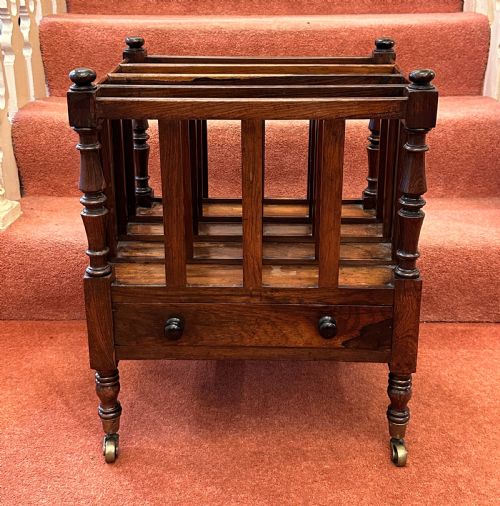


Antique Music Division Stand
An antique music division stand is a tiered wooden holder for sheets and folios, built to keep performance scores orderly beside the instrument.
Antique Music Division Stand
An antique music division stand, more commonly known in the trade as a Canterbury, provides fitted wooden or brass divisions to keep folios upright and close to hand. These pieces serve domestic sitting rooms and music salons across multiple historical periods, appearing in forms ranging from three to four divisions.
Makers fashioned these stands with distinct structural variations, including X-frame supports and upright corner posts. Each piece reflects the interior demands of its period, balancing rigid timber dividers with mobile caster wheels or fixed bases.
How they were made
Cabinet makers utilised dense hardwoods such as mahogany, Cuban mahogany and rosewood to construct the slatted divisions and sturdy main frames. These timbers provide the structural resilience required to support heavy paper folios without warping the upright partitions.
Artisans integrated brass elements, including carrying handles and small casters, to permit easy movement across carpeted music rooms. Pierced scroll work on the wooden divisions displays hand-cut detailing, while lower compartments frequently incorporate functional small drawers.
Joinery techniques combined pegged joints and mortise-and-tenon construction to secure the individual vertical divisions to the base plinth. The timber surfaces received hand-rubbed finishes that emphasise the natural grain patterns of the figured mahogany and dark rosewood.
Several stands include a carrying handle so musicians could drag their sheet music across the floor without dropping the scores.
What varies in quality
The standard of a piece depends heavily upon the selection of timber, with highly figured Cuban mahogany and rich rosewood marking the superior end of the range. Finer examples display meticulous craftsmanship in the piercing of the scroll divisions and the precise housing of the upright slats.
Proportion and decorative restraint dictate value, as stands featuring integrated carrying handles and original brass casters retain greater formal harmony. Lesser pieces show simpler turning on the corner posts and plainer secondary woods lacking the depth of grain seen in top-tier workshop productions.
The Antique Music Division Stand Glossary
- Canterbury
- A low stand with upright divisions designed for holding music sheets, newspapers or magazines. This form originated in the late eighteenth century and persisted through the Victorian era.
- Division
- An internal vertical partition that creates separate slots for organising stacked papers or folios. These partitions often feature pierced scroll outlines.
- Cuban Mahogany
- A dense, richly figured timber imported from the Caribbean, utilised by cabinet makers for high-status furniture during the eighteenth and nineteenth centuries.
- X-Frame
- A structural support configuration formed by two crossing diagonal members. This design adds rigidity to the lower framework of certain music stands.
- Regency
- A British design period spanning the early nineteenth century, characterised by classical revival motifs and refined proportions.
Antique Music Division Stand: Frequently Asked Questions
What is an antique music division stand?
An antique music division stand is a small compartmentalised piece of furniture designed to hold sheet music, scores and folios near a piano or music room seating.
These pieces feature vertical slats or dividers that keep soft-covered books upright and sorted by type or composer.
How were these stands used originally?
Musicians placed these stands beside keyboard instruments to provide immediate access to performance scores during practice or recitals.
The lower compartments and small drawers also served to store tuning keys, manuscript paper and smaller accessories.
Which woods are most common?
Mahogany, Cuban mahogany and rosewood dominate the surviving examples from the Georgian and Victorian periods.
Cabinet makers selected these dark, heavy timbers for their strength and decorative grain patterns.
How do I date a piece?
Dating relies on identifying the prevailing stylistic markers of the period, such as Regency classical lines or William IV structural mass.
The choice of timber, particularly the prevalence of Cuban mahogany or rosewood, also indicates the era of manufacture.