
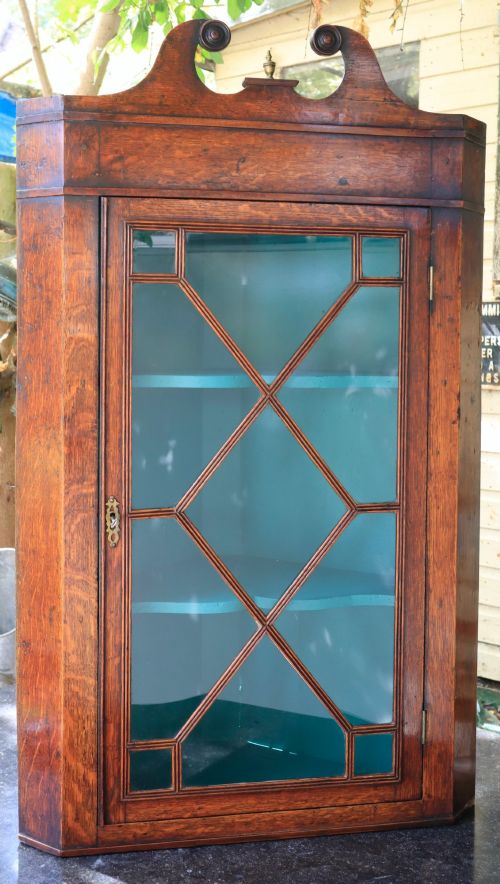


Antique Hanging Corner Case
An antique hanging corner case turns unused wall junctions into useful display and storage space using time-tested timber work.
Antique Hanging Corner Case
An antique hanging corner case is a wall-mounted storage unit designed to fit snugly into the 90-degree junction of two walls, saving floor space while adding architectural interest to a room. These pieces appear in forms such as corner cabinets and corner cupboards, spanning periods from the early 18th century through the Edwardian era and up to 1930.
The version most commonly met on this page is the Georgian mahogany glazed corner wall hanging cabinet, often featuring a single glass door for displaying contents. Pieces also arrive in oak, walnut, yew, and with inlay, showing styles ranging from George III Sheraton and Early Georgian to Arts and Crafts and Victorian.
How they were made
Cabinet makers constructed these cases using sturdy timbers like mahogany, oak, walnut, and yew, often selecting figured grains for the primary surfaces. Frames were joined to withstand wall mounting, while doors incorporated glass panels, sometimes with triple aspect glass fronts or bow fronts.
Detailing relied on craftsmanship rather than excess, employing brass hardware such as hinges and working locks with keys, alongside decorative inlay or fabric linings. Surface treatments protected the wood while allowing the natural grain and colour to remain prominent.
Several centuries ago, someone decided that empty wall corners were a tragic waste of potential shelving.
What varies in quality
The distinction between standard examples and finer pieces lies in the choice of timber and the sophistication of the joinery. Superior cases exhibit carefully selected mahogany, oak, or yew with well-matched grain patterns, alongside refined proportions in architectural cornices and glazing bars.
The Antique Hanging Corner Case Glossary
- Bow front
- A convex curved cabinet front that projects outward from the corners. This shape required advanced carpentry to curve the frame and door glass smoothly.
- Glazed door
- A frame fitted with glass panes to display the interior contents. These doors allow the case to function as a wall-mounted display cupboard.
- Serpentine front
- A curved cabinet front featuring a convex centre flanked by concave wings. This complex silhouette adds dynamic movement to the piece.
- Triple aspect glass front
- A design incorporating a central glass door flanked by additional glazed side panels. This configuration maximises visibility into the interior from multiple angles in the room.
- Inlay
- Contrasting woods or materials embedded flush into the primary timber surface to create decorative patterns. It frequently defines Sheraton and later styles.
Antique Hanging Corner Case: Frequently Asked Questions
How do I hang a heavy corner cabinet safely?
These wall-hanging cases require secure fixing directly into solid masonry or substantial timber wall studs using appropriate heavy-duty brackets. Professional installation is recommended to support the weight of the timber structure and its contents.
Because the design concentrates weight at the rear apex, load distribution must be handled carefully to prevent strain on the historical hanging points.
Were these cabinets meant for drinks?
Some period examples served to store spirits and glassware, as indicated by internal fittings or locking mechanisms with keys. Their elevated wall position kept valuable bottles safely out of reach.
Other variations functioned simply as display cupboards for china, books, or decorative objects in parlours and dining rooms.
How do I tell Georgian from Edwardian cases?
Georgian pieces typically utilise dense mahogany or oak with deep patination, heavier mouldings, and hand-cut joinery. They often date from the 18th century up to about 1820.
Edwardian versions, emerging around 1900 to 1910, frequently display lighter mahogany frames, delicate string inlay, and cleaner, standardised manufacturing techniques.
Can I use these in modern rooms?
An antique hanging corner case provides practical storage while utilising dead corner space that standard furniture ignores. They suit both traditional interiors and modern minimalist settings as focal accent pieces.
Styling them with books, ceramics, or glassware bridges historical craftsmanship with contemporary room layouts.