


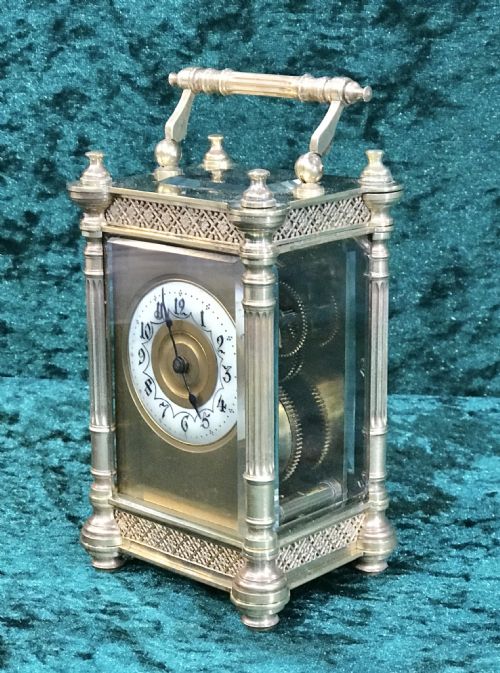


Antique Gilded Timekeeper
An antique gilded timekeeper brings the warm gleam of ormolu, gilt bronze, and brass into a room while marking the hours.
Antique Gilded Timekeeper
When you search for an antique gilded timekeeper, you are looking at timepieces shaped by the 19th century, Regency, and Victorian periods, often influenced by French styles like Louis XVI Revival and Belle Epoque. These pieces range from substantial mantel clocks adorned with figures and doves to portable carriage clocks and ornate wall clocks.
The version you are most likely to meet on this page is the French carriage clock or mantel clock from the late 19th century, frequently featuring enamel panels, engraved cases, and brass or gilt bronze construction. Alongside these, Swedish gilt and eglomise wall clocks and Regency mantel clocks with chain fusee movements appear.
Makers and retailers recorded in these pieces include Margaine of France, Samuel Marti, Goldsmiths, and FB Adams London, grounding the selection in recognised 19th-century horological traditions.
Judging quality and execution
The distinction between tiers of quality rests in the crispness of the chasing on gilt bronze and ormolu mounts, where hand-tooled depth separates a sharp figural casting from a soft one. Superior pieces display finely engraved brass cases, flawless enamel dials without hairline fractures, and robust movements signed by respected makers.
Secondary examples rely on simpler stamped brass and plain glass panels without engraved details or intricate dial masking. The presence of specialised complications, such as repeating mechanisms and alarms, elevates the horological standing of the piece.
Listings feature 19th-century French carriage clocks, Regency mantel clocks with chain fusee movements, and Swedish eglomise wall clocks framed in giltwood.
Margaine of France·Samuel Marti·Goldsmiths·FB Adams London
The Antique Gilded Timekeeper Glossary
- Ormolu
- Finely ground high-carat gold applied to a bronze base using a mercury amalgamation technique. This method yields a deep, enduring metallic richness characteristic of 19th-century French luxury objects.
- Carriage clock
- A small, portable spring-driven timepiece equipped with a carrying handle, originally designed for travellers in the 19th century. Many examples feature glass panels that reveal the escapement within.
- Chain fusee
- A conical pulley connected to the mainspring by a fine steel chain, designed to equalize the torque as the spring unwinds. This mechanism improves the timekeeping accuracy of antique clocks.
- Eglomise
- A technique of cold painting and gilding on the rear face of glass to produce a mirror-like finish with decorative borders. It frequently frames the dials of 19th-century Swedish wall clocks.
- Enamel banding
- A decorative border of fused vitreous glass fired onto a metal ground. It adds colour and refinement to the bezels and cases of carriage clocks.
Antique Gilded Timekeeper: Frequently Asked Questions
How do I wind an antique carriage clock?
Most carriage clocks use a key inserted into the backplate to wind both the time train and the alarm or striking train if present. Care must be taken not to overwind the mainspring.
Moving the hands should be done gently, following the manufacturer design, particularly on repeating models where intricate gear trains operate the strike.
What is the difference between ormolu and gilt brass?
Ormolu consists of mercury-gilt bronze, producing a heavy, warm, and deeply bonded golden surface typical of fine French decorative arts. Gilt brass is a thinner plating applied to a less dense yellow metal base.
Ormolu mounts generally indicate a higher grade of craftsmanship and heavier casting than standard gilt brass casings.
Where were carriage clocks originally placed?
Carriage clocks were originally built for wealthy travellers to take on journeys in horse-drawn carriages or early trains, housed in protective leather travelling cases. Their robust platform escapements allowed them to keep time despite motion.
Over time, they transitioned from travel accessories to mantel and desk ornaments in Victorian homes.
How can I tell a 19th century clock from a later copy?
Nineteenth-century timepieces display hand-cut screw threads, numbered matching components, and heavy mercury-gilding or fire-gilding on cast bronze. The wear patterns on the brass plates reflect decades of friction from the gear pivots.
Later reproductions often use modern machine screws, lighter electroplated finishes, and standardised mass-produced movements without maker signatures.