
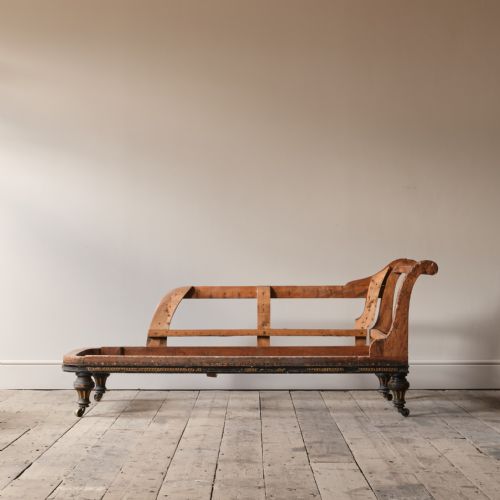
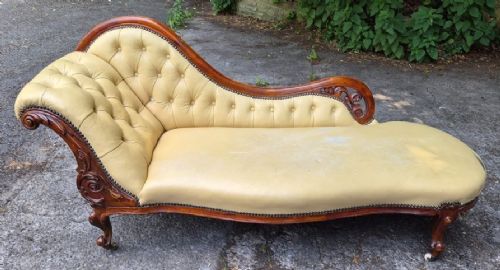
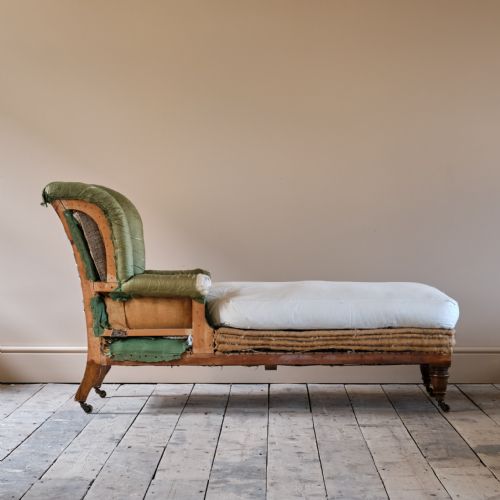
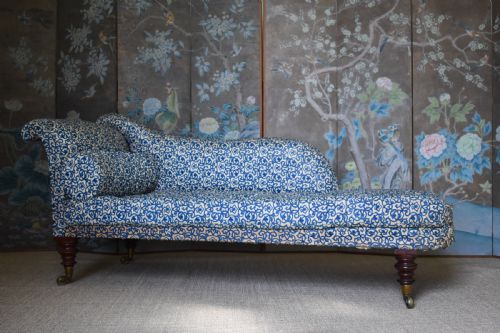


Antique Fainting Couch Frame
An antique fainting couch frame offers an elegant nineteenth-century curve for daily rest.
Antique Fainting Couch Frame
An antique fainting couch frame provides the structural bones for a reclining seat designed for nineteenth-century repose. These pieces appear in forms such as chaise longues and daybeds across Victorian, Edwardian, and Regency styles.
Buyers meet sturdy wooden frames carved from mahogany, rosewood, and solid oak alongside brass and iron components. Pieces span the nineteenth century and the early twentieth century, including gilt-decorated day beds and Howard style daybeds.
Makers such as Holland & Sons and Howard & Sons represent the fine cabinet-making traditions associated with these seating foundations. The structural framework often arrives ready for upholstery in fabrics like velvet, cotton, or calico.
Materials and construction
Cabinet makers utilised dense timbers like rosewood and mahogany to shape the curving backs and scrolling arms of a chaise longue. Carved ornamentation defines many Victorian and Edwardian examples, while other frames rely on gilt decoration or brass accents.
The underlying architecture supports reclining postures through robust joinery and solid wood frames. Surviving examples demonstrate the skill of nineteenth-century workshops in balancing structural strength with fluid decorative lines.
Periods represented span the Regency era, the nineteenth century, the Victorian period, and Edwardian times.
Assessing quality in frames
The distinction between standard production and top-tier work rests on the depth and crispness of the timber carving. Elaborate rosewood or mahogany frames carrying attribution to respected makers show superior cabinet-making pedigree.
Proportion and the integrity of the wooden joints determine the overall distinction of a frame. Substantial early Victorian carved frames demonstrate greater sculptural ambition than plain later variants.
Holland & Sons·Howard & Sons
The Antique Fainting Couch Frame Glossary
- Daybed
- A couch that functions as a seat during the day and a bed for resting. These pieces appear in Regency and Edwardian styles.
- Gilt Decorated
- Covered with a thin layer of gold leaf or gilt paint to accent the wooden structure. This finish appears on early twentieth-century day beds.
- Howard Style
- A comfortable, upholstered furniture design associated with nineteenth and twentieth-century London workshops. These frames prioritise deep cushioning and relaxed reclining.
Antique Fainting Couch Frame: Frequently Asked Questions
What is an antique fainting couch frame?
An antique fainting couch frame is the exposed wooden or metal skeleton of a nineteenth-century reclining seat. These structures provide the curving backrest and scrolled ends intended for resting without fully lying down.
They encompass styles from the Regency period through the Victorian and Edwardian eras. Many examples retain maker attributions to prominent London cabinet makers.
How do I date an antique daybed frame?
Dating relies on stylistic markers and timber choices typical of specific decades. Mahogany and rosewood frequently indicate mid-nineteenth-century Victorian production, while solid oak often points to Edwardian pieces.
Cabinet-making techniques and carved motifs help distinguish Regency daybeds from later Victorian and early twentieth-century variants. Attribution to firms like Holland & Sons also aids chronological placement.
What materials are used in these frames?
The primary structural materials are hardwoods such as mahogany, rosewood, and solid oak. Some frames incorporate iron or brass elements to reinforce the reclining architecture.
Surface finishes range from natural polished timber to gilt decoration. Upholstery foundations historically relied on webbing and springs supported by calico and cotton.