



Antique Etruscan Earrings
Antique Etruscan earrings bring classical archaeological motifs into nineteenth-century wearable gold, offering distinctive ancient revival styling.
Antique Etruscan Earrings
Antique Etruscan earrings comprise nineteenth-century interpretations of ancient Mediterranean ornamentation, drawing heavily on archaeological discoveries from the period. These pieces frequently manifest as drop earrings and jewellery sets showcasing classical revival designs.
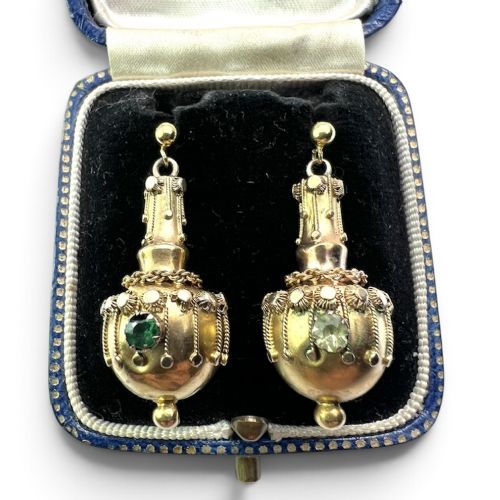
The versions most commonly met on this page span the Victorian and Edwardian eras, incorporating stylistic influences such as Etruscan Revival and Classical Revival. Makers translated ancient goldsmithing aesthetics into contemporary forms including amphora shapes, foxtail tassels, and teardrop drops.
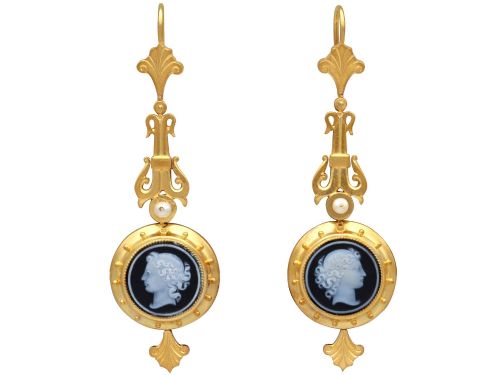
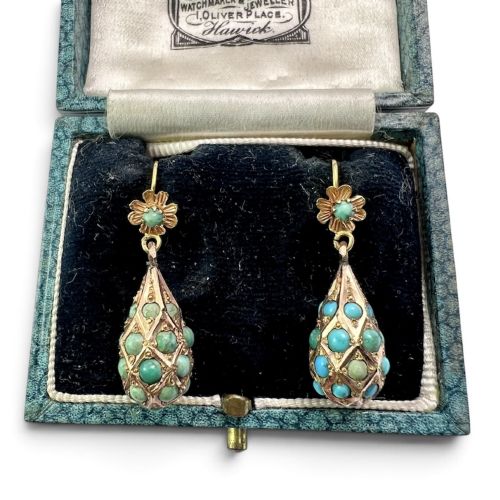
The selection ranges from elaborate revival motifs set with turquoise or paste garnet to cameo drop earrings and banded agate configurations. Buyers find both delicate everyday drops and substantial rose and yellow gold statement pieces within this grouping.
How antique etruscan earrings were made
The construction relies fundamentally on gold in various purities, specifically 9ct, 15ct, 22ct, and yellow or rose variants, alongside silver gilt. Artisans shaped these precious metals into domed bands, puff hearts, square cross wheels, and amphora vessels.
Surface ornamentation integrates natural stones and organic materials to complement the metalwork. Hardstone cameos, turquoise, banded agate, pearls, and paste garnets provide colour and contrast against the warm tones of the gold.
Antique Etruscan Earrings Retail Price Guide 2026
Typical asking prices for etruscan earrings among the pieces listed under this phrase on Sellingantiques today, from the lower quarter to the upper quarter. They describe what is for sale here now, not the wider market.
What varies in quality
The standard of execution in the metalwork and the complexity of the revival ornamentation differentiate the better examples. Subtlety in wirework and precision in shaping elements like amphorae or tassels elevate certain pieces above simpler production.
Material selection and stone matching also determine the tier of a pair. High-purity gold settings combined with well-matched turquoise, banded agate, or finely carved hardstone cameos represent the upper end of the range.
The Antique Etruscan Earrings Glossary
- Etruscan Revival
- A nineteenth-century design movement inspired by ancient Etruscan jewellery discoveries, known for granulation and filigree work. This style heavily influences the character of these earrings.
- Amphora
- A two-handled ancient jar shape frequently replicated in Victorian revival pendants and earrings. It provides a distinct classical silhouette.
- Foxtail
- A flexible, densely woven chain link resembling a fox's tail, often utilised in Victorian tassel earrings. This technique creates fluid movement.
- Banded Agate
- A variety of chalcedony featuring natural parallel colour bands, popular in nineteenth-century domed jewellery. It offers unique striping in each cut.
- Silver Gilt
- Silver covered with a thin layer of gold, providing the visual warmth of gold at a different weight and cost. It appears frequently in nineteenth-century decorative pieces.
Antique Etruscan Earrings: Frequently Asked Questions
What periods do these earrings come from?
These pieces originate primarily from the Victorian and Edwardian eras, reflecting nineteenth-century archaeological interests.
Craftsmen during this period produced revival styles spanning several decades around the turn of the twentieth century.
What materials are used in these earrings?
Gold forms the primary structure, ranging from 9ct and 15ct to 22ct, alongside silver gilt and rose gold variants.
Gemstones and organic materials such as turquoise, hardstone, banded agate, pearl, and paste garnet accent the metal.
How do you identify Etruscan Revival style?
This style borrows motifs from ancient Mediterranean civilisations, incorporating classical shapes like amphorae and elaborate wirework.
Nineteenth-century jewellers adapted these ancient archaeological forms into contemporary drop earrings and suites.
How should antique earrings be worn?
These drop and dangling earrings suit evening wear and special occasions due to their distinct length and movement.
Careful handling protects the delicate goldwork, hardstone cameos, and mounted turquoise settings during daily use.