


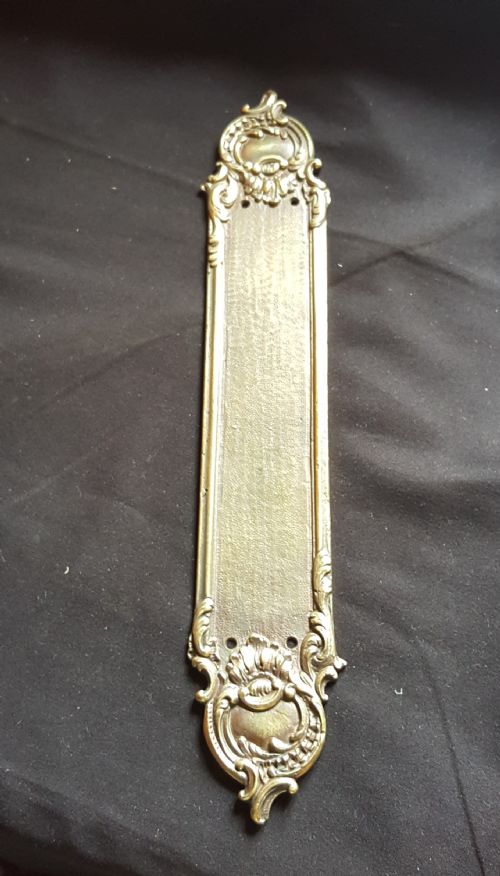


Antique Door Push Plate
These antique door push plate examples protect timber surfaces whilst adding period character to residential doorways.
Antique Door Push Plate
An antique door push plate protects timber doors from hand marks and wear around handles and locks. The selection here ranges across multiple decorative epochs, including Victorian, Edwardian Military, and Georgian eras.
Buyers encounter various forms, from simple brass plates to complete sets involving door knobs and finger plates. Art Deco and Art Nouveau styles feature prominently alongside traditional Chinese bronze work.
Most items date from the nineteenth and early twentieth centuries, constructed to withstand heavy domestic or institutional usage. Single plates appear alongside matched sets suitable for larger residential projects.
Materials and construction methods
Foundries utilised brass, bronze, cast brass, and copper alloy to produce durable metal fixtures. Enamel and glass additions appear on specific decorative items from the early twentieth century.
Manufacturing methods rely heavily on casting techniques, producing robust metal items designed for permanent attachment to doors. Wood also forms a component in certain listed hardware assemblies.
A military finger plate from the Royal Flying Corps preserves aviation history right on a domestic door.
Judging quality in antique hardware
Weight and casting definition separate standard utility hardware from finer decorative examples. Crisp surface detail in Art Nouveau plant motifs or geometric Art Deco lines indicates superior workmanship.
The completeness of matched sets and the survival of original surface finishes influence desirability. Complete assemblies containing matching handles or knobs command greater interest than isolated single plates.
The Antique Door Push Plate Glossary
- Push plate
- A protective metal or glass shield fitted to a door leaf to prevent finger marks. These plates sit immediately adjacent to the latch or handle.
- Finger plate
- An alternative term for a push plate, particularly common in domestic architecture of the nineteenth and twentieth centuries. They often match existing door furniture.
- Foo Dog
- A mythical guardian lion frequently depicted in traditional Chinese art and metalwork. Such motifs appear on imported or revival bronze door plates.
- Cast bronze
- An alloy of copper and tin shaped by pouring molten metal into a mould. This technique allows for intricate relief decoration on hardware.
Antique Door Push Plate: Frequently Asked Questions
How do I clean antique brass push plates?
Light dusting and occasional gentle wiping with a soft cloth preserve the historic patina. Avoid harsh chemical cleaners that strip aged metallic surfaces.
Preserving the natural oxidation maintains the visual character developed over decades of domestic use.
Are these plates suitable for modern doors?
Standard screw fixings allow most historical plates to fit contemporary interior doors without major modification. Careful measurement of existing latch positions ensures correct alignment.
Check the dimensions of each piece against your door stile before installation.
What is the difference between Art Deco and Art Nouveau plates?
Art Nouveau designs utilise flowing, organic plant motifs and asymmetrical curves popular around the turn of the twentieth century. Art Deco hardware favours geometric symmetry and stylised linear patterns from later decades.
These stylistic shifts help date specific pieces accurately.
Can I buy matching door knobs?
Several listings include complete sets combining push plates with matching door handles, knobs, or bells. These grouped items facilitate uniform hardware schemes across multiple rooms.
Single plates remain available for standalone placement.