




Antique Door Bell
These antique door bell examples offer solid brass and iron engineering that immediately replaces modern plastics with genuine period weight.
Antique Door Bell
When you search for an antique door bell, you encounter functional hardware that spans the Georgian, Victorian, and early twentieth century periods. The selection here ranges from wall mounted ringers on iron brackets to brass pull mechanisms and heavy door stops.
How they were made
The evidence shows makers relied heavily on cast brass, wrought iron, and cast iron to build mechanisms capable of withstanding decades of physical use. Certain pieces combine brass with horn or porcelain elements to provide contrast and grip.
Surface finishing includes gilded metal alongside natural patinas developed through age and handling. Metalwork techniques rely on casting and forging rather than modern stamping, giving each bracket and pull its distinct heft.
Listings span from the Georgian period through the Victorian era up to nineteen twenty, utilising brass, iron, horn, and porcelain.
What varies in quality
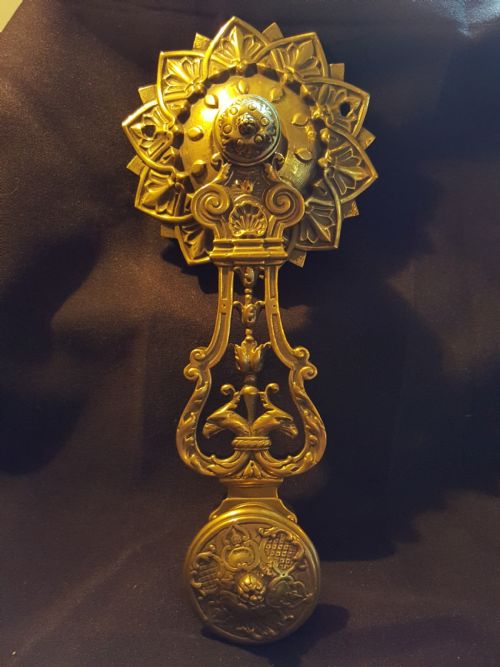
Quality separates the standard utility hardware from pieces that incorporate French Rococo Revival or Art Nouveau detailing. Castings with crisp, deep relief work in the foliage and scrollwork demonstrate superior pattern making.
The choice of secondary materials marks the difference between basic iron brackets and examples incorporating horn or porcelain inserts. Intact mechanical assemblies and original mounting hardware elevate the desirability of a pull or ringer.
The Antique Door Bell Glossary
- Bell pull
- A mechanical linkage mounted beside an entrance that transfers physical leverage through a wall to ring a distant bell. These operate via a pivoting handle or a sliding rod.
- Cast brass
- Molten brass poured into a sand or metal mould to form complex decorative shapes. This technique allows for the ornate relief patterns seen on period hardware.
- Wrought iron
- Iron beaten and shaped by hand while hot, creating a fibrous structure of high tensile strength. It appears frequently in the sturdy brackets supporting wall bells.
- Door stop
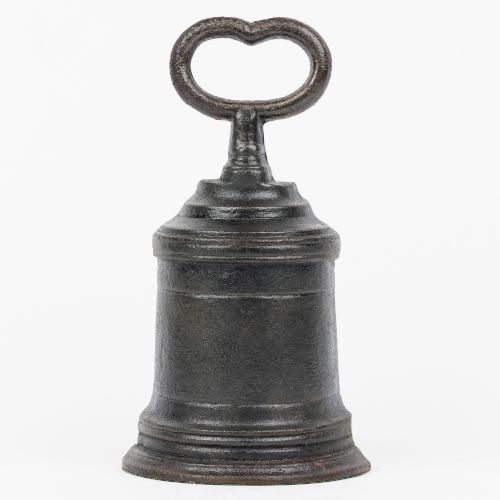
- A heavy weighted object used to keep a door stationary, often shaped to resemble other hardware. The archive records examples sharing forms with bell weights.
Antique Door Bell: Frequently Asked Questions
How did these bells work?
Most antique door bell mechanisms operate mechanically rather than electrically. A pull handle outside connects to a wire or crank system that rings a bell situated elsewhere in the house.
Simpler wall bells rely on a direct pull cord or lever attached to the iron bracket itself.
Where were they installed?
Door bells and pulls were mounted beside exterior front and service entrances of period homes. They served to announce visitors before electric chimes became common.
Wall bells often hung in hallways or kitchens where servants could hear the summons.
Can I still mount them today?
Many surviving examples retain their original structural integrity and can be fitted to modern doorframes. Consideration must be given to the wall construction and the matching mechanism.
Some pieces, such as bell-shaped door stops, function purely as floor weights without requiring installation.
How do I date a bell pull?
Dating relies on stylistic clues such as Georgian symmetry, Victorian ornamentation, or Art Nouveau curves. The materials used, including cast brass and wrought iron, also point to specific manufacturing eras.
Consulting the associated period indicators helps place an item within its historical context.