


Antique Devotional Jewellery
These pieces of antique devotional jewellery carry centuries of faith, taking the form of gold pendants, crosses, and medals.
Antique Devotional Jewellery
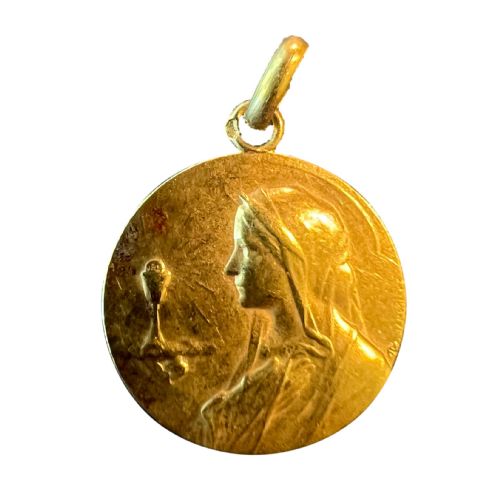
When someone searches for antique devotional jewellery, they encounter items shaped by religious observance, most frequently French pendant medals and crosses originating from the Victorian era through to the mid-twentieth century. These items serve as personal expressions of faith, depicting sacred figures such as the Virgin Mary, the Madonna and Child, and Jesus Christ.
The pieces on this page lean heavily towards French religious art from the early twentieth century, alongside Victorian examples. Buyers regularly meet yellow gold and rose gold charms and pendants featuring intricate engravings of saints, the Sacred Heart, and ecclesiastical motifs.
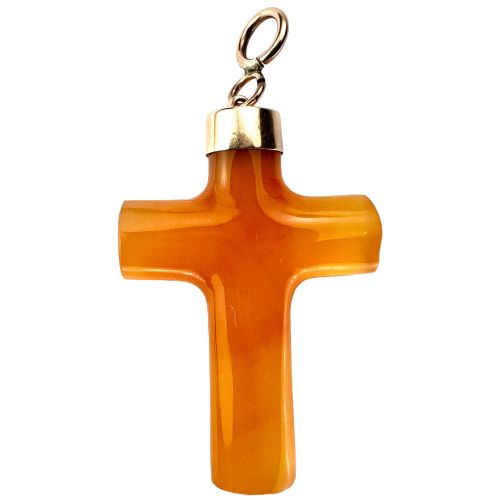
Forms span from simple carved agate crosses to elaborately framed medals incorporating enamel, seed pearls, and diamonds. Each item reflects the devotional practices of its period, capturing a tangible connection to personal piety and craftsmanship.
Materials and construction
Decorative elements incorporate specialist techniques such as plique-à-jour enamel, which allows light to pass through translucent coloured glass. Artisans also integrated natural materials like agate, mother of pearl, seed pearls, and diamonds to enhance the visual depth of crosses and medals.
Several pieces preserve the quiet signatures of nineteenth-century medallists who carved tiny holy faces into solid gold.
Distinctions in quality
The integration of precious materials and enamelling techniques dictates the upper tier of the range. Pieces featuring undamaged plique-à-jour enamel or carefully matched seed pearls and diamonds show a higher level of atelier skill and original expense.
Emile Monier·Emile Dropsy·Mazzoni·Pageli Perriat·Sellier·Tairac·Arnault·Grün·Ruffony
The Antique Devotional Jewellery Glossary
- Medal
- A small metal disc bearing a religious image or inscription, designed to be worn as a pendant. These devotional items often commemorate saints or sacred figures.
- Plique-a-jour
- An enamelling technique where the enamel is applied without a backing, resembling miniature stained glass. This method allows light to illuminate the translucent coloured areas.
- Agate
- A form of banded chalcedony used by lapidaries to carve devotional crosses and cameos. Its natural variations provide texture and pattern to the stone.
- Sacred Heart
- A traditional Christian symbol representing the physical heart of Jesus Christ as a representation of his divine love for humanity. It frequently appears wreathed in flames or crowned with thorns on religious medals.
- Ecclesiastical
- Relating to the Christian Church or its clergy, influencing the solemn artistic styles seen in religious pendants and crosses.
Antique Devotional Jewellery: Frequently Asked Questions
What materials are used in antique devotional jewellery?
These pieces predominantly utilise 18ct yellow gold, rose gold, and occasionally white gold for their structural mounts. Artisans also incorporated natural materials including agate, mother of pearl, seed pearls, diamonds, and enamel.
Precious metals provide a durable base for intricate hand engraving and sculptural relief work. The combination of gold with enamel and gemstones creates lasting visual contrast on religious pendants.
How do I identify French religious medals?
French religious medals typically feature distinct iconography such as the Virgin Mary, the Madonna and Child, or the Sacred Heart. Many examples bear hallmarks on the jump rings or edges indicating gold fineness and maker marks.
Inscriptions and signatures from specific Parisian workshops or medallists often appear near the rim of the medal. The stylistic execution usually aligns with periods like Art Nouveau or early twentieth-century ecclesiastical design.
What is plique-a-jour enamel on pendants?
Plique-à-jour is an enamelling technique where translucent enamel sits within an open metal cell framework without a solid backing. This allows natural light to pass directly through the coloured glass areas.
On devotional pendants, this technique creates a luminous, stained-glass effect behind sacred figures or floral motifs. It requires advanced technical skill to prevent the enamel from cracking during the firing process.
How were devotional pendants worn in the past?
Devotional pendants and medals were traditionally worn close to the heart suspended from gold chains or ribbons as personal amulets of faith. They served as daily reminders of spiritual protection and religious devotion.
Owners often added these charms to chatelaines or charm bracelets alongside other sentimental trinkets. Today, collectors typically hang them from modern or period gold chains for contemporary wear.