



Antique Church Watercolour
These antique church watercolour paintings capture centuries of sacred architecture and parish life on paper through the hands of British and European artists.
Antique Church Watercolour
An antique church watercolour brings together historic ecclesiastical architecture and the delicate medium of pigment on paper, spanning periods from the early nineteenth century to the interwar years. When you search for antique church watercolour, you encounter depictions of rural parish churches, historic abbeys, and urban London landmarks captured by regional and named artists.
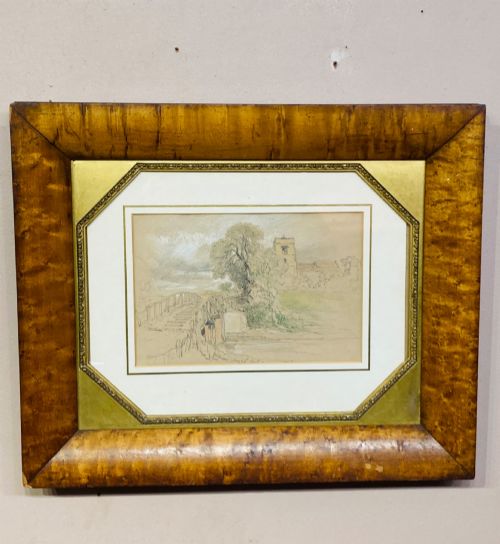
The selections available here range from Victorian village studies by the Norfolk School and provincial artists to early twentieth-century British impressionist compositions. These works frequently arrive framed in period gilt wood and protected behind glass, preserving the original watercolour paint and ink details.
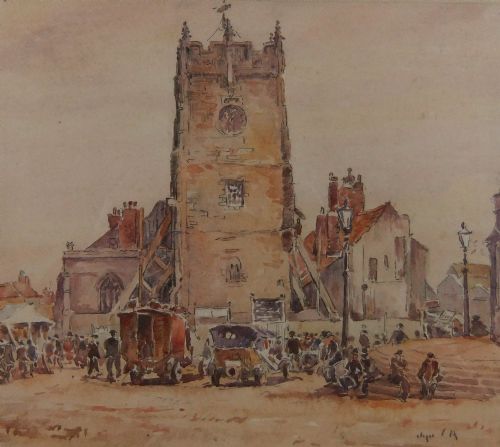
Subject matter varies from specific local sites such as Whitby Abbey and St Martins in the Fields to picturesque French village scenes and Berkshire parishes. Each piece offers a direct record of how past painters observed religious buildings and their surrounding churchyards.
How they were made
Artists applied watercolour pigment and ink directly onto paper, utilising fluid washes to build atmospheric skies and precise line work for architectural stonework. Many of these works were subsequently housed in gilt wood frames beneath glass to protect the delicate water-soluble pigments from moisture and light damage.
The technical approach relies on the white of the exposed paper to provide highlights within the church windows and stone facades. Painters balanced transparent washes of colour with finer ink details to define the contours of gravestones, towers, and surrounding trees.
Antique Church Watercolour Retail Price Guide 2026
Typical asking prices for church watercolour among the pieces listed under this phrase on Sellingantiques today, from the lower quarter to the upper quarter. They describe what is for sale here now, not the wider market.
The listings span five distinct decades from 1800 to 1930, capturing shifts from the Norwich School to British Impressionism.
What varies in quality
Quality rests upon the artist's command of perspective and spatial depth when rendering complex ecclesiastical architecture on paper. Superior works demonstrate confident brushwork and a sophisticated handling of light across stone surfaces, whereas lesser examples rely on stiff outlines and flat colour application.
The condition of the paper and the preservation of the original pigments distinguish finer examples from faded or heavily discoloured pieces. Additionally, the presence of original period framing and documented artist attributions elevates the standing of an individual painting.
John Smith Atherton·Alfred George Morgan·John Edward Bale·Rowland Henry Hill·Maurice Asselin·David Bates·Fred Lawson·John Thistle
The Antique Church Watercolour Glossary
- Watercolour
- A painting method in which the paints are made of pigments suspended in a water-based solution. The paper serves as the reflective light source beneath the translucent washes.
- Gilt wood
- Wood that has been treated with a thin layer of gold leaf or metallic gilding powder. This finish is commonly found on the traditional frames encasing nineteenth-century paintings.
- Norwich School
- A regional group of artists inspired by the Norfolk landscape and rural architecture during the early nineteenth century. John Thistle stands among the notable figures associated with this movement.
- Diptych
- A painting comprising two separate panels or sheets presented as a paired artwork. Alfred George Morgan utilised this format to depict complementary ecclesiastical views.
- Pigment
- The finely ground coloured powder that forms the base of the paint. Historic watercolours relied on natural and early synthetic minerals for their palette.
Antique Church Watercolour: Frequently Asked Questions
What periods do these watercolours date from?
The works span from the early nineteenth century through the Victorian and Edwardian eras up to the 1930s. This includes pieces created by artists working within the Norwich School and subsequent British impressionist circles.
Each period brings distinct stylistic approaches to architectural representation and landscape setting, reflecting the changing aesthetic preferences of British art over a century.
How should I display and care for them?
Keep these works behind glass and position them away from direct sunlight to prevent the watercolour pigments from fading. Maintaining stable indoor humidity protects both the paper support and the period gilt wood frame.
Displaying them in rooms with controlled environmental conditions ensures the paper does not buckle or develop foxing over time.
Are these paintings signed by the artists?
Several pieces feature artist signatures, inscriptions identifying specific locations such as Whitby Abbey or St Martins in the Fields, and documented dates on the paper or mounts. Other works are attributed based on stylistic evidence and historical recording by dealers.
Inscribed titles often provide precise local context, noting the specific church and parish recorded by the painter.
What framing comes with these pieces?
Many examples retain their period gilt wood frames and glass protection, which complement the age and style of the watercolour within. Original frames provide historical context and evidence of how the artwork was presented in the past.
Buyers should examine the specific listing details to confirm whether a piece retains its antique frame or has been remounted in a modern setting.