



Antique Chess Pieces
These antique chess pieces range from travelling bone sets to weighted Staunton boxwood designs, offering both practical play and historical character.
Antique Chess Pieces
When you search for antique chess pieces, you encounter full sets, travelling boxes, games compendiums, and occasional related items like desk paperweights. The most common forms on this page are complete traditional chess sets spanning the nineteenth century through to the Edwardian period and the early twentieth century.
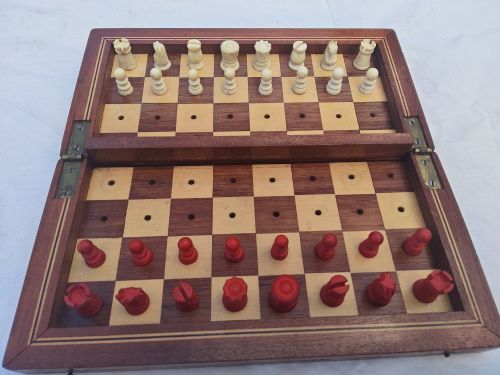
The objects take several distinct styles, from the standard Staunton pattern to earlier Calvert and St George designs. Pieces also appear housed in dedicated folding boards, mahogany travel boxes, and larger games compendiums alongside drafts and other pastimes.
Materials and Construction
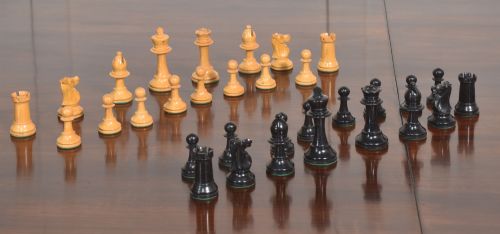
Makers utilised dense timbers such as boxwood, ebony, rosewood, and ebonised wood to carve contrasting armies for regular play. Natural materials like bone appear frequently, particularly in smaller travelling formats where individual figures are intricately carved by hand.
Heavier tournament sets incorporate weighting within the base of each piece for stability during play. Felt linings on the underside of pieces protect the board surface and provide a smooth glide during movement.
Antique Chess Pieces Retail Price Guide 2026
Typical asking prices for chess pieces among the pieces listed under this phrase on Sellingantiques today, from the lower quarter to the upper quarter. They describe what is for sale here now, not the wider market.
Assessing Quality and Execution
The refinement of the carving on knights and kings separates standard production from superior workshop output. Well-executed pieces show crisp detail in the horse's mane, clear turning on rooks, and proportional balance across the entire set.
Completeness and matching patination across all thirty-two pieces dictate the desirability of a set. Original boxes, weighted bases, and identifiable maker marks elevate a set beyond anonymous equivalents.
Jaques·British Chess Company·F. H. Ayres
The Antique Chess Pieces Glossary
- Staunton pattern
- The standard design of chess pieces established in the mid-nineteenth century, characterised by architectural forms for major pieces and a functional cross on the king.
- Calvert pattern
- An earlier nineteenth-century style of turned and carved bone chess pieces, often featuring distinct cylindrical bodies and delicate openwork details.
- St George pattern
- A traditional English pre-Staunton design featuring straightforward, sturdy forms without the exaggerated finials seen in earlier periods.
- Games compendium
- A fitted box containing equipment for multiple board games and pastimes, frequently incorporating chess sets alongside draughts and backgammon.
- Ebonised wood
- Timber treated with a dark stain or finish to imitate true ebony, commonly used for the dark side in boxwood sets.
Antique Chess Pieces: Frequently Asked Questions
What is a Staunton chess set?
The Staunton pattern is the standard style of chess piece introduced in the mid-nineteenth century, featuring distinct, easily recognisable forms for each piece type.
This design quickly became the tournament standard and remains the template for almost all modern chess sets used today.
How do I spot bone chess pieces?
Bone chess pieces usually exhibit a creamy colour that develops a warm patina with age, often showing fine growth lines under close inspection.
They are frequently found in smaller travel sets from the nineteenth century, sometimes paired with mahogany folding boards or storage boxes.
What is a travelling chess set?
A travelling chess set is a compact version designed for use on journeys, typically featuring a folding wooden box that stores the pieces inside.
Many examples use pinned or pegged pieces that fit into holes on the board to prevent movement during transit.
How do I care for antique chess sets?
Keep antique chess sets out of direct sunlight and away from extreme temperature fluctuations to prevent timber from splitting or bone from drying out.
Store pieces in a lined box or dedicated compartment when not in use to avoid unnecessary friction and surface wear.