

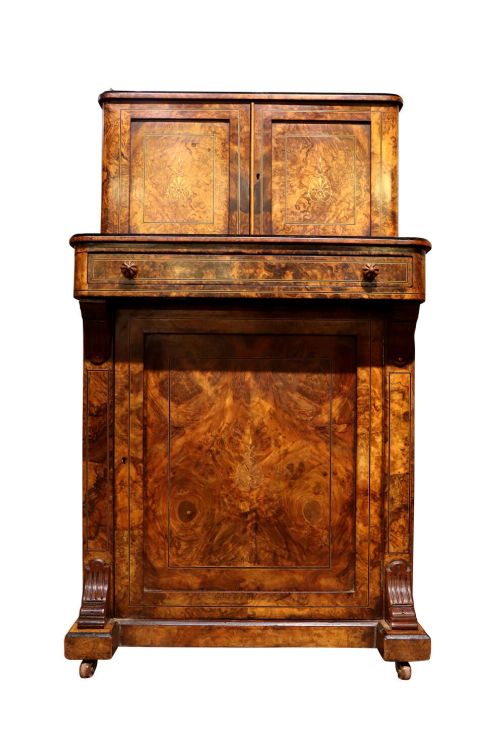


Antique Bureau De Cabinet
An antique bureau de cabinet is a refined writing piece designed for correspondence and private papers, offering elegant compartments and a compact surface.
Antique Bureau De Cabinet
An antique bureau de cabinet takes various forms, most commonly appearing as ladies desks, bonheur de jour tables, and writing desks from the eighteenth, nineteenth, and early twentieth centuries. These pieces combine a writing surface with small drawers, pigeonholes, and cabinets arranged above the top for stationery and keepsakes.
The selection on this page draws heavily from French taste, featuring frequent examples of Louis XV and Louis XVI revival styles alongside Victorian and Edwardian interpretations. Walnut, burr walnut, mahogany, and satinwood dominate the construction, often enhanced by intricate marquetry and gilt mounts.
How they were made
Cabinetmakers utilised timber veneers such as kingwood, satinwood, rosewood, and amboyna over sturdy foundational woods, creating rich geometric patterns and contrasting borders. Burr walnut provides deep, swirling grain figures that catch the light across curved and flat surfaces alike.
Ormolu mounts and brass inlay punctuate the woodwork, cast and chased in classical French motifs to frame drawers and corners. Glass panels occasionally enclose upper compartments, while marquetry introduces floral and pictorial designs in lighter and darker woods.
Antique Bureau De Cabinet Retail Price Guide 2026
Typical asking prices for bureau de cabinet among the pieces listed under this phrase on Sellingantiques today, from the lower quarter to the upper quarter. They describe what is for sale here now, not the wider market.
Secret compartments hidden behind miniature drawers reward owners who investigate the inner joinery of these tiny writing cabinets.
What varies in quality
Quality rests in the precision of the cabinetwork and the crispness of the gilt bronze or ormolu mounts. Finer pieces demonstrate seamless veneer matching and smooth drawer operation without excessive play in the joints.
The depth and detail of the marquetry work distinguish standard production from superior examples. Hand-chased mounts with sharp relief indicate greater workshop care than mass-produced castings.
The Antique Bureau De Cabinet Glossary
- Bureau de cabinet
- A small writing cabinet with internal drawers and compartments designed for personal correspondence. It sits upon a table base or legs.
- Bonheur de jour
- A light ladies writing desk originating in France during the eighteenth century, featuring a small cabinet superstructure on the desk top. Collectors prize these for their delicate proportions.
- Ormolu
- Gilded bronze used for decorative mounts and accents on furniture. It requires careful cleaning to preserve the rich golden tone.
- Marquetry
- Inlay work using various coloured woods to create decorative patterns and pictures on furniture surfaces. The technique requires immense skill to cut and fit each piece tightly.
- Kingwood
- A dense, heavily figured timber with dark violet-brown tones utilised in high-end cabinetmaking. It forms striking contrast bands on walnut and satinwood carcases.
Antique Bureau De Cabinet: Frequently Asked Questions
How do I date an antique writing desk?
Dating relies on timber selection, construction methods, and stylistic revival influences. Eighteenth-century models show hand-cut joinery and simpler native veneers, while nineteenth-century pieces often embrace French revival designs with elaborate ormolu.
Examining secondary woods inside the drawers provides further clues regarding the manufacturing period and workshop origin.
Where were these desks used?
These desks belonged in private chambers, drawing rooms, and ladies boudoirs for managing correspondence and keeping personal journals. Their modest scale allowed them to sit comfortably against walls or near windows.
Unlike large partners desks, they served individual use rather than official business.
How do I care for walnut and satinwood?
Maintain these timbers by keeping them away from direct sunlight and extreme temperature fluctuations that dry out the wood. Regular dusting with a soft, dry cloth protects the delicate veneer surfaces.
Avoid commercial silicone polishes and instead use traditional beeswax sparingly to nourish the grain.
What is the difference between a bonheur de jour and a ladies desk?
A bonheur de jour specifically incorporates a small tiered cabinet or shelving unit fixed to the top of a writing table. The term ladies desk covers a broader range of smaller writing forms including simpler sloped bureaus.
Both types share a lighter scale suited to domestic rather than institutional spaces.