
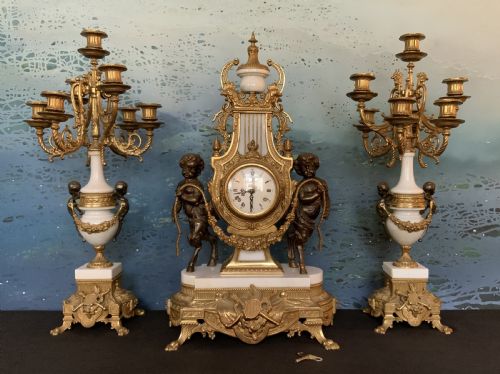


Antique 3 Piece Clock
An antique 3 piece clock brings symmetry and weight to a room, pairing a central timepiece with matching garnitures.
Antique 3 Piece Clock
When you search for an antique 3 piece clock, you encounter sets comprising a main mantel timepiece accompanied by a pair of matching side pieces such as candelabras or urns. The evidence shows these arrangements frequently date from the nineteenth century and the Victorian era, heavily influenced by French design idioms.
Materials and Construction
Maker workshops utilised dense stones such as rouge marble, black slate, and green onyx as the structural foundation for heavy clock bodies and garnitures. These mineral housings were frequently mounted with cast brass, gilt bronze, or ormolu decorative elements.
Dial faces incorporated white enamel with painted numerals, while internal movements relied on mechanical brass gear trains driven by springs or weights, often featuring pendulum regulation or platform escapements.
Listings demonstrate a strong prevalence of nineteenth-century French manufacture, utilising marble, bronze, and enamel across matched three-piece garnitures.
Evaluating Craftsmanship
The distinction between ordinary and superior pieces rests in the crispness of the bronze casting and the depth of the hand-chased surface detail on the ormolu mounts. Finer sets display harmonious proportions across all three components, where the side garnitures match the architectural vocabulary of the central clock precisely.
Movement sophistication also dictates standard, with signed French mechanisms, jewelled balances, and complex quarter-striking trains representing higher manufacturing ambition than standard mass-produced timepieces.
Gontard & Bolviller Paris·Payne & Co London·Henry Marc·Le Roy et Fils à Paris·Finnigan Manchester·Osborn of Bognor Regis
The Antique 3 Piece Clock Glossary
- Garniture
- A matched set of decorative ornaments designed to be displayed together, typically consisting of a central clock flanked by two matching candelabras, urns, or vases.
- Ormolu
- Gilded bronze, where a layer of finely ground gold-mercury amalgam is applied to a bronze base and heated to fuse the finish.
- Escapement
- The mechanical linkage in a clock that controls the release of power from the train to maintain the motion of the pendulum or balance wheel.
- Fusee
- A conical pulley used in mechanical clocks to equalise the diminishing power of the mainspring as it unwinds.
- Cloisonne
- An enamelling technique where vitreous paste is applied within compartments created by soldering flat metal wire to a metal backing.
Antique 3 Piece Clock: Frequently Asked Questions
How do I wind an antique mechanical clock?
Most mechanical clocks require a specific winding key inserted into the dial holes to tension the internal springs or lift the driving weights.
Care must be taken not to over-wind the mechanism, stopping as soon as resistance is felt.
What is a clock garniture set?
A clock garniture set is a coordinated grouping of three decorative mantel objects designed to sit together on a fireplace shelf or sideboard.
The central timepiece is balanced visually by a pair of matching side ornaments such as candelabras or decorative urns.
How do I date a marble clock?
Dating relies on examining the combination of materials, the style of the numerals on the enamel dial, and the cast signatures on the movement backplate.
Victorian and nineteenth-century pieces often feature heavy classical motifs, whereas 1920s examples adopt geometric Art Deco lines.
Where should I place a heavy marble clock?
Due to the substantial weight of marble and slate housings, these clocks require a sturdy, level surface such as a low sideboard, heavy mantelpiece, or dedicated wall bracket.
Placing them on an uneven surface can alter the beat of the pendulum and cause the movement to stop.