
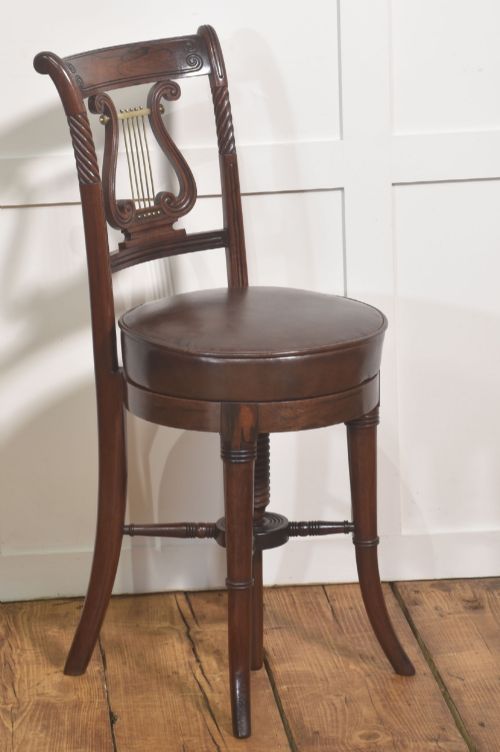
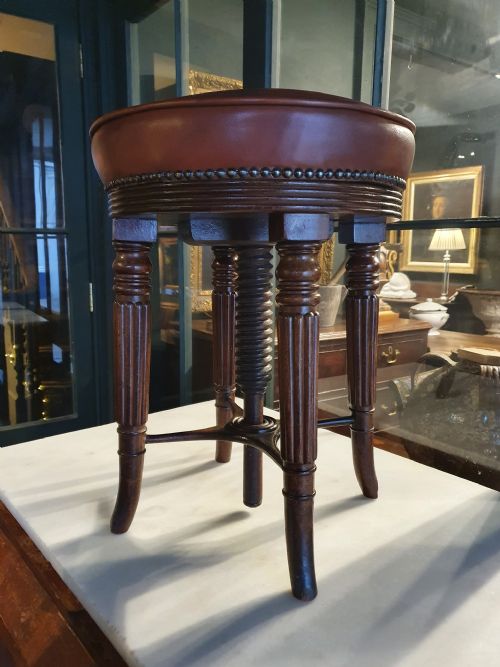


Adjustable Height Piano Stool
An adjustable height piano stool gives a room mechanical ingenuity alongside timber presence, pairing the practicality of player positioning with period character.
Adjustable Height Piano Stool
When you search for an adjustable height piano stool, you are looking at seating engineered for musicians that crosses over easily into dressing tables and general living spaces. These pieces span multiple eras, with nineteenth-century Victorian examples appearing frequently alongside Georgian, Regency, William IV, and Edwardian specimens.
The primary forms include revolving swivel tops, rise and fall mechanisms, and screw-top designs configured as music chairs, dressing chairs, and accent stools. Mahogany and walnut dominate the offerings, often complemented by rosewood, satinwood, iron, and brass details.
Origin variations range from domestic country pieces to specialised workshop productions. You will encounter straightforward timber frames alongside heavily carved styles, industrial cast iron variants, and patent music chairs upholstered in leather or fabric.
Materials and construction methods
Cabinetmakers built these stools using dense hardwoods such as mahogany, walnut, and rosewood, frequently turning or carving the timber to achieve sturdy central columns and cabriole or sabre legs. Brass and cast iron components formed the hidden or exposed screw threads and swivel mechanisms that allowed the seats to rise and fall smoothly.
Upholstery required durable textiles, green leather, or modern fabric replacements secured over padded tops to withstand constant shifting and movement during use. Ebonised finishes, gilt paint, and brass inlay provided decorative contrast on grander Regency and Victorian models.
Some Victorian industrial examples swap polished rosewood for raw cast iron, proving that even nineteenth-century pianists appreciated heavy-duty workshop machinery.
Assessing build quality and execution
The sophistication of the mechanical adjustment mechanism sets the standard, where a fluid, stable screw thread or swivel joint represents superior metalwork compared to a stiff or wobbly action. Carved detail depth and timber selection also differentiate standard output from workshops of high repute.
The integrity of the frame joints and the retention of original timber patination determine overall desirability. Examples retaining original leather or period fabric upholstery alongside functional hardware sit firmly at the upper end of the scale.
Gillows·James Shoolbred
The Adjustable Height Piano Stool Glossary
- Revolving
- A seat design incorporating a swivel top that rotates freely on a central spindle. This movement allowed players to pivot slightly towards sheet music cabinets without moving the base.
- Rise and fall
- A mechanical system enabling the seat height to be adjusted up or down via a winding screw action. It ensures the player achieves the correct ergonomic posture at the keyboard.
- Ebonised
- Timber treated with a dark finish to imitate expensive ebony wood. Cabinetmakers utilised this technique heavily during the Victorian period to create stark contrast.
- Patent music chair
- An adjustable seating form protected by a registered nineteenth-century design patent. These often feature specialised mechanical linkages or cast iron framing.
- Satinwood
- A pale, lustrous hardwood prized for its fine grain. It appeared frequently on decorative late nineteenth-century pieces as veneer or inlay.
Adjustable Height Piano Stool: Frequently Asked Questions
How do adjustable piano stools work?
Most variants rely on a central wooden or metal screw thread hidden beneath the upholstered seat top. Turning the seat clockwise or anticlockwise raises or lowers the height relative to the base.
Alternative designs utilise specialised levers or metal ratchets to lock the seat platform into position at predetermined levels.
Were these stools only used for pianos?
While originally designed to give musicians precise posture control at the keyboard, their compact footprint made them exceptionally popular elsewhere in the home.
They frequently served as dressing table chairs in bedrooms or as versatile swivel accent seating in nineteenth-century drawing rooms.
How do I date an adjustable piano stool?
Dating relies heavily on identifying timber choices, leg styles, and mechanical construction methods. Regency and Georgian examples tend to feature sabre legs and brass inlay, whereas Victorian pieces often showcase heavy walnut framing or cast iron industrial elements.
Edwardian and later iterations display lighter proportions, simplified turning, and early twentieth-century manufacturing signatures.
Can I use an antique music stool daily?
These pieces were built from dense hardwoods like mahogany and walnut to endure daily physical adjustment and active use. Provided the internal screw mechanism and timber joints remain stable, they function reliably in modern settings.
Routine care involves checking the central pivot and treating the timber surfaces gently with appropriate wax.