

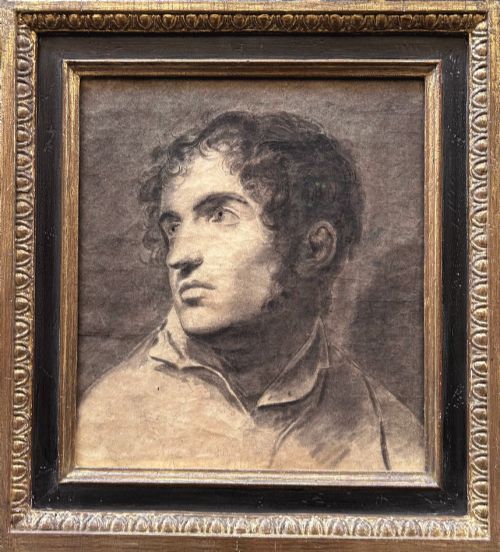

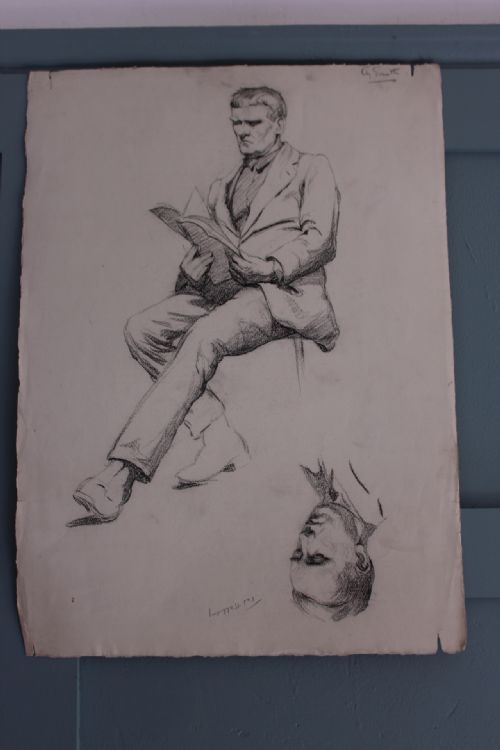


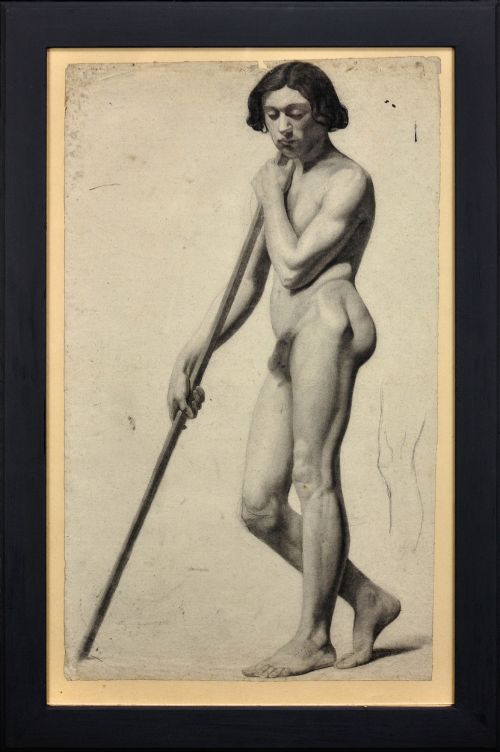


Academic Portrait Study Charcoal
An academic portrait study charcoal captures the disciplined eye of the training studio through monochrome draughtsmanship.
Academic Portrait Study Charcoal
An academic portrait study charcoal is a focused drawing created within a studio or school tradition, capturing the human subject with careful observation of tone and form. These works emerge from formal training environments where artists honed their skills in capturing likeness, expression, and anatomy. The pieces on this page span the nineteenth and early twentieth centuries, reflecting both anonymous studio exercises and signed portraits.
The selection here encompasses various interpretations of the human form, from male nude life studies to detailed character portrayals of notable figures. Framed artworks dominate the offering, preserved behind glass in wood and giltwood frames that protect the delicate mediums. Buyers encounter both French and British schools, showing how instructional methods crossed national boundaries during the Victorian and Edwardian eras.
Materials and Technique
Support materials typically consist of period paper housed within wooden or giltwood frames. The application of these dry media required a steady hand and a fixation method to prevent smudging over time, resulting in durable yet sensitive surfaces that demand careful framing behind glass.
Academic Portrait Study Charcoal Retail Price Guide 2026
Typical asking prices for academic portrait study charcoal among the pieces listed under this phrase on Sellingantiques today, from the lower quarter to the upper quarter. They describe what is for sale here now, not the wider market.
Listings feature works spanning the nineteenth century through the 1930s, utilising paper, charcoal, graphite, chalk, and watercolour within wood and giltwood frames.
Draughtsmanship and Provenance
Quality in these works rests upon the surety of the line and the precision of anatomical or facial rendering. A superior study demonstrates a confident grasp of proportion, light, and shadow that elevates a mere instructional exercise into a compelling portrait. The finest examples reveal the artist's acute understanding of personality and bone structure through minimal yet deliberate marks.
Attribution and provenance further distinguish the works. Pieces bearing the signature of a documented Royal Academician or a known school hold distinct historical weight compared to anonymous studio exercises. The preservation of the original paper and the integrity of the period frame also influence the overall character of the piece.
Winifred Eugene Ballard·Reginald G. Eves·Robin Watt·Theobald Chartran·Ernest Borough Johnson·George Richmond·Cecil CP Lawson
The Academic Portrait Study Charcoal Glossary
- Academic Realism
- A style of painting and drawing produced under the influence of European academies of art, emphasising precise anatomical accuracy and classical form. It represents the rigorous training regimen nineteenth-century artists underwent.
- Life Study
- A drawing or painting executed directly from a live model, serving as a fundamental exercise in art schools. These studies focus heavily on capturing musculature, posture, and human expression.
- Graphite
- A crystalline form of carbon used as a drawing medium, yielding silver-grey marks. It often appears alongside charcoal and chalk in preparatory sketches.
- Giltwood
- Wood that has been covered with a thin layer of gold leaf or gold paint. Frames of this material are commonly found protecting nineteenth-century works on paper.
- French School
- A term denoting artists trained within the French academic tradition. These works often display a distinct emphasis on dramatic lighting and expressive draughtsmanship.
Academic Portrait Study Charcoal: Frequently Asked Questions
What is an academic charcoal study?
An academic charcoal study is a drawing executed as part of an artist's training or studio practice, focusing on accurate representation of the human subject.
These pieces often depict models, historical figures, or portraits of private individuals, showcasing the rigorous methods taught in nineteenth and early twentieth-century art schools.
How do I date these drawings?
Dating relies on stylistic markers, framing, signatures, and biographical details of the sitter or artist recorded in the title.
Nineteenth and early twentieth-century works frequently display specific paper qualities, handwriting, and framing techniques characteristic of the Victorian and Edwardian periods.
What is the difference between a life study and a portrait?
A life study concentrates primarily on the physical form, anatomy, and lighting of an anonymous model during a training session.
A portrait, conversely, captures the specific likeness, identity, and character of a named individual, often commissioned or created as a finished artwork.