


19th Century Optical Instrument
These 19th century optical instruments are precision lenses and brass mechanisms that bring distant landscapes or microscopic details sharply into view.
19th Century Optical Instrument
A 19th century optical instrument is a scientific or domestic device designed to manipulate light for magnification, measurement or observation. When you search for a 19th century optical instrument, you encounter everything from field microscopes and portable telescopes to stereoscopes and folding opera glasses housed in original wooden cases.
The Victorian period yields the majority of these pieces, spanning portable campaign equipment and heavy brass desk accessories. Makers ranged from renowned London opticians supplying professional gear to smaller workshops producing domestic entertainment devices like stereoscopes.
Forms vary according to their original purpose, separating laboratory spectroscopes and architects' levels from gentlemanly pocket magnifiers and theatre glasses. Each item reflects the rapid scientific expansion of the era, combining practical utility with polished craftsmanship.
How they were made
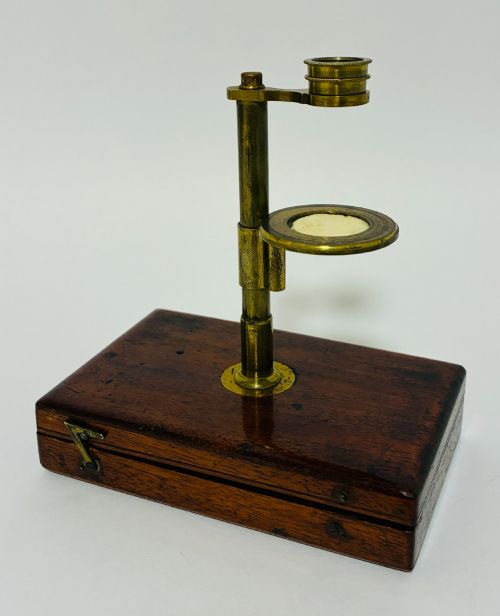
Makers constructed these instruments using heavy brass for optical tubes and mechanical mounts, paired with hand-finished glass lenses. Wood played a vital structural and protective role, with cabinets, cases and stereoscopes turned and joined in mahogany, rosewood and burr yew.
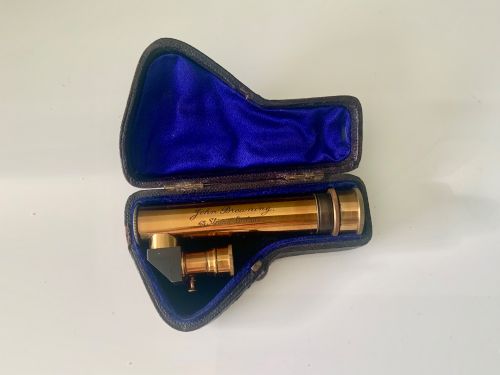
Portability required durable exterior finishes, leading workshops to wrap telescope tubes in stitched leather and line storage cases in velvet. Metal components received precise threading and engraving to sign the maker and location along the barrel or stage.
The documented object types span telescopes, stereoscopes, spectroscopes, test glass lens kits, architects' levels and field microscopes.
What varies in quality
Quality separates utilitarian working tools from presentation pieces commissioned for wealthy patrons or scientific societies. Superior examples retain clear, original glass without distortion, alongside crisp maker signatures and smooth mechanical focus adjustments.
The standard of the secondary housing dictates much of the appeal, distinguishing instruments preserved in fitted mahogany cases with velvet linings from those stripped of their accessories. Materials also signal tier, moving from standard brass and mahogany up to sterling silver mountings and exotic hardwoods.
John Browning Strand London·R. & J. Beck London·Steward of London·Francis West of Fleet Street London·WF Stanley
The 19th Century Optical Instrument Glossary
- Spectroscope
- An optical instrument used to measure properties of light over a specific portion of the electromagnetic spectrum. It splits light into its component wavelengths for chemical analysis.
- Stereoscope
- A device for viewing a stereoscopic pair of separate images, depicting left-eye and right-eye views as a single three-dimensional image. Victorian versions often used burr yew wood.
- Stanhope Lens
- A tiny cylindrical ultraviolet or magnifying lens that produces a microscopic photograph visible when held to the eye. Francis West produced improved versions of these.
- Binocular Microscope
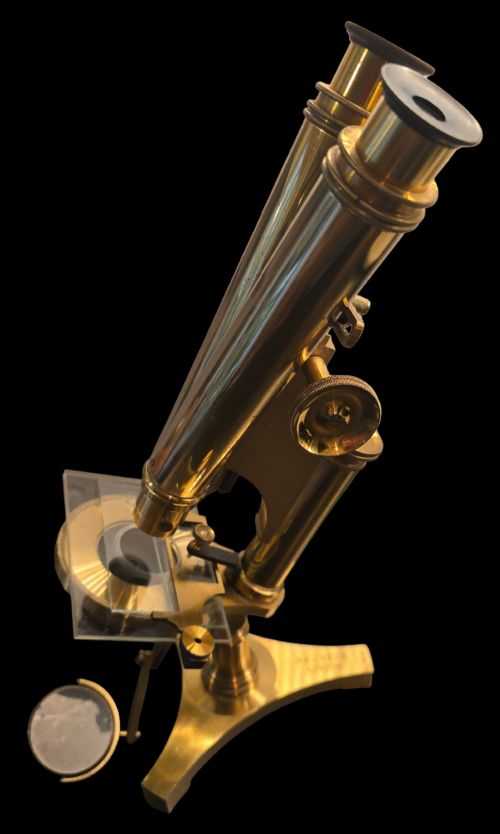
- A microscope having two eyepieces, allowing both eyes to be used simultaneously for comfortable viewing of magnified slides. Examples like the Improved National utilised original mahogany cases.
- Campaign Telescope
- A portable telescope designed for military or field use, featuring sliding brass draws often wrapped in leather for protection during travel.
19th Century Optical Instrument: Frequently Asked Questions
Are these instruments still fully functional?
Many 19th century telescopes, microscopes and opera glasses remain entirely usable for observation. Focus mechanisms and sliding brass tubes often operate smoothly after a century of use.
Some scientific instruments serve primarily as decorative or study pieces due to missing auxiliary lenses or outdated calibrations. Check the optical clarity and mechanical movement before attempting field use.
Why do some instruments have wooden cases?
Fitted mahogany and rosewood cases protected delicate scientific instruments during transport in the field or aboard ships. They kept dust away from precision glass and organised spare lenses and slides.
Original cases significantly enhance the historical context and completeness of the piece. Lined interiors in velvet or silk cushioned the brass components against shock.
How do I date a Victorian telescope?
Engraved signatures naming specific London streets or exhibitions often provide a reliable window into a maker's working years. Patent dates and style shifts from Regency robust forms to Victorian compactness also help narrow the decade.
Materials change over time, moving from heavy mahogany barrels with simple brass mounts to refined all-metal construction. Consulting recorded maker addresses clarifies the manufacturing timeline.