
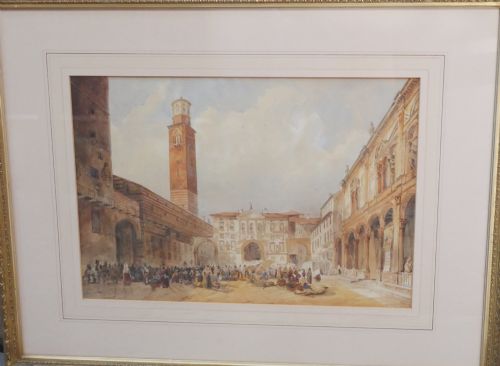
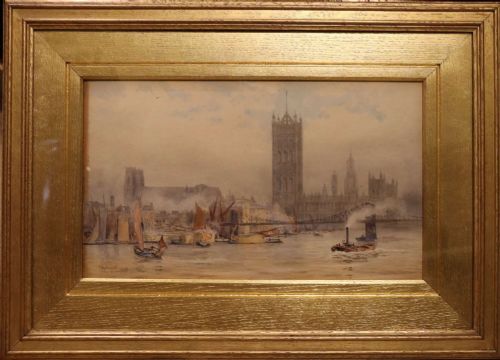


19th Century Cityscape Watercolour
These 19th century cityscape watercolour works capture urban streets, rivers, and ancient ruins through delicate pigment on paper.
19th Century Cityscape Watercolour
A 19th century cityscape watercolour brings historic streets, rivers, and monuments into domestic spaces through delicate pigment on paper. These paintings capture distant capitals and local landmarks, from the banks of the Thames and St Paul's Cathedral to the Forum of Nerva and the Spanish Steps in Rome.
The pieces available here lean towards Victorian British Impressionism, the Norwich School, and Grand Tour aesthetics. Buyers frequently encounter framed artwork depicting Italian scenes, Venetian waterways, and continental streetscapes alongside familiar English views.
Works originate across the nineteenth century, with specific dates pointing to the 1880s, 1890s, and 1900, while broader listings stretch back to the 1800s and forward into later periods. Each painting offers a specific window into urban life and topography from these decades.
Materials and construction
Artists built these compositions using watercolour paint and pigment applied directly onto paper supports. This medium allowed for rapid outdoor sketching during travels or careful studio completion of intricate architectural details.
Finished works found protection beneath glass and within framing materials that often include gilt wood and gold leaf elements. These traditional mountings preserve the fragile paper surfaces from atmospheric degradation over time.
Listings feature works spanning the nineteenth century, with specific dates recorded from 1800 through to 1940.
Factors of distinction
Quality rests upon the artist's ability to command perspective and atmospheric light across the paper. Accomplished hands capture the distinct density of winter twilight or the brilliant glare of a Venetian canal with precise control over pigment dilution.
The handling of architectural elements, such as cathedral spires or classical ruins, separates routine topographical recording from evocative fine art. Framing choices involving period gilt wood and gold leaf also indicate the original investment in the piece.
H. Medlycott·Walter Duncan·David Law·Ettore Ascenzi·Matthew Hale·John Thistle
The 19th Century Cityscape Watercolour Glossary
- Grand Tour
- A traditional trip of Europe undertaken by upper-class European young men of sufficient means. This cultural journey generated a demand for topographical art depicting classical ruins and foreign cities.
- Norwich School
- The first provincial art movement in Britain, founded around artists working in East Anglia. Members produced landscape and cityscape watercolours influenced by Dutch landscape traditions.
- Gilt wood
- Wood coated with a thin layer of gold leaf or metallic gilt. This material frequently frames nineteenth-century paintings to enhance the visual weight of the artwork.
- Topography
- The detailed mapping and description of particular places. In painting, it refers to accurate representations of specific real-world buildings and streets.
- Pigment
- The finely ground coloured material mixed with a binder to create watercolour paint. The permanence and quality of these substances determine how well the colours survive.
19th Century Cityscape Watercolour: Frequently Asked Questions
What is a cityscape watercolour?
A cityscape watercolour is an original painting on paper that depicts urban scenes, streets, rivers, and architectural landmarks using water-soluble pigments. These works range from quick topographical sketches to finished exhibition pieces.
Artists during the nineteenth century used this medium to record domestic views and travels abroad, capturing the changing light on buildings and monuments.
Where were these watercolours painted?
These watercolours were painted both on location during travels and back in the studio from preliminary sketches. Subjects span British locations like London and Hereford alongside continental destinations.
Popular foreign locations include Venice, Rome, and various Italian street scenes encountered during European tours.
How should I frame and hang them?
Watercolours require careful framing behind glass to protect the delicate paper and pigments from dust and moisture. Archival mounts prevent the paper from touching the glass directly.
Display these paintings away from direct sunlight to prevent the watercolours from fading over the years.
How do I identify the period?
Period identification relies on stylistic clues, framing materials, artist signatures, and occasionally written dates on the reverse or front of the paper. Victorian and Grand Tour aesthetics often point towards specific decades.
Examining the type of paper and the framing style under the glass provides further contextual clues about the date of creation.