


19th Century Alabaster Carving
These pieces gather carved 19th century alabaster carving items, capturing classical figures and Grand Tour souvenirs that bring tactile warmth to interiors.
19th Century Alabaster Carving
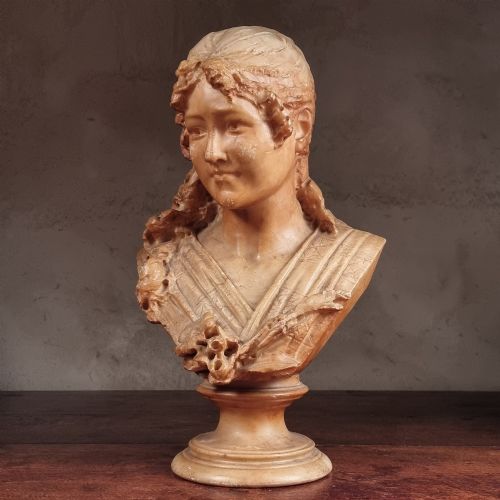
A 19th century alabaster carving encompasses decorative vessels, portrait busts, animal figures, and mythological sculptures shaped across the Victorian and Edwardian eras. These objects range from modest Italian Grand Tour souvenirs to substantial Continental statues and architectural plant stands.
The selections on this page lean heavily towards Italian workshops and French studios, reflecting the heavy output of classical figures, wall plaques, and chambersticks during the late nineteenth century.
Materials and Technique
Carvers shaped these items using soft gypsum-based alabaster and various types of marble, frequently mounting white or veined Carrara varieties onto contrasting black marble bases. Artisans employed hand chisels and abrasive powders to achieve the smooth, translucent surfaces characteristic of figurative work.
Certain objects incorporate mixed media, pairing carved stone elements with mahogany or bronze components, particularly within clock sets and pedestal mounts.
Sculptural forms include deities such as Hestia and Diana alongside mythological subjects and literary figures like Virgil and Dante.
Standard and Execution
Signatures by recognised sculptors or workshops elevate certain sculptures above anonymous tourist mementos, reflecting greater technical ambition in drapery and expression.
Bright And Sons·Mieczyslaw Leon Zawiejski·Antonio Frilli·Pugi·Gugielmo Pugi·P. Emilio Fiaschi·R. Lusili·A. Cipriani
The 19th Century Alabaster Carving Glossary
- Alabaster
- A fine-grained, soft stone prized for its translucence and ease of carving. It permits delicate rendering of skin tones and drapery.
- Grand Tour
- A traditional trip through Europe undertaken by upper-class travellers in the nineteenth century. Souvenirs included miniature architectural models and carved stone sculptures.
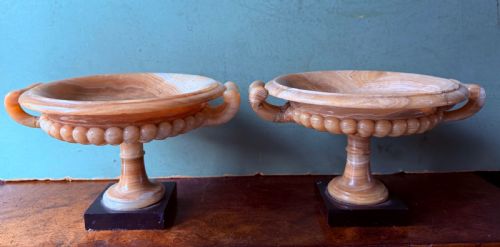
- Tazza
- A shallow cup or vase raised on a stem and foot. These decorative vessels often appear in matched pairs on marble plinths.
- Spinario
- A Greco-Roman Hellenistic bronze sculpture depicting a boy pulling a thorn from his foot. 19th-century carvers frequently reproduced this subject in alabaster.
- Carrara Marble
- A type of white or blue-grey marble quarried in the city of Carrara in Tuscany. It provides a dense, consistent medium for architectural elements and busts.
19th Century Alabaster Carving: Frequently Asked Questions
How do I clean an alabaster carving safely?
Alabaster dissolves in water and absorbs liquids readily. Dust the surface gently with a soft, dry brush and avoid chemical cleaning agents entirely.
Keep these items away from damp environments and direct sunlight to preserve the polished finish and prevent discoloration.
What is alabastro egiziano?
Alabastro egiziano refers to a heavily figured, banded variety of stone utilised by Italian artisans. It often displays rich warm tones that create distinct visual patterns across tazze and vases.
Carvers selected this material to highlight the decorative contours of Grand Tour souvenir vessels.
How do I distinguish alabaster from marble?
Alabaster is significantly softer than marble and can be scratched with a fingernail or metal point. It also possesses a higher degree of translucency when held near a light source.
Marble maintains a harder, colder surface with crystalline structures that do not transmit light to the same depth.
Where were these sculptures made?
The majority of figurative works and architectural souvenirs originated in Italian workshops, particularly in Florence and Volterra. French studios also produced significant quantities of clock sets and portrait busts.
These centres catered to travelling collectors seeking tangible reminders of classical antiquity.