


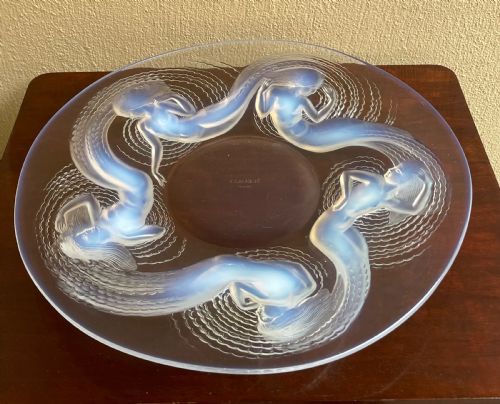


1930s Glass Platter
These 1930s glass platter pieces bring unmistakable Art Deco geometry and opalescent depth to a table.
1930s Glass Platter
A 1930s glass platter encompasses shallow bowls, chargers, decorative plates, and serving trays produced during the interwar period. The forms lean heavily into Art Deco aesthetics, combining utility with striking display qualities.
You are most likely to encounter moulded opalescent glass chargers alongside mirrored glass and etched drinks trays. Pieces often incorporate metal, chrome, or macassar ebony mounts that frame the central glass surface.
How they were made
Makers utilised press-moulding and hot-working techniques to achieve heavy relief details, particularly within opalescent glass bowls and plates. Acid-etching and surface cutting created crisp geometric motifs on mirrored glass trays.
Composites of glass, chrome, and wood appeared frequently, uniting metal handles or wooden frames with mirrored bases. Millefiori work also surfaces, fusing coloured glass canes together in intricate patterns.
Current listings demonstrate a concentration of French Art Deco pieces combining opalescent glass, chrome, and macassar ebony.
What varies in quality
Depth of relief and uniformity in opalescence separate standard production runs from masterworks. The crispness of the moulded signature or etch marks dictates the prestige of the maker.
The integration of auxiliary materials like chrome mounts or macassar ebony frames defines the overall finish. Superior examples maintain structural integrity between the glass plate and its metal or wooden housing.
Rene Lalique·Sabino
The 1930s Glass Platter Glossary
- Opalescent glass
- Glass that exhibits a milky, translucent quality with shifting blue or amber highlights depending on the light. This effect was especially popular among French makers.
- Charger
- A large decorative plate or platter used primarily for presentation or serving rather than daily dining. These pieces often feature bold relief designs.
- Millefiori
- A glasswork technique involving the production of glass canes with multicoloured patterns that are sliced and fused together. It translates to a thousand flowers.
- Macassar ebony
- A heavily grained exotic wood from Indonesia utilised for tray borders and handles. Its dark brown and golden stripes complement polished glass.
1930s Glass Platter: Frequently Asked Questions
How are these glass platters best displayed?
Place them on flat surfaces where natural light can strike the glass, especially with opalescent or etched pieces.
Chargers and large plates suit wall hanging using specialist brackets or flat tabletop presentation.
Were these trays used for serving drinks?
Mirrored trays and metal-mounted versions served cocktails and glassware in domestic settings during the interwar years.
Their robust construction allowed functional use alongside decorative display.
What defines Art Deco in these pieces?
Symmetrical patterns, stylised floral motifs, and geometric borders characterise the visual language of the decade.
Materials like chrome and mirrored glass reinforce this modern industrial mood.
How do I identify French pieces?
Look for moulded signatures in the glass and distinct opalescent finishes characteristic of major Parisian ateliers.
Combined elements like macassar ebony frames also point towards French production.