

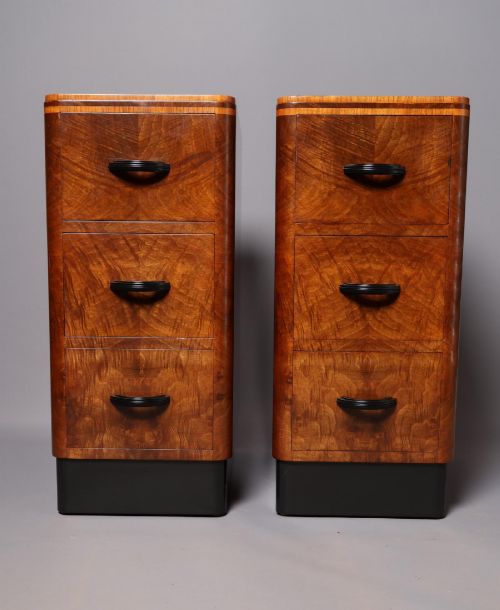


1930s Bedside Chests
These 1930s bedside chests bring practical storage and striking grain patterns to the bedside.
1930s Bedside Chests
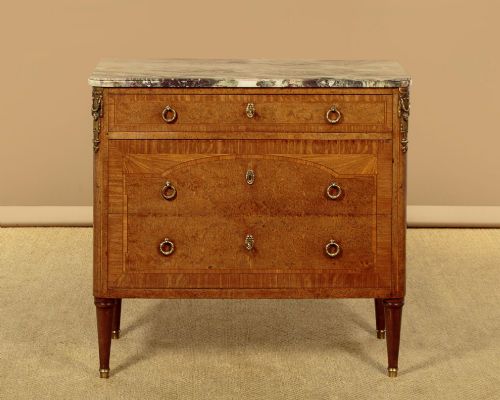
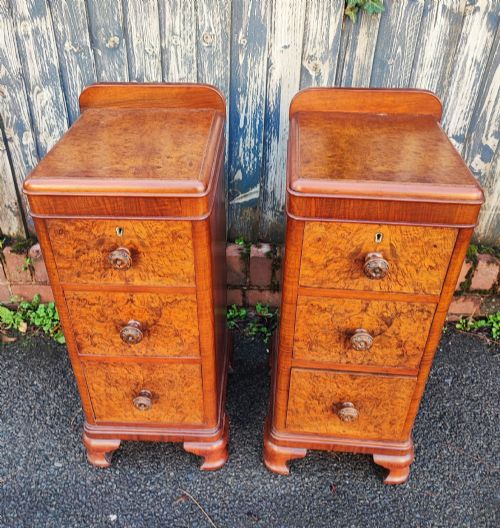
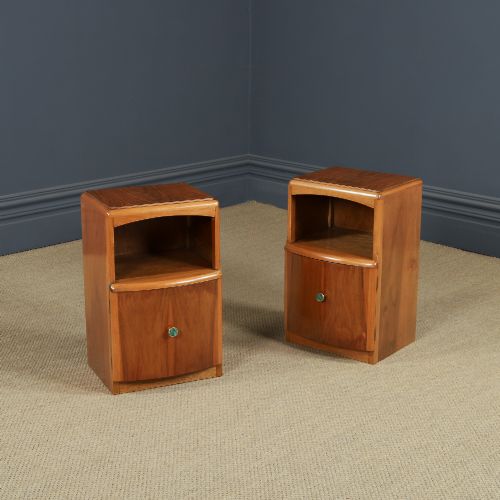
When you search for 1930s bedside chests, you find compact cabinets designed to sit beside a bed to hold night-time essentials. They appear most frequently as walnut pieces built in the Art Deco style, often featuring cupboards and drawers.
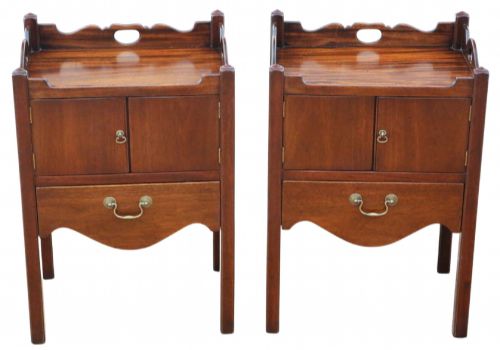
The selection includes matching pairs alongside single cabinets, spanning the 1920s through to the 1940s. Alongside walnut, the evidence records pieces built from oak, mahogany, satinwood, and birds eye maple.
Makers utilised various forms, including bedside tables, lamp tables, and pot cupboards, adapting the classic chest format to different bedroom layouts.
How they were made
Cabinetmakers constructed these pieces using solid timbers and wood veneers over sturdy wood carcases. Figured walnut, burr walnut, and satinwood veneer create striking patterns across the drawer fronts and cabinet doors.
Metal and brass components provide structural accents and opening handles, whilst selected pieces incorporate bakelite details. French provincial and Georgian revival influences also appear alongside the dominant Art Deco aesthetic.
1930s Bedside Chests Retail Price Guide 2026
Typical asking prices for 1930s bedside chests among the pieces listed under this phrase on Sellingantiques today, from the lower quarter to the upper quarter. They describe what is for sale here now, not the wider market.
Listings span periods from 1920 to 1940, encompassing Art Deco, Georgian Revival, and French Provincial styles.
What varies in quality
Quality rests in the selection of wood veneers and the precision of the cabinetwork. Pieces featuring matched burr walnut or birds eye maple display a higher degree of decorative ambition than plain timber versions.
The integration of functional elements, such as smooth-running drawers, secure cupboard doors, and original hardware, separates standard utility pieces from finer examples.
The 1930s Bedside Chests Glossary
- Art Deco
- A design style characterised by sleek geometric shapes, streamlined forms, and modern ornamentation. It dominated decorative arts during the period.
- Burr Walnut
- A specialised wood veneer taken from the growth growths of a walnut tree, yielding swirling, highly decorative grain patterns. Cabinetmakers prize it for feature panels.
- Pot Cupboard
- A traditional term for a small bedside cabinet originally designed to house a chamber pot. They now serve general bedside storage purposes.
1930s Bedside Chests: Frequently Asked Questions
Are pairs common for these chests?
Matching pairs appear regularly across the listings, alongside single cabinets for asymmetric bedroom layouts.
Buyers seeking symmetry often choose these paired sets to balance both sides of a bed.
What materials feature most often?
Walnut and wood veneer dominate the selection, appearing in both figured and burr varieties.
Oak, mahogany, satinwood, and birds eye maple also feature in the construction.
How do I identify Art Deco pieces?
Art Deco pieces display geometric lines, clean silhouettes, and striking wood veneers like walnut or birds eye maple.
These designs often include integrated handles and curved cabinet profiles.
Can these work as lamp tables?
Many of these cabinets function equally well as side tables or lamp stands in living spaces.
Their compact proportions suit placement beside armchairs or sofas.