
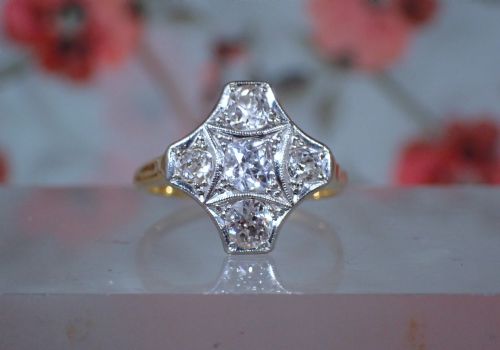


1920s Platinum Plaque Ring
A 1920s platinum plaque ring is a geometric jewel that frames diamonds and sapphires flat against the finger.
1920s Platinum Plaque Ring
A 1920s platinum plaque ring typically presents an elongated or panel-shaped face dominated by the Art Deco style. These jewels sit low on the hand, designed to catch the light across intricate geometric patterns.
The selection ranges from platinum pieces to combinations of platinum and 18ct gold or 18ct yellow gold. Alongside diamonds, makers incorporated sapphires, rubies, emeralds, and onyx into the clusters and panels.
How they were made
Makers utilised platinum for its strength and malleability, allowing for delicate, lace-like pierced metalwork that could securely hold stones with minimal visible framing. This metal choice defined the crisp white aesthetic of the period.
Gems were cut in old cuts, old transitional cuts, and rose cuts, then set by hand into the metal face. Combinations of gold and platinum were often employed to contrast warm yellow bands against bright white settings.
What varies in quality
Quality depends on the precision of the piercing and the symmetry of the geometric layout across the plaque. Piercing work that remains crisp and uniform distinguishes superior examples.
The selection and matching of secondary stones, such as calibrated sapphires or rubies alongside diamonds, influences the overall harmony of the piece.
The 1920s Platinum Plaque Ring Glossary
- Plaque ring
- A ring featuring a flat, ornamental panel that extends across the finger. These mountings often display pierced openwork and dense stone settings.
- Art Deco
- A design style spanning the 1920s and 1930s characterised by symmetry, geometric lines, and stylised motifs. It rejected the flowing curves of earlier periods in favour of architectural structure.
- Old cut diamond
- A hand-faceted diamond cut before modern machine precision, featuring a smaller table and higher crown. These stones exhibit a distinctive, softer candlelight gleam.
- Transition cut
- A diamond cut used during the shift from old cut to modern brilliant cut during the early twentieth century. It bridges the proportions of older stones with wider facets.
- Cluster ring
- A ring design where a central stone is surrounded by a tight grouping of smaller gems. This arrangement magnifies the visual impact on the hand.
1920s Platinum Plaque Ring: Frequently Asked Questions
What is an Art Deco plaque ring?
An Art Deco plaque ring is a jewel featuring a flat, broad face decorated with geometric patterns and pierced metalwork. These pieces are designed to showcase diamonds and coloured stones across the top of the hand.
The style emerged during the 1920s, prioritising clean architectural lines and symmetry over floral motifs.
How do I wear an antique plaque ring?
These rings work well worn alone on the hand due to their width and detailed presence. Their low profile makes them practical for regular wear while protecting the setting.
Consider the shape of the plaque against your finger length when choosing an elongated or square panel design.
Are these rings made entirely of platinum?
Many examples combine platinum for the top face with 18ct gold, 18ct yellow gold, or standard gold for the shank. Platinum was favoured for the setting because its strength allowed for delicate work.
Inspect the metal hallmarks and colour contrasts to identify dual-metal construction in vintage pieces.
What stones are used in 1920s rings?
Diamonds form the primary brilliance, often accompanied by sapphires, rubies, emeralds, and onyx. These coloured gemstones provide vibrant contrast within the geometric platinum framework.
Combinations of rubies, sapphires, and diamonds appear together in tricolour panel designs from the era.