
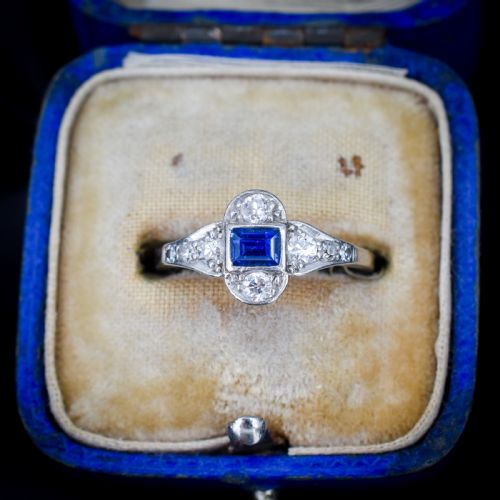


1920s Emerald Diamond Ring
A 1920s emerald diamond ring brings the geometry and bright contrast of the period straight to the finger.
1920s Emerald Diamond Ring
A 1920s emerald diamond ring unites green beryl with faceted stones in settings shaped by the Art Deco movement. These jewels span the decades from 1920 into the 1930s and 1940s, capturing a distinct period of design.
The version most commonly met on this page is the platinum or white gold cluster ring, featuring a central emerald surrounded by diamonds. Alongside these are five-stone settings and panel configurations that emphasise clean lines.
Makers of the era also paired diamonds with sapphires, tourmalines, aquamarines, and amethysts within the same geometric framework. Such pieces demonstrate how the characteristic aesthetic of the decade extended beyond emeralds alone.
How they were made
Platinum and white gold provide the bright metallic framework characteristic of the period, offering the strength needed for intricate pierced work. Yellow gold also appears in fourteen, fifteen, and eighteen-carat standards, particularly in transitional five-stone designs.
Goldsmiths set emeralds alongside diamonds using pave, cluster, and panel arrangements. The combination exploits the contrast between the deep green of the central beryl and the sharp brilliance of the surrounding stones.
Several rings come with specific finger sizes noted in the record, ensuring a precise fit for a century-old jewel.
What varies in quality
The distinction between upper and lower tiers rests upon the origin and character of the central emerald, particularly where Colombian stones are concerned. Natural treatment grades and weight proportions dictate the standing of the piece.
Execution of the metalwork defines the construction quality, as fine millegrain edges and precise platinum mounting demand advanced bench skills. The balance between diamond carat weight and emerald presence alters the visual impact of the design.
The 1920s Emerald Diamond Ring Glossary
- Art Deco
- A design style spanning the 1920s and 1930s characterised by geometric symmetry, stylised motifs, and linear precision. It replaced the flowing curves of the Edwardian era with bold, architectural forms.
- Cluster ring
- A ring featuring a central stone encircled by a group of smaller gems, typically diamonds framing a coloured focal stone. This layout maximises surface presence and light reflection.
- Pave
- A setting style where numerous small diamonds are closely set together with minimal visible metal, creating a continuous surface of stones. The French term translates to paved.
- Colombian emerald
- An emerald originating from the mines of Colombia, historically prized for an intense green hue. These stones frequently appear in high-tier period pieces.
1920s Emerald Diamond Ring: Frequently Asked Questions
What periods do these rings date from?
The pieces span the 1920s, 1930s, and 1940s, with the vast majority anchored firmly in the Art Deco era.
Design characteristics transition from early platinum clusters through to later white gold and yellow gold interpretations.
Which metals are used in these settings?
Platinum and 18ct white gold dominate the selections, offering a bright surface suited to geometric designs.
Yellow gold also appears in 14ct and 15ct standards, particularly in traditional five-stone rings from the early twenties.
Are all the emeralds natural?
The listings include natural emeralds, with specific examples noting Colombian origin and minor oil treatments.
Other coloured stones such as sapphires, aquamarines, and tourmalines also feature within the same structural formats.
How do cluster rings differ from other styles?
Cluster configurations place a prominent central emerald amid a border of smaller diamonds to enlarge the visual focal point.
Alternative formats include linear five-stone arrangements and flat panel designs that sit flush against the finger.