
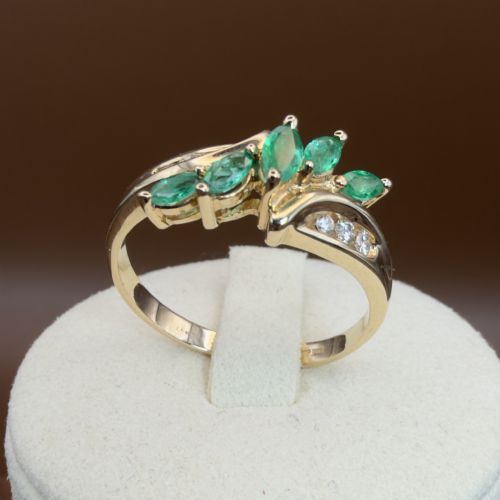


14k Gold Diamond Ring
A 14k gold diamond ring brings together enduring metal and bright stones across styles from Victorian work to mid-century modern designs.

14k Gold Diamond Ring
A 14k gold diamond ring combines the warm or bright tones of fourteen-carat gold with diamond settings, appearing across Victorian, Art Deco, and mid-century periods. These pieces serve as dress rings, cluster rings, and bands.
The selections available here range from blue and green enamel accents paired with brilliant-cut diamonds to structural Art Deco white gold creations. Buyers encounter various formations, including marquise cuts, halo settings, and half hoops.
Originating from eras such as the 1920s, 1930s, 1950s, and 1960s, these rings display diverse gemstone pairings alongside diamonds, incorporating emeralds, sapphires, amethysts, tanzanites, and pearls.
How they were made
Goldsmiths utilised fourteen-carat yellow gold and white gold to construct foundational bands, bezels, and complex cluster galleries. These metals provide the structural strength needed to secure multiple stones.
Craftsmen set diamonds alongside coloured stones like emeralds and sapphires, occasionally integrating enamel work into the gold framework. Surface decoration and stone arrangements define the distinct aesthetic of each period.
Listings feature fourteen-carat white gold, yellow gold, and combinations of both metals across mid-century and earlier periods.
What varies in quality
The distinction between tiers rests upon the precision of the stone setting and the complexity of the goldwork. Master goldsmiths achieved tighter tolerances in cluster arrangements and more refined integration of enamel details.
Proportion and balance across the ring gallery determine visual success, separating standard production from exceptional examples. The clarity of design execution within periods like Art Deco or Victorian manufacturing dictates the standing of a piece.
The 14k Gold Diamond Ring Glossary
- Cluster ring
- A ring featuring a central stone surrounded by a collection of smaller gems. This layout maximises visual impact and combines different materials like diamonds and emeralds.
- Half hoop
- A band design where stones span across the upper portion of the finger. It offers a continuous line of gems without a full eternity circle.
- Halo ring
- A setting style where a ring of smaller diamonds encircles a larger central gemstone. This technique enhances the perceived size and brilliance of the middle stone.
- Marquise cut
- A boat-shaped gemstone cut with pointed ends and curved sides. It creates an elongated appearance on the finger.
- Enamel
- A glassy substance melted onto the surface of gold for decorative colour. It appears in blue and green tones across various period pieces.
14k Gold Diamond Ring: Frequently Asked Questions
What periods do these rings come from?
The pieces span from the Victorian era through the 1920s and 1930s Art Deco periods, extending into 1950s and 1960s mid-century designs. Each decade brings distinct aesthetic choices in gold colour and stone arrangement.
Buyers find both early handmade examples and later vintage interpretations utilising fourteen-carat gold.
What stones are paired with diamonds?
Gems accompanying diamonds include emeralds, sapphires, amethysts, tanzanites, and pearls. Enamel accents also appear in several designs alongside the primary stones.
These combinations change depending on the manufacturing period, from Victorian enamel work to mid-century dress ring formations.
How do yellow gold and white gold differ?
Fourteen-carat yellow gold offers a traditional warm tone utilised heavily in Victorian and mid-century pieces. Fourteen-carat white gold provides a silvery appearance often favoured in Art Deco designs.
Both variants share the same gold purity while altering the visual character of the ring.
How are different ring styles identified?
Styles are recognised through geometric layouts in Art Deco pieces, floral arrangements in cluster rings, and linear stones in half hoops. Examining the setting technique and secondary materials clarifies the period.
Details like enamel panels and specific stone cuts assist in placing a ring within its era.