19,814  PAGES BROWSED TODAY PAGES TODAY 70  ANTIQUES UPLOADED TODAY NEW ARRIVALS
ID #SA973173
FOR SALE
£3,350
Email
Save
19th Century Animalier Bronze Sculpture Entitled "Reindeer" by Isidore Bonheur
Hickmet Fine Arts
for sale €3,920     $4,255
£3,350
Hickmet Fine Arts

Hickmet Fine Arts

Sellingantiques Verified Since Apr 2012
View Dealers Stock Page
  • About Us
    Established in 1936, hickmet fine arts is an international family run antiques business
  • Trade Associations
    Hickmet Fine Arts is a registered member of LAPADA  BADA  CINOA
Id #SA973173
PDF SHARE
SAVE

19th Century Animalier Bronze Sculpture Entitled "Reindeer" by Isidore Bonheur

19th century
Description

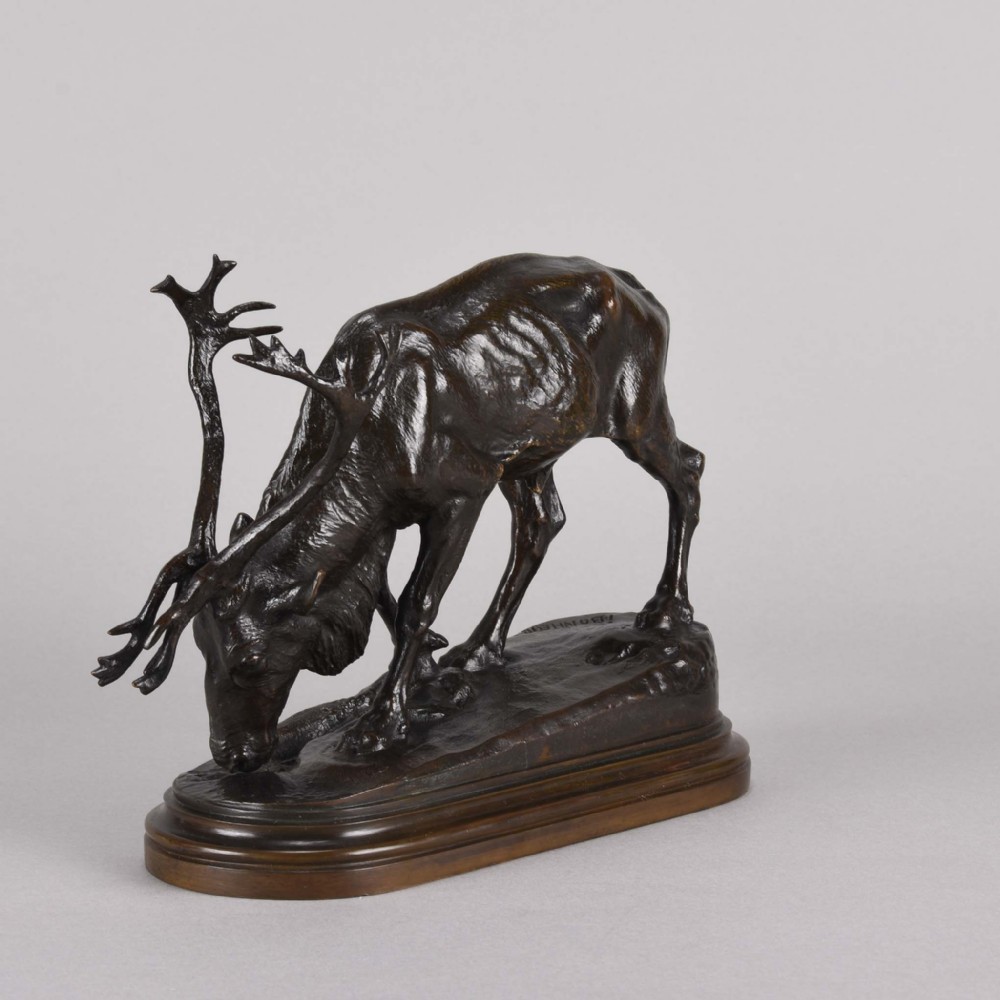
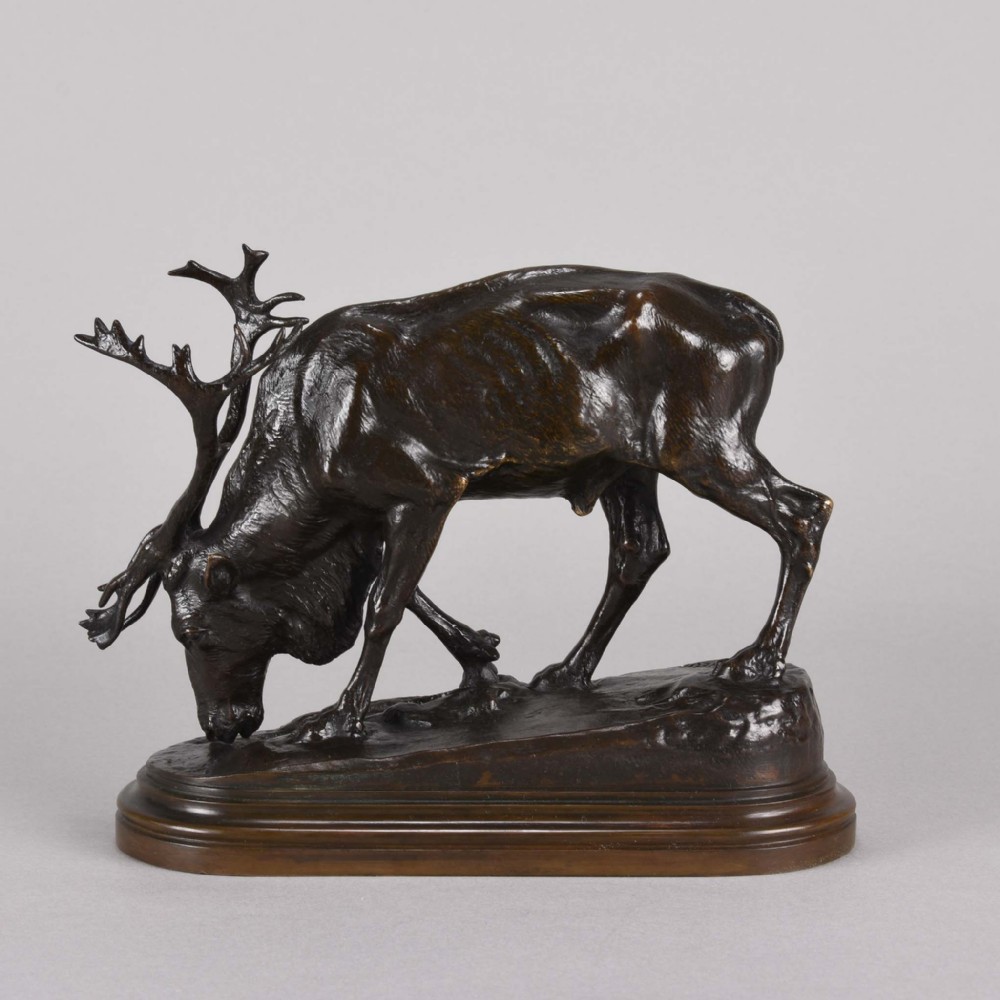
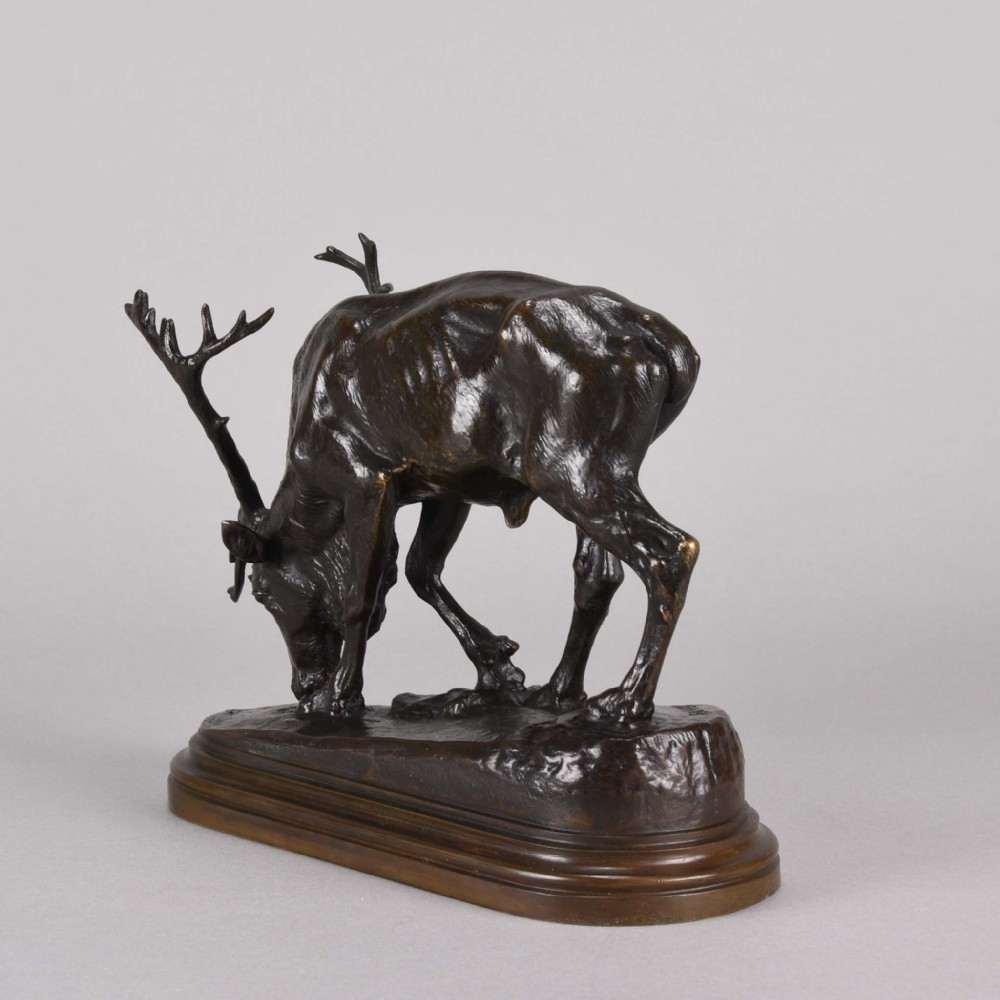
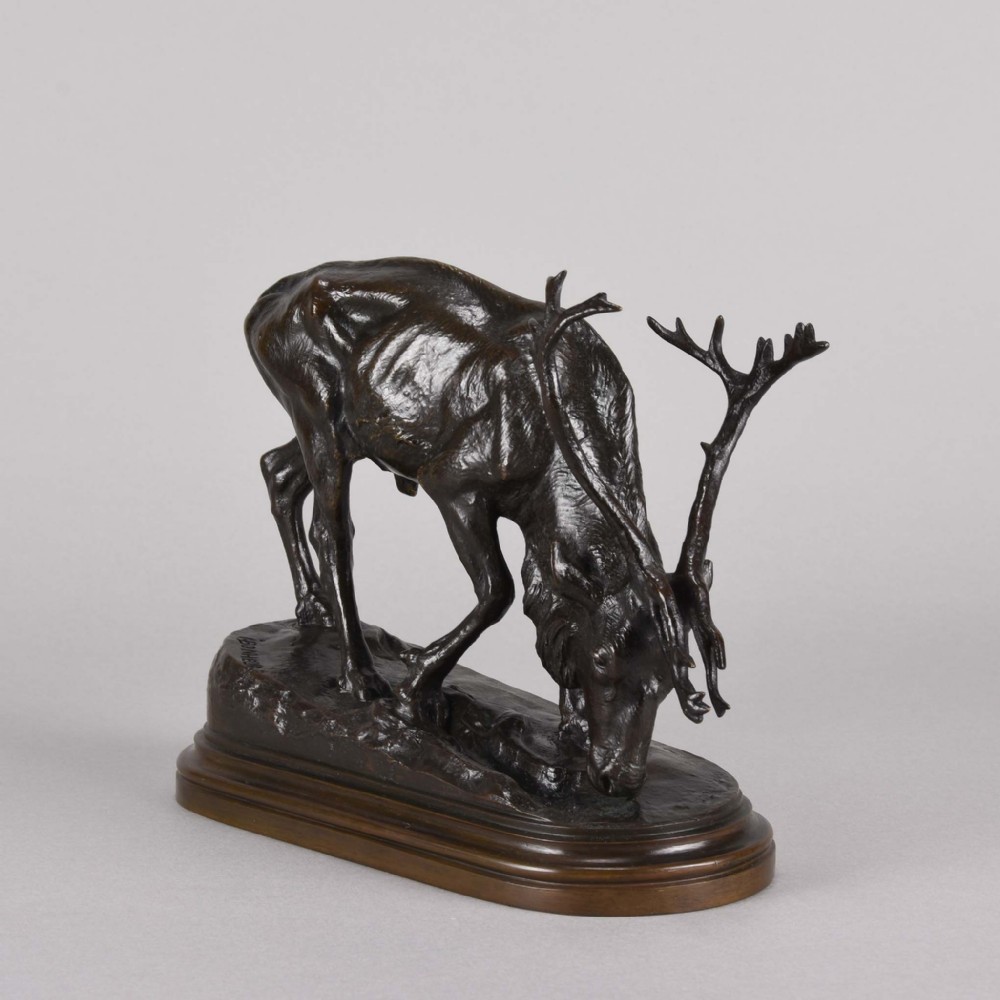
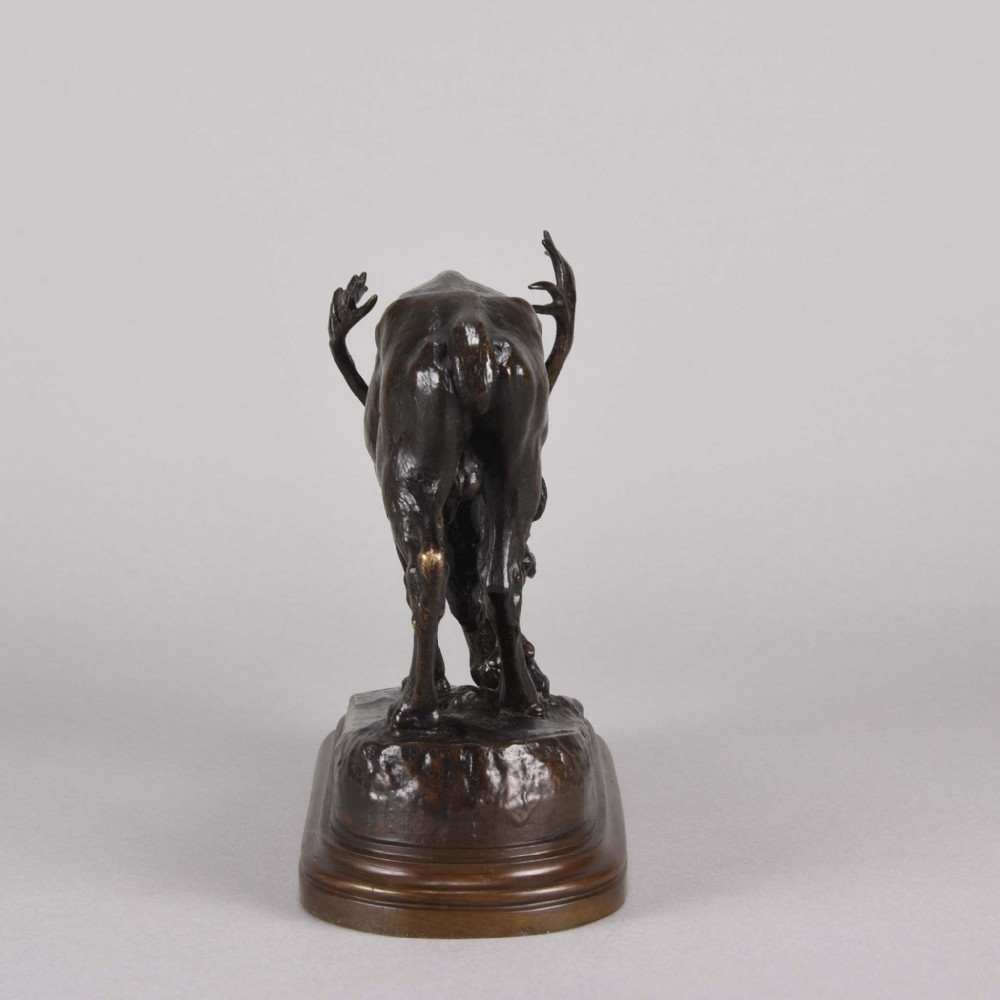
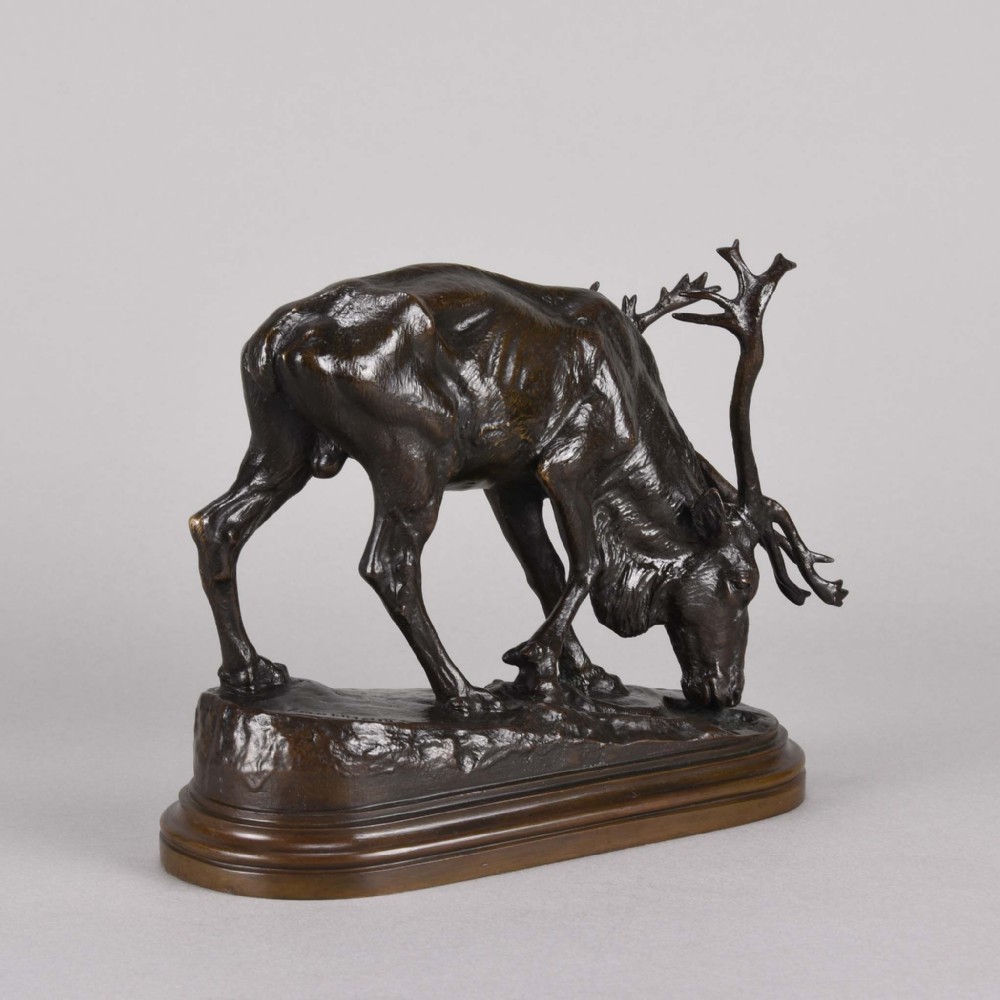
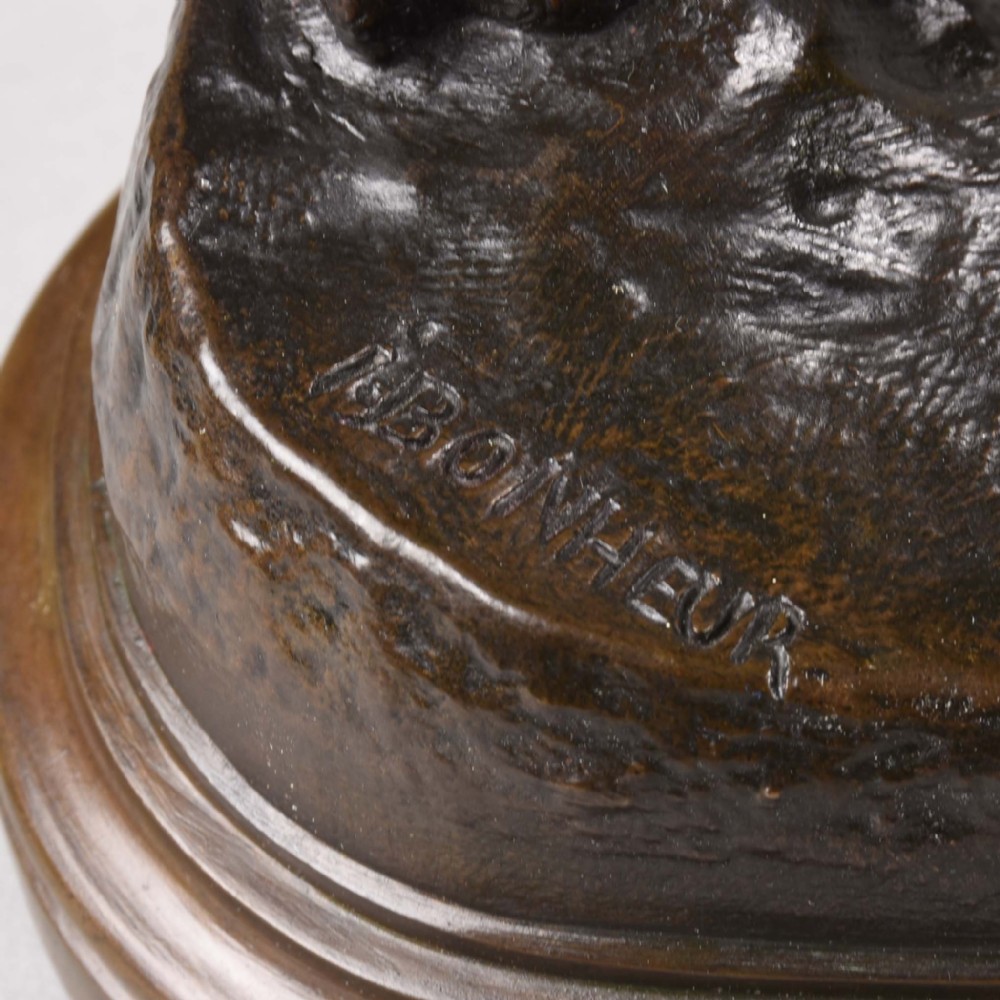
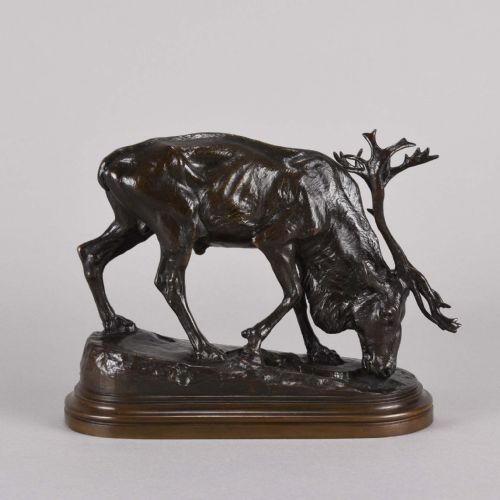
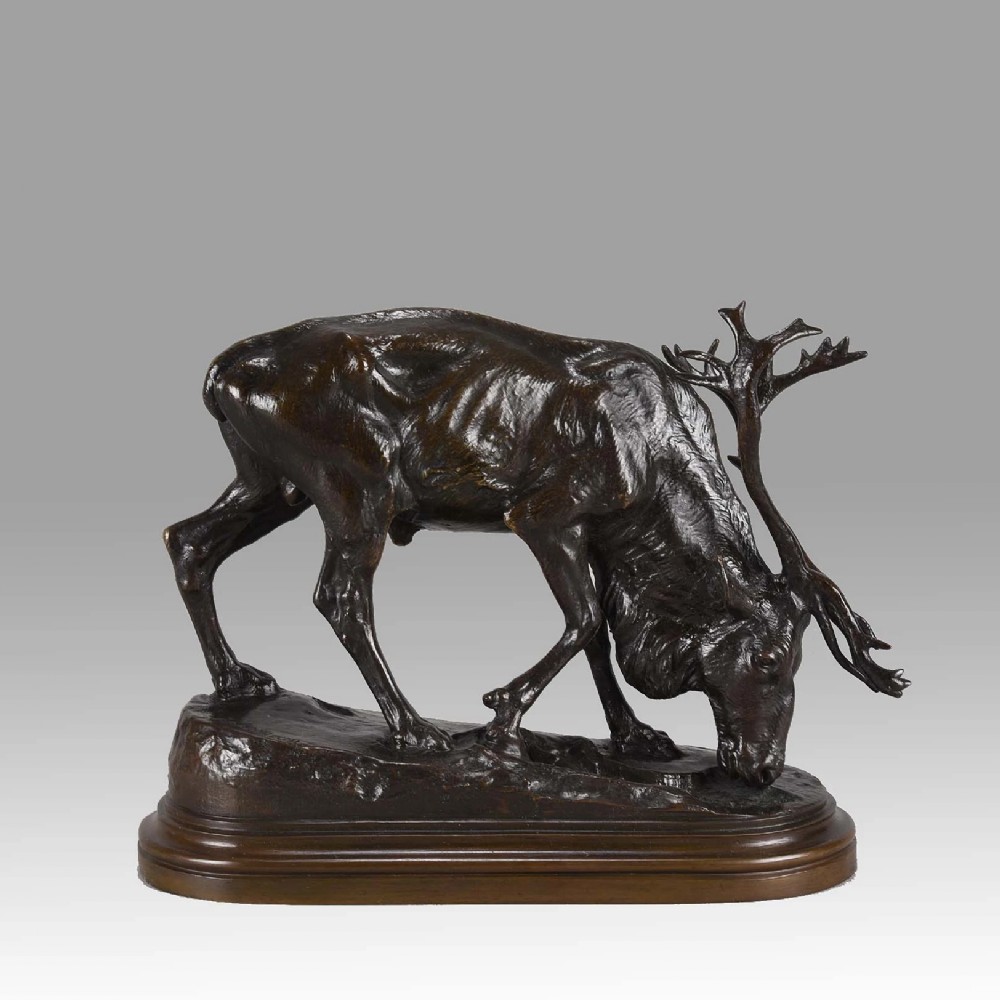
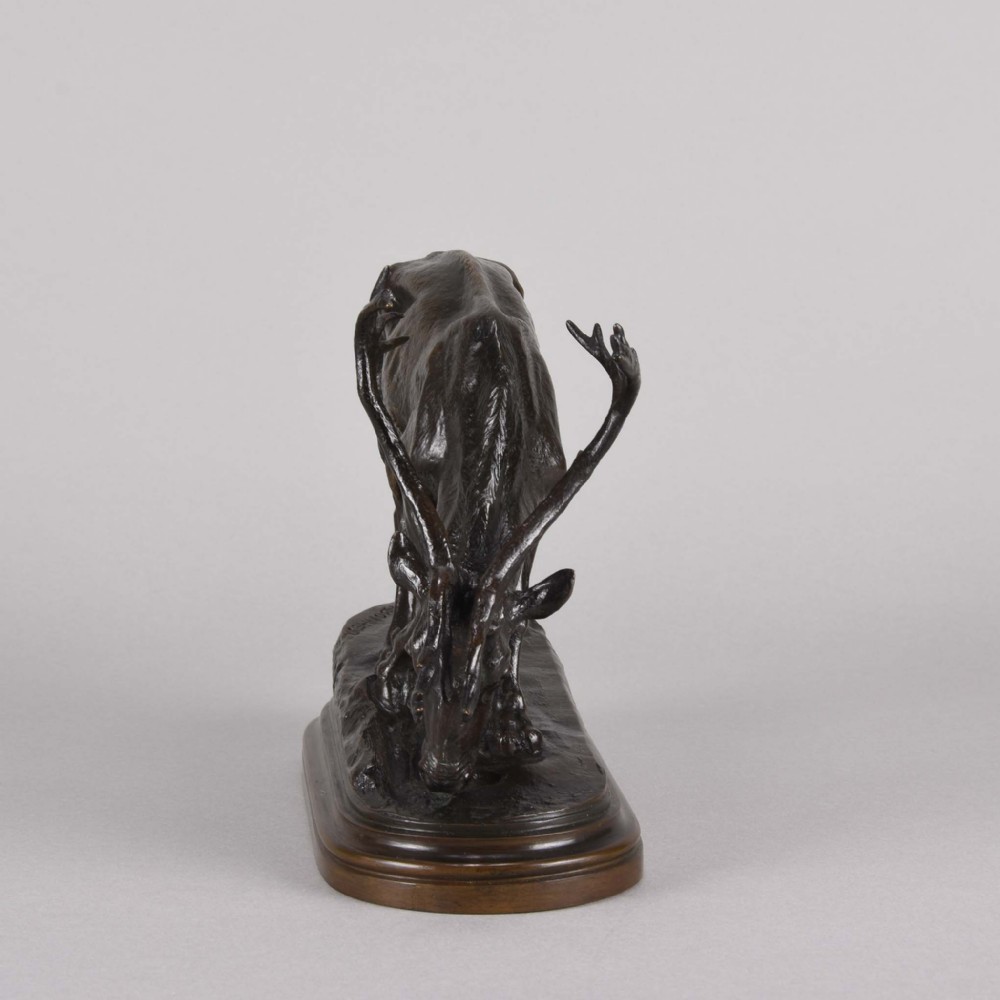
Excellent late 19th Century animalier bronze study of a feeding reindeer with rich brown colour and very fine hand chased and etched surface detail, raised on a stepped naturalistic base, stamped with Peyrol foundry mark and signed Isidore Bonheur

ADDITIONAL INFORMATION

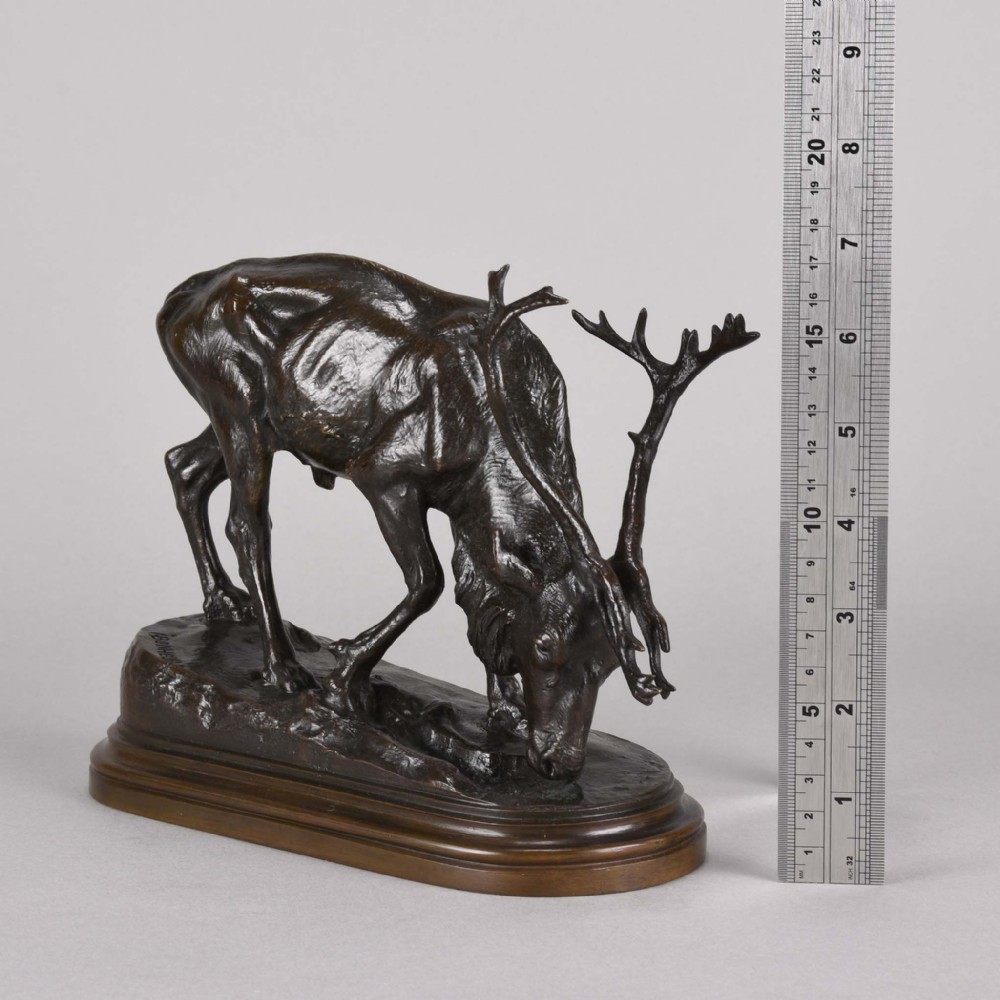
Height: 16 cm

Width: 22 cm

Condition: Excellent Original Condition

Foundry: Peyrol

Circa: 1880

Materials: Bronze

SKU: 8211

DESCRIPTION

Isidore Bonheur

Isidore Bonheur, born in Bordeaux May 15 1827. Isidore was the third child of Christine Dorotheé Sophie Marquis (1797–1833), a musician, and Oscar-Raymond Bonheur (1796–1849) (a landscape and portrait painter and an early adherent of Saint-Simonianism, a Christian-socialist sect that promoted the education of women alongside men). Isidore was the brother of Auguste Bonheur and Rosa Bonheur (1822–1899). "It is I who first gave modelling and sculpture lessons to my brother Isidore" (Rosa Bonheur)

In Bordeaux his father had been friends with Francisco Goya who was living there in Exile. In 1828 Bonheur moved to Paris with his mother, brothers and sister, his father having gone ahead of them to establish a residence and income.

He studied painting at first, enrolling in 1849 at the École nationale supérieure des Beaux-Arts, though he made his debut at the Salon (Paris) in 1848 (a Cavalier nègre attaqué par une lionne, plaster, and a drawing of the same subject) and exhibited regularly until 1899. He won medals in 1859, 1865, 1869, took part in the Exposition Universelle (1855), exhibited in London at the Royal Academy of Arts in the 1870s, where he gained great success with equine figures and groups, and won the coveted Médaille d'Or (gold medal) with a sculpture entitled Cavalier Louis XV at the Exposition Universelle (1889). He won a silver medal at l'Exposition de Madrid in 1892, a gold medal at the Exposition Internationale d'Anvers (1894).

Also in 1894, Bonheur was awarded the status of Knight in the Order of the Immaculate Conception of Vila Viçosa (Cavaleiro da Ordem de Nossa Senhora da Conceição de Vila Viçosa), Portugal. In 1895 he was named Chevalier (Knight) of the Order of Isabella the Catholic, Spain. He was named Chevalier (Knight) of the Legion of Honour on 7 May 1895, decorated 24 May, and breveted 18 September 1895, Paris.

He had given up painting in favor of sculpture early on in his career, though he was noted primarily for his small animalier groups. His studio (atelier) was located at l'Impasse du Moulin Joly, on the corner of rue du Faubourg-du-Temple in Paris.

Isidore Bonheur found a greater market for his work in the mid-nineteenth century in England versus France. In 1870 he gained representation at the Royal Academy and produced a variety of work that catered to English collectors.

Many of his bronzes were edited by the founder Hippolyte Peyrol, his brother in law whom was married to his younger sister Juliette. The Peyrol casts for both Rosa and Isidore Bonheur are exceptionally well executed, which suggests a strong working relationship between the founder and sculptor. There is little doubt that Isidore Bonheur was an acute observer of nature; his animals were not anthropomorphised, but modelled to catch movement or posture characteristic of the particular species. He achieved this most successfully with his sculptures of horses, which are usually depicted as relaxed rather than spirited, and which are among his most renowned works.

Physical Dimensions
Height
16cm (6.30")
Width
22cm (8.66")
Declaration

Hickmet Fine Arts has dated this Antique Bronze Reindeer Sculpture to the 1880s.
Reference Numbers
Sellingantiques Reference
SA973173
Dealers Internal Reference
8211
Dealers Notes

Please contact us for a shipping quotes.

Viewing can be arranged at our gallery and everything sold by Hickmet Fine Arts comes with a full certificate of Authenticity and Valuation.

If you have enjoyed seeing this item and wish to see more quality pieces please visit our website www.hickmet.com

Description
Excellent late 19th Century animalier bronze study of a feeding reindeer with rich brown colour and very fine hand chased and etched surface detail, raised on a stepped naturalistic base, stamped with Peyrol foundry mark and signed Isidore Bonheur
fig 1. A 19th-century dark brown patinated bronze sculpture depicting a grazing reindeer with branching antlers on an oval naturalistic base.
fig 1. 19th Century Animalier Bronze Sculpture Entitled "Reindeer" by Isidore Bonheur

ADDITIONAL INFORMATION

Height: 16 cm

Width: 22 cm

Condition: Excellent Original Condition

Foundry: Peyrol
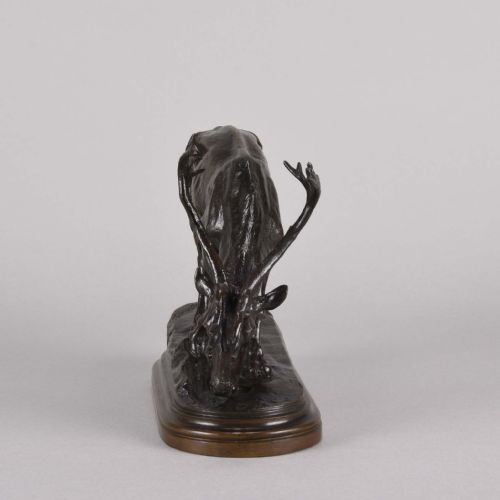
fig 2. A 19th-century dark brown patinated bronze sculpture depicting a grazing reindeer with branching antlers on an oval naturalistic base.
fig 2. 19th Century Animalier Bronze Sculpture Entitled "Reindeer" by Isidore Bonheur

Circa: 1880

Materials: Bronze

SKU: 8211

DESCRIPTION

Isidore Bonheur

Isidore Bonheur, born in Bordeaux May 15 1827. Isidore was the third child of Christine Dorotheé Sophie Marquis (1797–1833), a musician, and Oscar-Raymond Bonheur (1796–1849) (a landscape and portrait painter and an early adherent of Saint-Simonianism, a Christian-socialist sect that promoted the education of women alongside men). Isidore was the brother of Auguste Bonheur and Rosa Bonheur (1822–1899). "It is I who first gave modelling and sculpture lessons to my brother Isidore" (Rosa Bonheur)

In Bordeaux his father had been friends with Francisco Goya who was living there in Exile.
In 1828 Bonheur moved to Paris with his mother, brothers and sister, his father having gone ahead of them to establish a residence and income.
Hickmet Fine Arts
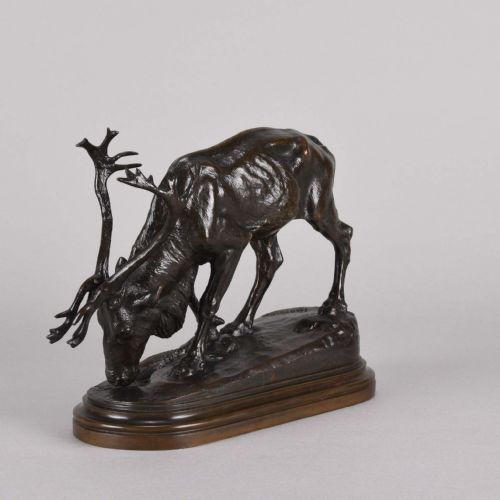
fig 3. A 19th-century dark brown patinated bronze sculpture depicting a grazing reindeer with branching antlers on an oval naturalistic base.
fig 3. 19th Century Animalier Bronze Sculpture Entitled "Reindeer" by Isidore Bonheur

He studied painting at first, enrolling in 1849 at the École nationale supérieure des Beaux-Arts, though he made his debut at the Salon (Paris) in 1848 (a Cavalier nègre attaqué par une lionne, plaster, and a drawing of the same subject) and exhibited regularly until 1899. He won medals in 1859, 1865, 1869, took part in the Exposition Universelle (1855), exhibited in London at the Royal Academy of Arts in the 1870s, where he gained great success with equine figures and groups, and won the coveted Médaille d'Or (gold medal) with a sculpture entitled Cavalier Louis XV at the Exposition Universelle (1889). He won a silver medal at l'Exposition de Madrid in 1892, a gold medal at the Exposition Internationale d'Anvers (1894).
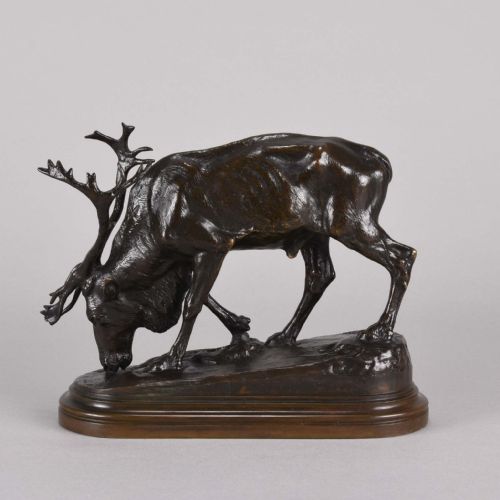
fig 4. A 19th-century dark brown patinated bronze sculpture depicting a grazing reindeer with branching antlers on an oval naturalistic base.
fig 4. 19th Century Animalier Bronze Sculpture Entitled "Reindeer" by Isidore Bonheur

Also in 1894, Bonheur was awarded the status of Knight in the Order of the Immaculate Conception of Vila Viçosa (Cavaleiro da Ordem de Nossa Senhora da Conceição de Vila Viçosa), Portugal. In 1895 he was named Chevalier (Knight) of the Order of Isabella the Catholic, Spain. He was named Chevalier (Knight) of the Legion of Honour on 7 May 1895, decorated 24 May, and breveted 18 September 1895, Paris.
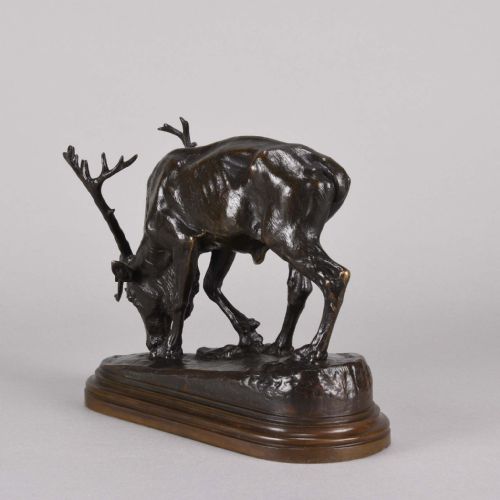
fig 5. A 19th-century dark brown patinated bronze sculpture depicting a grazing reindeer with branching antlers on an oval naturalistic base.
fig 5. 19th Century Animalier Bronze Sculpture Entitled "Reindeer" by Isidore Bonheur

He had given up painting in favor of sculpture early on in his career, though he was noted primarily for his small animalier groups. His studio (atelier) was located at l'Impasse du Moulin Joly, on the corner of rue du Faubourg-du-Temple in Paris.
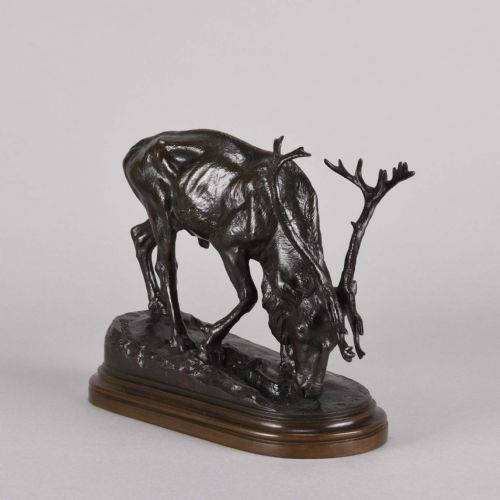
fig 6. A 19th-century dark brown patinated bronze sculpture depicting a grazing reindeer with branching antlers on an oval naturalistic base.
fig 6. 19th Century Animalier Bronze Sculpture Entitled "Reindeer" by Isidore Bonheur

Isidore Bonheur found a greater market for his work in the mid-nineteenth century in England versus France. In 1870 he gained representation at the Royal Academy and produced a variety of work that catered to English collectors.
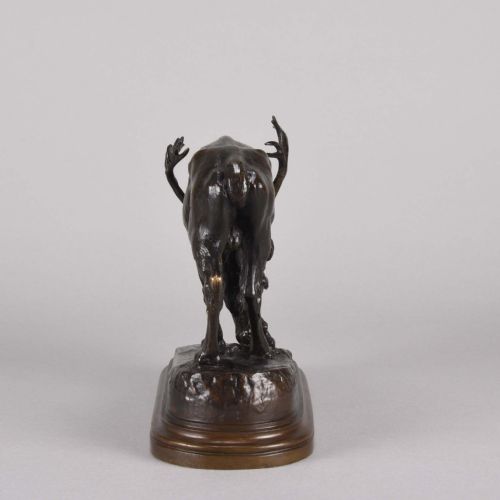
fig 7. A 19th-century dark brown patinated bronze sculpture depicting a grazing reindeer with branching antlers on an oval naturalistic base.
fig 7. 19th Century Animalier Bronze Sculpture Entitled "Reindeer" by Isidore Bonheur

Many of his bronzes were edited by the founder Hippolyte Peyrol, his brother in law whom was married to his younger sister Juliette. The Peyrol casts for both Rosa and Isidore Bonheur are exceptionally well executed, which suggests a strong working relationship between the founder and sculptor. There is little doubt that Isidore Bonheur was an acute observer of nature; his animals were not anthropomorphised, but modelled to catch movement or posture characteristic of the particular species. He achieved this most successfully with his sculptures of horses, which are usually depicted as relaxed rather than spirited, and which are among his most renowned works.

Height
16cm (6.30")
Width
22cm (8.66")
Date of Manufacture

Hickmet Fine Arts has dated this Antique Bronze Reindeer Sculpture to the 1880s.

Reference Numbers
Sellingantiques Ref
SA973173
Dealers Internal Ref
8211
Hickmet Fine Arts
Hickmet Fine Arts
Sellingantiques verified Since Apr 2012

Established in 1936, hickmet fine arts is an international family run antiques business

Dealer Profile

You can view the stock and full dealer information on the Hickmet Fine Arts Profile Page

Trade Associations

Hickmet Fine Arts is a registered member of LAPADA  BADA  CINOA
PDF SHARE
SAVE
A 19th-century dark brown patinated bronze sculpture depicting a grazing reindeer with branching antlers on an oval naturalistic base.
1 / 11
Archive I A 19th-century dark brown patinated bronze sculpture depicting a grazing reindeer with branching antlers on an oval naturalistic base.

19th Century Animalier Bronze Sculpture entitled "Reindeer" by Isidore Bonheur
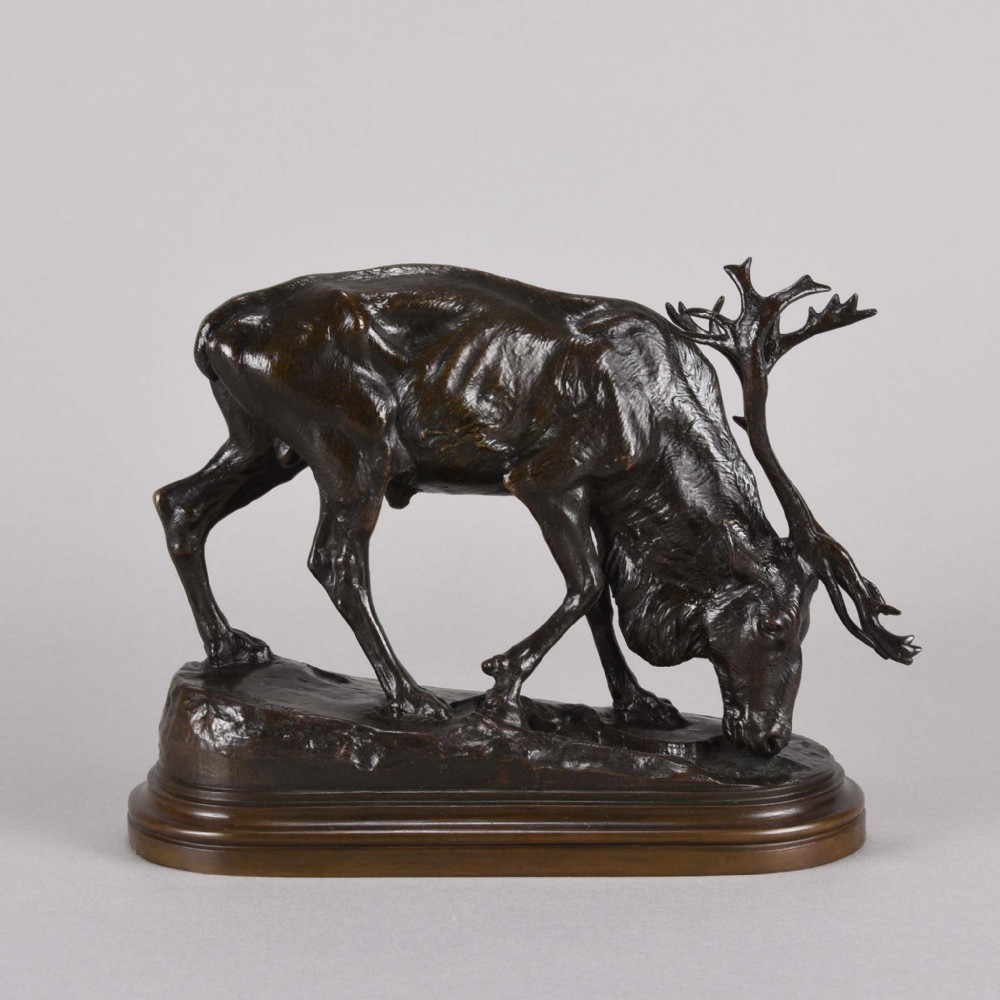
Archive II A 19th-century dark brown patinated bronze sculpture depicting a grazing reindeer with branching antlers on an oval naturalistic base. View II
Archive III A 19th-century dark brown patinated bronze sculpture depicting a grazing reindeer with branching antlers on an oval naturalistic base. View III
Archive IV A 19th-century dark brown patinated bronze sculpture depicting a grazing reindeer with branching antlers on an oval naturalistic base. View IV
Archive V A 19th-century dark brown patinated bronze sculpture depicting a grazing reindeer with branching antlers on an oval naturalistic base. View V
Archive VI A 19th-century dark brown patinated bronze sculpture depicting a grazing reindeer with branching antlers on an oval naturalistic base. View VI
Archive VII A 19th-century dark brown patinated bronze sculpture depicting a grazing reindeer with branching antlers on an oval naturalistic base. View VII
Archive VIII A 19th-century dark brown patinated bronze sculpture depicting a grazing reindeer with branching antlers on an oval naturalistic base. View VIII
Archive IX A 19th-century dark brown patinated bronze sculpture depicting a grazing reindeer with branching antlers on an oval naturalistic base. View IX
Archive X A 19th-century dark brown patinated bronze sculpture depicting a grazing reindeer with branching antlers on an oval naturalistic base. View X
Archive XI A 19th-century dark brown patinated bronze sculpture depicting a grazing reindeer with branching antlers on an oval naturalistic base. View XI
FURTHER BROWSING

Visitors also looked at these ⇣

Enlarged Archival View
Telephone 07971 850405
Location
Gallery Eighty Five
85 Portobello Road
London
W11 2QB
United Kingdom
Verified Since Apr 2012
Items For Sale 112
Items Sold 6
Hickmet Fine Arts
Hickmet Fine Arts
Verified Since Apr 2012
View Dealer Info
Location: Gallery Eighty Five, 85 Portobello Road, London, W11 2QB, United Kingdom
Verified
Apr 2012
For Sale
112
Sold
6
A 19th-century dark brown patinated bronze sculpture depicting a grazing reindeer with branching antlers on an oval naturalistic base.
19th Century Animalier Bronze Sculpture entitled "Reindeer" by Isidore Bonheur
Ref: SA973173
A 19th-century dark brown patinated bronze sculpture depicting a grazing reindeer with branching antlers on an oval naturalistic base.
Detail View 1
Detail View 2
Detail View 3
Detail View 4
Detail View 5
Detail View 6
Detail View 7
Detail View 8
Detail View 9
Detail View 10
Archival Detail
Every single antique dealer on our platform is individually approved by our internal team. We verify their professional trade history, ethical standards, and photographic quality to ensure a secure, high-standard buying environment. Upon joining, every dealer agrees to a strict 9-point code of conduct. While issues can occasionally arise, our dealers typically resolve them swiftly and directly with the buyer. In fact, since our founding in 2002, Sellingantiques has only had to step in to help resolve an issue on roughly five occasions—a true testament to the quality of our dealers and their dedication to your happiness.
Our dealers are highly experienced in packing and shipping fragile, high-value antiques. Because you are in direct contact with the dealer, you will be able to easily go through all available shipping and insurance options together to ensure your item arrives safely.
Antiques are the ultimate green purchase. By choosing historical pieces over newly manufactured goods, you completely eliminate the carbon footprint of modern mass production while preserving exceptional, timeless craftsmanship.

The Animalier movement emerged in 19th-century France, focusing on the realistic depiction of animals in bronze and other media, popularized by sculptors including Antoine-Louis Barye and Isidore Bonheur.

These sculptures were cast using the lost-wax or sand-casting methods, followed by hand-chasing and the application of a chemical patina to achieve dark brown tones.

Authentic pieces display foundry stamps, sculptor signatures cast directly into the base, detailed chasing work, and natural wear to the patina rather than painted surface finishes.

An animalier bronze sculpture can be positioned on a library desk, mantelpiece, or sideboard alongside natural materials such as stone and dark timber.

Dust regularly using a soft microfibre cloth and apply a light coat of clear microcrystalline wax periodically to protect the patina from oxidisation.
items
Add keywords to the filter
Price
£100
£250000
Era
Movements
Material
Origin
Stock Location
Freshness
Online Payments
Categories