23,004  PAGES BROWSED TODAY PAGES TODAY 36  ANTIQUES UPLOADED TODAY NEW ARRIVALS
ID #SA837510
FOR SALE
£1,200
Email
Save
Edward John Niemann, 1813 - 1876 Landscape in the Trossachs, Stirlingshire, Scotland with Figures in the Foreground
Artware Fineart
for sale €1,404     $1,524
£1,200

Artware Fineart

Sellingantiques Verified Since Sep 2008
View Dealers Stock Page
Id #SA837510
PDF SHARE
SAVE

Edward John Niemann, 1813 - 1876 Landscape in the Trossachs, Stirlingshire, Scotland with Figures in the Foreground

19th century
For Sale by Artware Fineart
Description

Edward John Niemann, 1813 - 1876

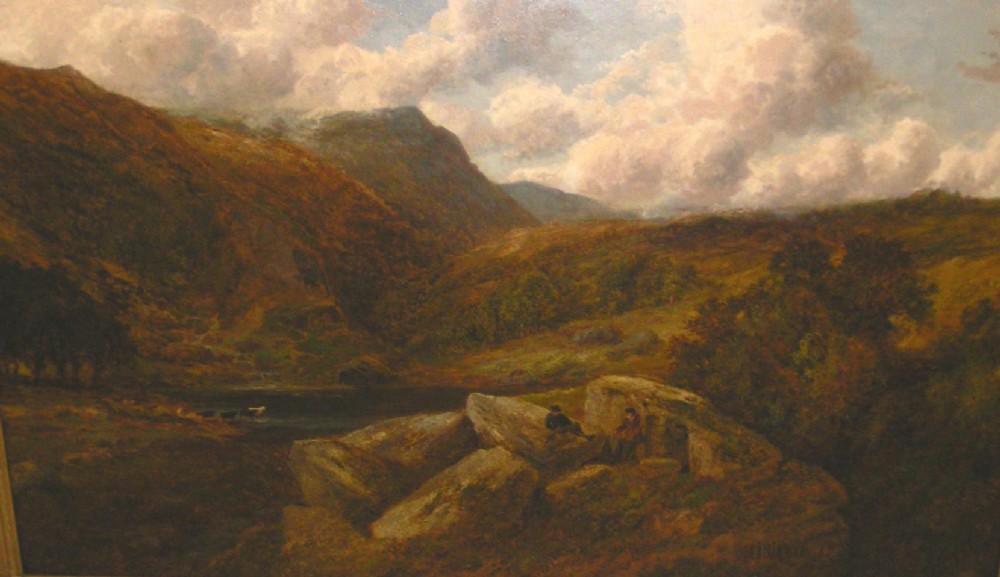
The Trossachs, Stirlingshire, Scotland with figures in the foreground

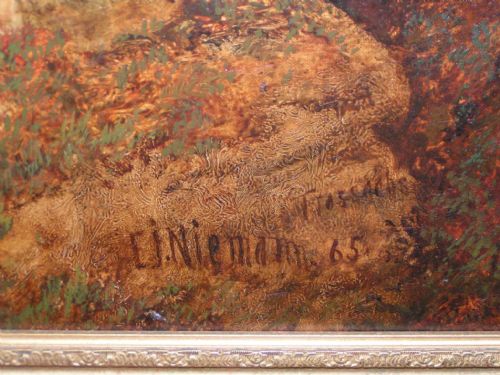
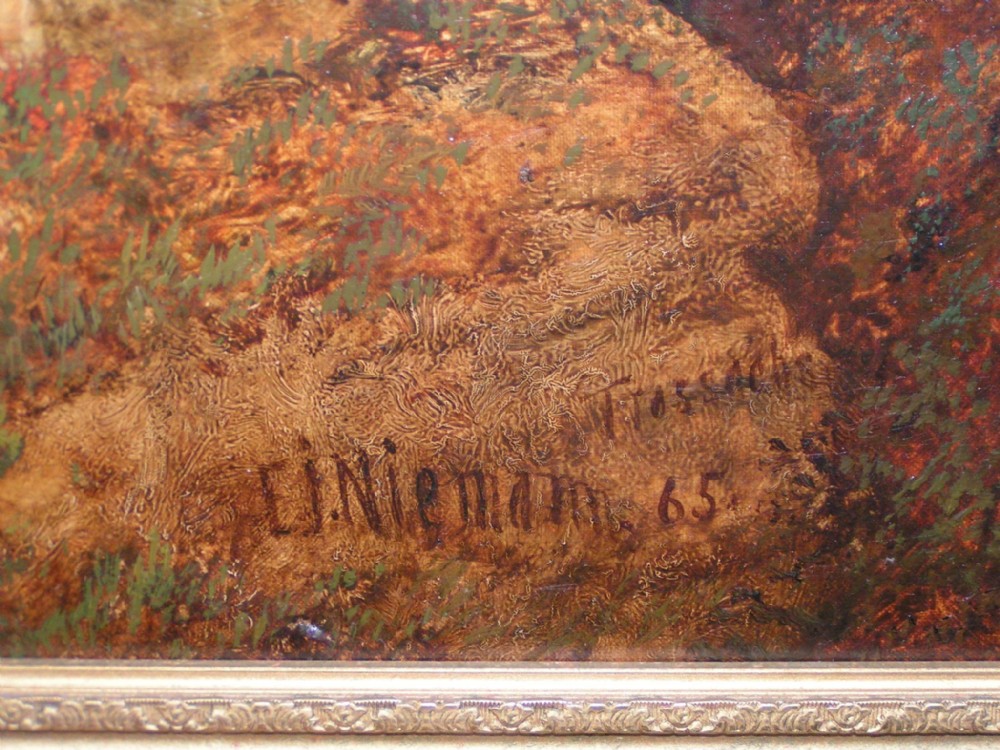
signed and dated " E J Neimann 1865"

oil on canvas

76.20 x 127 cm. (30 x 50 in.)

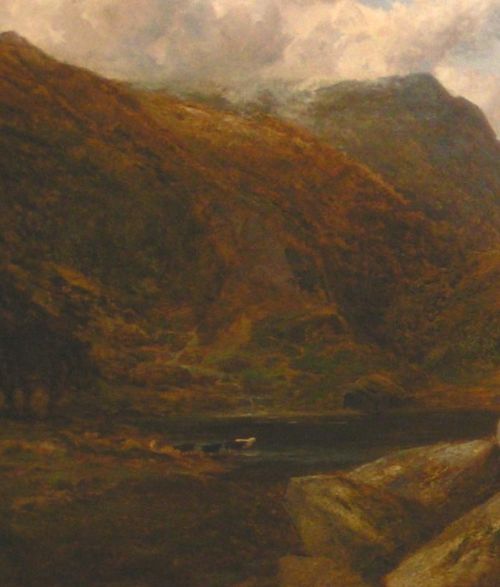
The Trossachs and Breadalbane mark the spot where the Highlands and Lowlands meet. Much of this picturesque area lies within the boundaries of Loch Lomond and The Trossachs National Park. The

Trossachs hills mark the dividing ‘Highland Line’ and, though its peaks may be humbler than those of its namesake, the Trossachs green uplands still dwarf the Lowland plain to the south.

The gateways to this startling landscape, rich in mythology and folklore, are the villages of Callander and Aberfoyle. Callander has an abundance of craft and woollen shops and the centre of the town cradles the memories and exploits of legendary Highland Rogue Rob Roy MacGregor, local hero and bandit.To the north of the town lies the less excitable, more tranquil hamlet of Balquhidder, where the
churchyard containing Rob Roy’s grave can be found, etched with the stirring epitaph “MacGregor Despite Them”. Above Aberfoyle the Queen Elizabeth Forest Park is a haven for walkers and trekkers, and the splendour of nearby Loch Katrine, the inspiration for Walter Scott’s Lady of the Lake and Rob Roy, can be enjoyed from the decks of the elegant Steam Ship Sir Walter Scott.
The Trossachs (Scottish Gaelic, Na Trosaichean) itself is a small woodland glen in the Stirling council area of Scotland. It lies between Ben An to the north and Ben Venue to the south, with Loch Katrine to the west and Loch Achray to the east. However, the name is used generally to refer to the wider area of wooded glens and braes with quiet lochs, lying to the east of Ben Lomond.
The scenic charms of this area came to popularity when Walter Scott extended his romantic portrayal of Scotland's past from border ballads to poems of a medieval past rich in chivalry and symbolism,

with his 1810 poem Lady of the Lake giving a roll call of Trossachs place names, the lady herself being found on Loch Katrine. This was followed up by his 1817 historical novel Rob Roy romanticising the
outlaw cattle thief Raibert Ruadh born by Loch Katrine and buried at nearby Balquhidder. Scotland's only lake, the Lake of Menteith, lies about 6 miles (10 km) to the south east of the glen, on the edge of

the Trossachs area.

The effect of this romantic literature was to draw tourists to the area and make the Trossachs Hotel well known. Loch Katrine itself changed in 1859 when a dam was built at the eastern end and

connecting aqueducts built to bring a new main water supply to Glasgow. Queen Victoria had a holiday house built overlooking the loch. A steamer service started, and the 1900 SS Sir Walter Scott is

still going, giving visitors a delightful way to enjoy the scenery while adding to the picturesque view. The area is now in the Loch Lomond and the Trossachs National Park, remaining popular with

walkers and cyclists, and for the motorist the winding roads have a certain charm.

Artist Biography

Edmund John Niemann (1813–1876) was a prolific and highly successful British landscape artist working mostly in oils. Nine of his paintings are held in the Wolverhampton Art Gallery.Niemann was born in Islington, London in 1813. His father, John Diedrich Niemann, was a native of Minden, Westphalia and was a member ofLloyd's, working in the City of London. As a young man, Edmund was employed as a clerk at Lloyd's, but he decided to devote himself to art and in 1839 settled in High Wycombe, Buckinghamshire, mostly painting out of doors. Though he especially enjoyed painting the scenery of theThames and of the River Swale, near Richmond in Yorkshire, many other areas of the British Isles are covered in the corpus of his work.

Between 1844 and 1872, he exhibited paintings at a wide range of prestigious gallerie

Physical Dimensions
Height
76cm (29.92")
Width
127cm (50.00")
Depth
2cm (0.79")
Declaration

Artware Fineart has dated this Victorian Scottish Landscape Painting to the 19th Century.

Reference Numbers
Sellingantiques Reference
SA837510
Dealers Internal Reference
3044
Description
Edward John Niemann, 1813 - 1876

The Trossachs, Stirlingshire, Scotland with figures in the foreground

signed and dated " E J Neimann 1865"

oil on canvas

76.20 x 127 cm. (30 x 50 in.)

The Trossachs and Breadalbane mark the spot where the Highlands and Lowlands meet.

Much of this picturesque area lies within the boundaries of Loch Lomond and The Trossachs National Park.
Artware Fineart

The

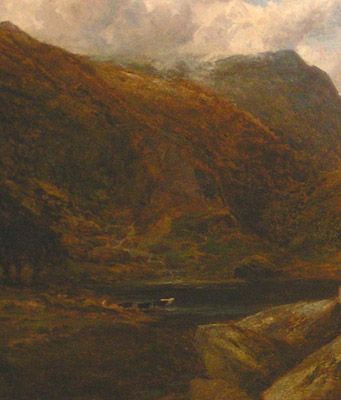
fig 1. A nineteenth-century Victorian oil painting depicting a rugged Scottish mountain landscape in the Trossachs with cloud formations and foreground figures.
fig 1. Edward John Niemann, 1813 - 1876 Landscape in the Trossachs, Stirlingshire, Scotland with Figures in the Foreground

Trossachs hills mark the dividing ‘Highland Line’ and, though its peaks may be humbler than those of its namesake, the Trossachs green uplands still dwarf the Lowland plain to the south.

The gateways to this startling landscape, rich in mythology and folklore, are the villages of Callander and Aberfoyle. Callander has an abundance of craft and woollen shops and the centre of the town cradles the memories and exploits of legendary Highland Rogue Rob Roy MacGregor, local hero and bandit.To the north of the town lies the less excitable, more tranquil hamlet of Balquhidder, where the

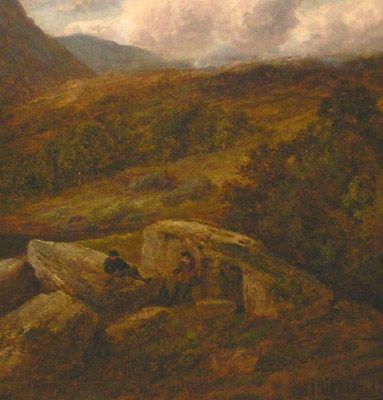
fig 2. A nineteenth-century Victorian oil painting depicting a rugged Scottish mountain landscape in the Trossachs with cloud formations and foreground figures.
fig 2. Edward John Niemann, 1813 - 1876 Landscape in the Trossachs, Stirlingshire, Scotland with Figures in the Foreground

churchyard containing Rob Roy’s grave can be found, etched with the stirring epitaph “MacGregor Despite Them”. Above Aberfoyle the Queen Elizabeth Forest Park is a haven for walkers and trekkers, and the splendour of nearby Loch Katrine, the inspiration for Walter Scott’s Lady of the Lake and Rob Roy, can be enjoyed from the decks of the elegant Steam Ship Sir Walter Scott.

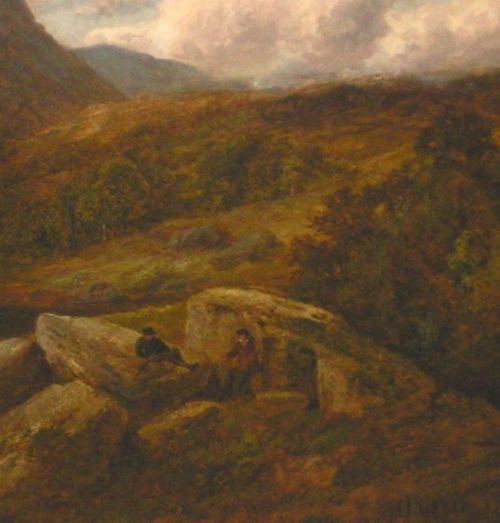
fig 3. A nineteenth-century Victorian oil painting depicting a rugged Scottish mountain landscape in the Trossachs with cloud formations and foreground figures.
fig 3. Edward John Niemann, 1813 - 1876 Landscape in the Trossachs, Stirlingshire, Scotland with Figures in the Foreground

The Trossachs (Scottish Gaelic, Na Trosaichean) itself is a small woodland glen in the Stirling council area of Scotland. It lies between Ben An to the north and Ben Venue to the south, with Loch Katrine to the west and Loch Achray to the east. However, the name is used generally to refer to the wider area of wooded glens and braes with quiet lochs, lying to the east of Ben Lomond.

fig 4. A nineteenth-century Victorian oil painting depicting a rugged Scottish mountain landscape in the Trossachs with cloud formations and foreground figures.
fig 4. Edward John Niemann, 1813 - 1876 Landscape in the Trossachs, Stirlingshire, Scotland with Figures in the Foreground

The scenic charms of this area came to popularity when Walter Scott extended his romantic portrayal of Scotland's past from border ballads to poems of a medieval past rich in chivalry and symbolism,

with his 1810 poem Lady of the Lake giving a roll call of Trossachs place names, the lady herself being found on Loch Katrine. This was followed up by his 1817 historical novel Rob Roy romanticising the

fig 5. A nineteenth-century Victorian oil painting depicting a rugged Scottish mountain landscape in the Trossachs with cloud formations and foreground figures.
fig 5. Edward John Niemann, 1813 - 1876 Landscape in the Trossachs, Stirlingshire, Scotland with Figures in the Foreground

outlaw cattle thief Raibert Ruadh born by Loch Katrine and buried at nearby Balquhidder. Scotland's only lake, the Lake of Menteith, lies about 6 miles (10 km) to the south east of the glen, on the edge of

the Trossachs area.

The effect of this romantic literature was to draw tourists to the area and make the Trossachs Hotel well known. Loch Katrine itself changed in 1859 when a dam was built at the eastern end and

connecting aqueducts built to bring a new main water supply to Glasgow. Queen Victoria had a holiday house built overlooking the loch. A steamer service started, and the 1900 SS Sir Walter Scott is

still going, giving visitors a delightful way to enjoy the scenery while adding to the picturesque view. The area is now in the Loch Lomond and the Trossachs National Park, remaining popular with

walkers and cyclists, and for the motorist the winding roads have a certain charm.

Artist Biography

Edmund John Niemann (1813–1876) was a prolific and highly successful British landscape artist working mostly in oils. Nine of his paintings are held in the Wolverhampton Art Gallery.Niemann was born in Islington, London in 1813. His father, John Diedrich Niemann, was a native of Minden, Westphalia and was a member ofLloyd's, working in the City of London. As a young man, Edmund was employed as a clerk at Lloyd's, but he decided to devote himself to art and in 1839 settled in High Wycombe, Buckinghamshire, mostly painting out of doors. Though he especially enjoyed painting the scenery of theThames and of the River Swale, near Richmond in Yorkshire, many other areas of the British Isles are covered in the corpus of his work.

Between 1844 and 1872, he exhibited paintings at a wide range of prestigious gallerie

Height
76cm (29.92")
Width
127cm (50.00")
Depth
2cm (0.79")
Date of Manufacture

Artware Fineart has dated this Victorian Scottish Landscape Painting to the 19th Century.

Reference Numbers
Sellingantiques Ref
SA837510
Dealers Internal Ref
3044
Artware Fineart
Sellingantiques verified Since Sep 2008
Dealer Profile

You can view the stock and full dealer information on the Artware Fineart Profile Page
PDF SHARE
SAVE
A nineteenth-century Victorian oil painting depicting a rugged Scottish mountain landscape in the Trossachs with cloud formations and foreground figures.
1 / 6
Archive I A nineteenth-century Victorian oil painting depicting a rugged Scottish mountain landscape in the Trossachs with cloud formations and foreground figures.

Edward John Niemann, 1813 - 1876 Landscape in the Trossachs, Stirlingshire, Scotland with Figures in the Foreground
Archive II A nineteenth-century Victorian oil painting depicting a rugged Scottish mountain landscape in the Trossachs with cloud formations and foreground figures. View II
Archive III A nineteenth-century Victorian oil painting depicting a rugged Scottish mountain landscape in the Trossachs with cloud formations and foreground figures. View III
Archive IV A nineteenth-century Victorian oil painting depicting a rugged Scottish mountain landscape in the Trossachs with cloud formations and foreground figures. View IV
Archive V A nineteenth-century Victorian oil painting depicting a rugged Scottish mountain landscape in the Trossachs with cloud formations and foreground figures. View V
Archive VI A nineteenth-century Victorian oil painting depicting a rugged Scottish mountain landscape in the Trossachs with cloud formations and foreground figures. View VI
FURTHER BROWSING

Visitors also looked at these ⇣

Enlarged Archival View
Telephone 07958 699 645
Location
18 La Gare
51 Surrey Row
London
SE1 0BZ
United Kingdom
Verified Since Sep 2008
Items For Sale 243
Items Sold 223
Artware Fineart
Verified Since Sep 2008
View Dealer Info
Location: 18 La Gare , 51 Surrey Row , London , SE1 0BZ , United Kingdom
Verified
Sep 2008
For Sale
243
Sold
223
A nineteenth-century Victorian oil painting depicting a rugged Scottish mountain landscape in the Trossachs with cloud formations and foreground figures.
Edward John Niemann, 1813 - 1876 Landscape in the Trossachs, Stirlingshire, Scotland with figures in the foreground
Ref: SA837510
A nineteenth-century Victorian oil painting depicting a rugged Scottish mountain landscape in the Trossachs with cloud formations and foreground figures.
Detail View 1
Detail View 2
Detail View 3
Detail View 4
Detail View 5
Archival Detail
Every single antique dealer on our platform is individually approved by our internal team. We verify their professional trade history, ethical standards, and photographic quality to ensure a secure, high-standard buying environment. Upon joining, every dealer agrees to a strict 9-point code of conduct. While issues can occasionally arise, our dealers typically resolve them swiftly and directly with the buyer. In fact, since our founding in 2002, Sellingantiques has only had to step in to help resolve an issue on roughly five occasions—a true testament to the quality of our dealers and their dedication to your happiness.
Our dealers are highly experienced in packing and shipping fragile, high-value antiques. Because you are in direct contact with the dealer, you will be able to easily go through all available shipping and insurance options together to ensure your item arrives safely.
Antiques are the ultimate green purchase. By choosing historical pieces over newly manufactured goods, you completely eliminate the carbon footprint of modern mass production while preserving exceptional, timeless craftsmanship.

Victorian Scottish landscape paintings are known for depicting dramatic natural scenery, rugged mountainous topography, and atmospheric weather conditions. Popularised in the nineteenth century, artists aimed to capture the natural light and sublime scale of the Scottish countryside using rich oil palettes.

Paintings from this era were predominantly executed in oil paints composed of natural mineral pigments and drying oils, applied onto hand-stretched linen or cotton canvas frames. Stretcher bars were typically constructed from softwood timber, often fitted with corner keys to maintain canvas tension over time.

Authentic works from this period usually demonstrate natural craquelure patterns across the paint surface consistent with aged oil layers. Inspection of the reverse side often reveals oxidized timber stretchers, period canvas stamps, hand-cut joinery, and natural darkening of the canvas fibers.

A traditional landscape painting can be placed above a fireplace mantel, integrated into a salon-style gallery wall, or paired alongside contemporary minimalism to create visual contrast. Displaying the painting within a dark timber panelled room or above a mahogany sideboard complements its historic aesthetic.

Antique oil paintings should be displayed away from direct sunlight, excessive heat sources, and fluctuating humidity levels to prevent paint cracking and canvas warping. Cleaning should be restricted to gentle surface dusting with a soft, dry brush, avoiding water, solvents, or household cleaning products.
items
Add keywords to the filter
Price
£100
£250000
Era
Movements
Material
Origin
Stock Location
Freshness
Online Payments
Categories