Artware Fineart has dated this Georgian Architectural Oil Painting to the 18th Century.
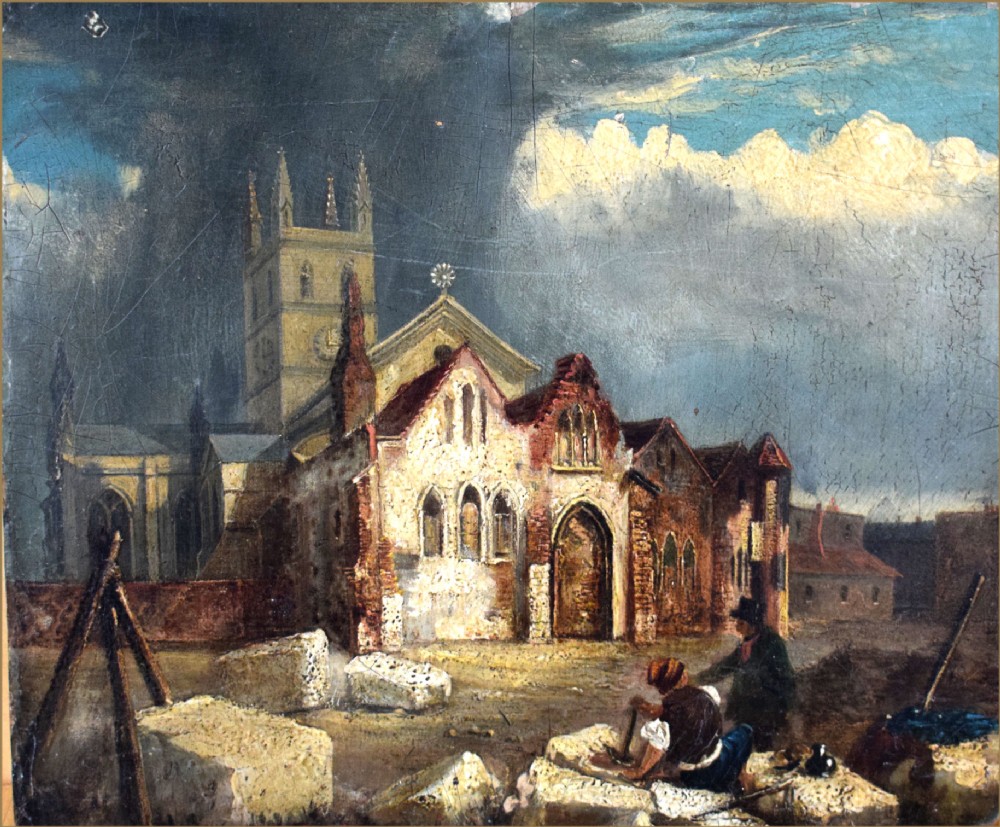
Cathedral & Collegiate Church of Southwark
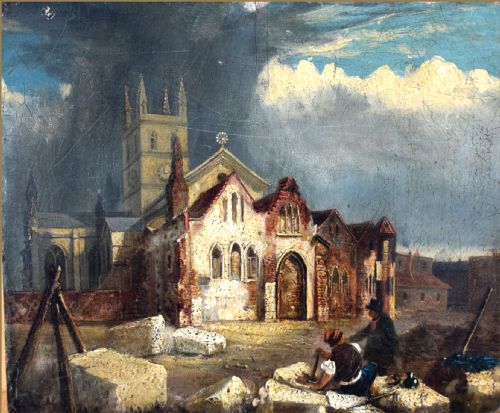
oil on board
11.3/4 x 13.1/4in. (29 x 34 cm.)
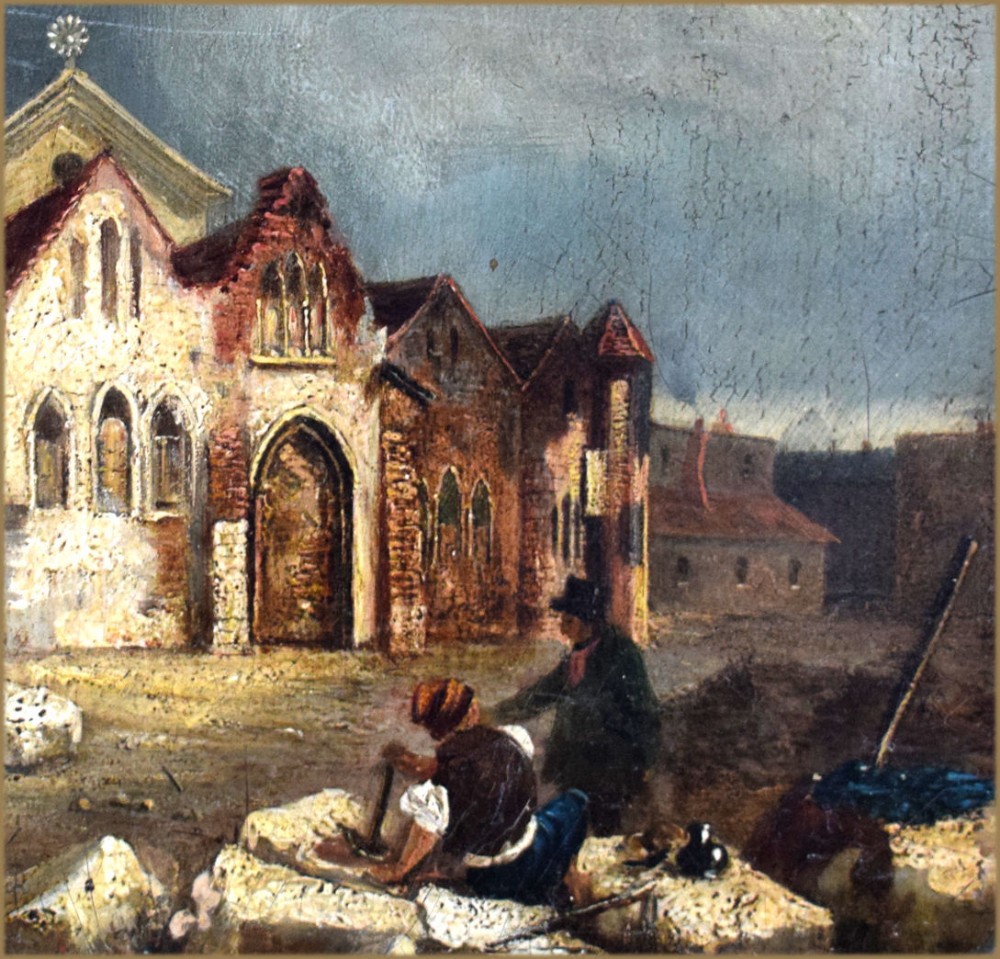
It is likely that this was painted circa 1832, since the choir has clearly already been restored (1822-24), and it looks like the transepts had been restored as well (1830), and both the Mary Magdalene Chapel (1820s) and the Bishop's Chapel (c.1830) have gone. It is possible that the surveyors in the picture are associated with the approach road to the new London Bridge, prior to the restoration of the retrochoir in 1832. with thanks to Dr Jackie Hall Southwark Cathedral Archaeologist
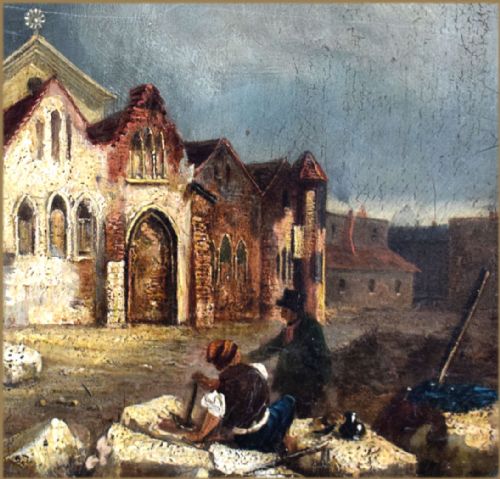
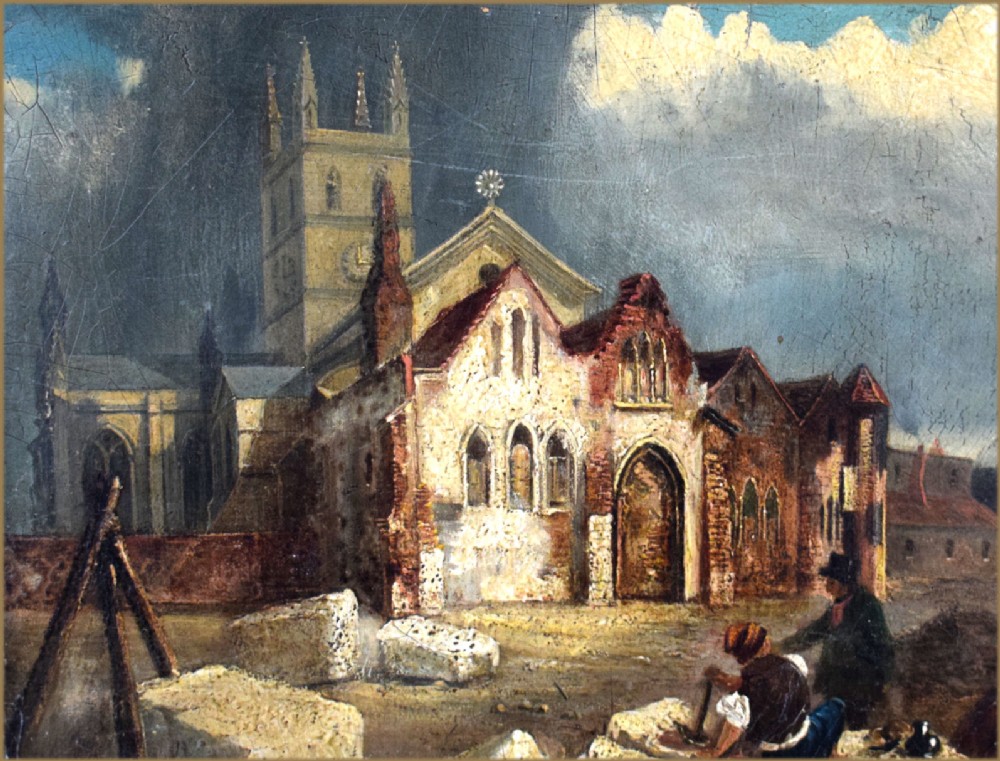
This view is taken from the east end of the Cathedral and shows the Cathedral before it was restored between 1818 and 1830 by George Gwilt jun, who was determined to return the church to its 13th century appearance. By the early 19th century the fabric of the church had fallen into disrepair. All the medieval furnishings were gone , and the interior was as Francis Bumpus later described it, "pewed and galleried to a fearful extent". Gwilt removed the early sixteenth century windows at the east end of the choir and, lacking firm evidence as to the original design, substituted an elevation of his own invention, with three lancet windows, and a circular one in the gable above. The transepts were restored, less sympathetically, by Robert Wallace. The Bishop’s Chapel and parochial chapel were removed, but plans for the demolition of the retrochoir were averted, and it was restored by Gwilt in 1832.
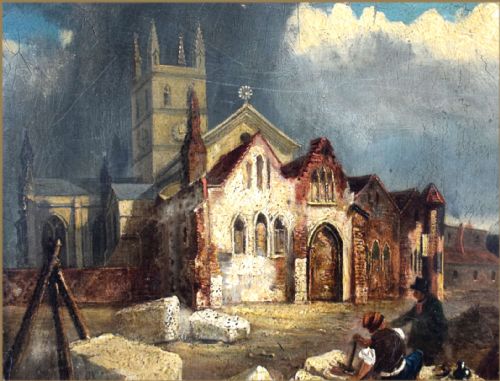
At a vestry meeting held in May 1831 it was decided to remove the nave roof, which had become unsafe, leaving the interior open to the weather, and to hold all future services in the choir and transepts. In 1839, the roofless nave was demolished to within seven feet of the ground,and rebuilt to a design by Henry Rose.The new nave was at a higher level than the surviving mediaeval eastern part, and closed off from it by a glazed screen. It had a plaster vault carried on iron columns, and a wooden gallery around three sides. It was widely criticised, notably by Pugin who wrote "It is bad enough to see such an erection spring up at all, but when a venerable building is demolished to make way for it, the case is quite intolerable."On the initiative of Anthony Thorold, Bishop of Rochester, the nave was once again rebuilt between 1890 and 1897[21] by Arthur Blomfield, in a manner intended to recreate its 13th century predecessor as accurately as possible, and to preserve the few surviving mediaeval fragments.The main railway viaduct connecting London Bridge station to Blackfriars, Cannon Street and Charing Cross stations passes only eighteen metres from the southeast corner of the cathedral, blocking the view from the south side. This was a compromise when the railway was extended along this viaduct in 1852; the alternative was to demolish the building completely to allow a more direct passage for the line.
The collegiate parish church of St Saviour was designated as a cathedral in 1905 when the Church of England Diocese of Southwark was created. The nearby early-18th-century church of St Thomas became the new cathedral's chapter-house.The cathedral stands in an area heavily damaged by German bombing during the Second World War. The total number of bombs dropped on Southwark between 7 October 1940 to 6 June 1941 alone was 1,651 High Explosive Bombs and 20 Parachute Mines.On 20 February 1941 it was reported (after being unrestricted by the ministry of information) the cathedral had been damaged by a bomb. Shrapnel damage is still visible on the outside of the building to this day.There are memorials to Isabella Gilmore and the victims of the Marchioness disaster, and monuments to Nelson Mandela and Desmond Tutu. In 2001 Mandela opened a new northern "cloister" on the site of the old monastic one
Artware Fineart has dated this Georgian Architectural Oil Painting to the 18th Century.
You can view the stock and full dealer information on the Artware Fineart Profile Page

Follower of William Marlow, 1740-1813 The Cathedral and Collegiate Church of St Saviour & St Mary Overie, Southwark, with Stone Masons & Surveyor in the Foreground