13,953  PAGES BROWSED TODAY PAGES TODAY 26  ANTIQUES UPLOADED TODAY NEW ARRIVALS
ID #SA496808
FOR SALE
£1,200
Email
Save
Follower of William Marlow, 1740-1813 The Cathedral and Collegiate Church of St Saviour & St Mary Overie, Southwark, with Stone Masons & Surveyor in the Foreground
Artware Fineart
for sale €1,404     $1,524
£1,200

Artware Fineart

Sellingantiques Verified Since Sep 2008
View Dealers Stock Page
Id #SA496808
PDF SHARE
SAVE

Follower of William Marlow, 1740-1813 The Cathedral and Collegiate Church of St Saviour & St Mary Overie, Southwark, with Stone Masons & Surveyor in the Foreground

18th century
For Sale by Artware Fineart
Description

Follower of William Marlow, 1740-1813

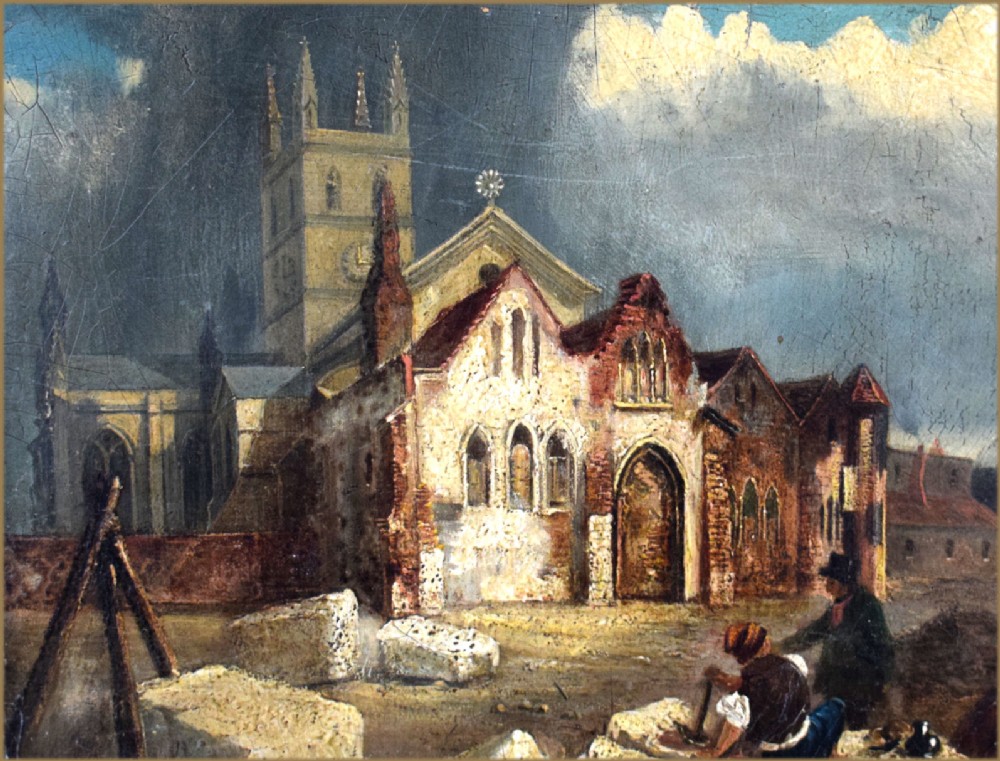
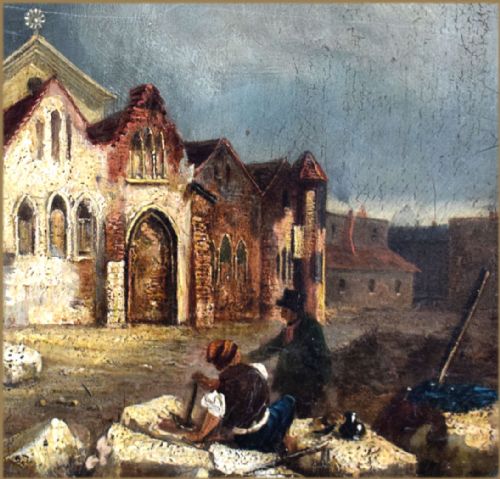
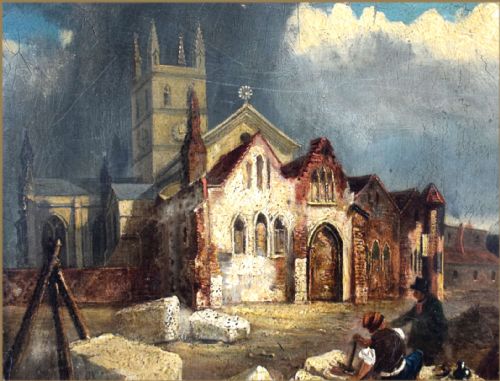
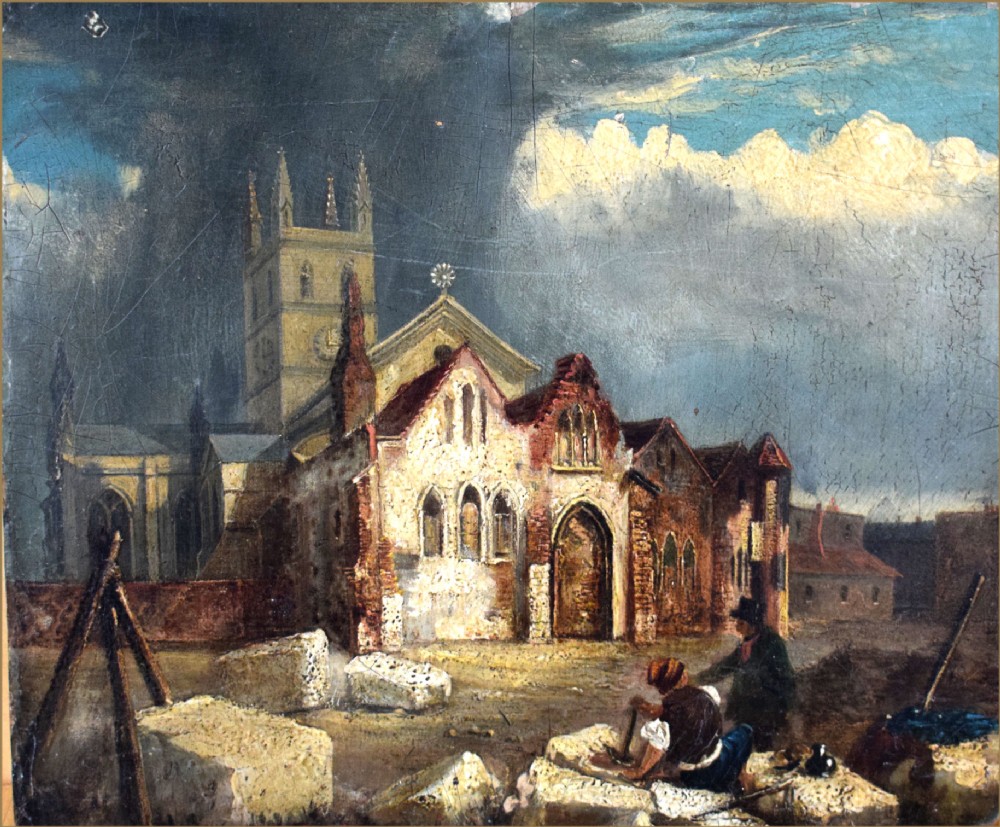
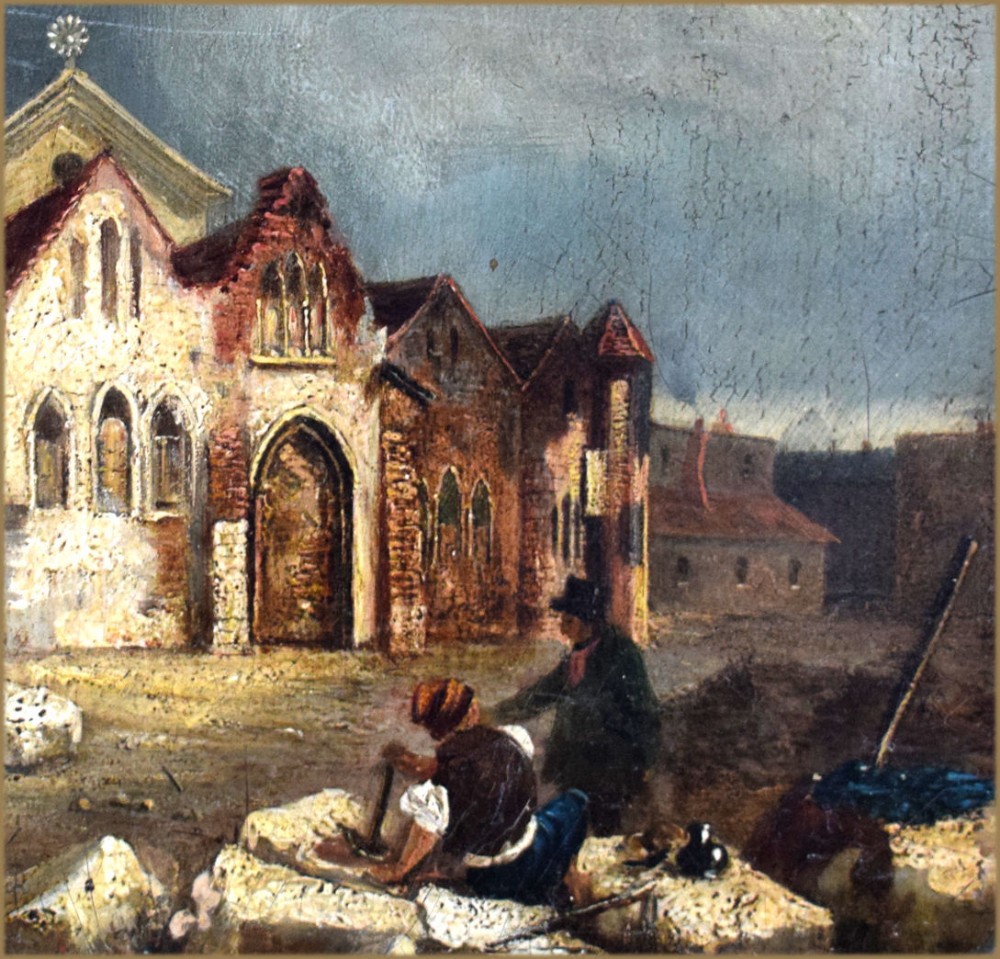
The Cathedral and Collegiate Church of St Saviour & St Mary Overie, Southwark, with stone Masons & Surveyor in the foreground

Cathedral & Collegiate Church of Southwark
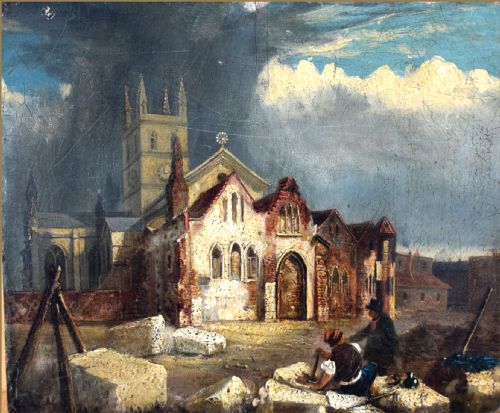
oil on board

11.3/4 x 13.1/4in. (29 x 34 cm.)

It is likely that this was painted circa 1832, since the choir has clearly already been restored (1822-24), and it looks like the transepts had been restored as well (1830), and both the Mary Magdalene Chapel (1820s) and the Bishop's Chapel (c.1830) have gone. It is possible that the surveyors in the picture are associated with the approach road to the new London Bridge, prior to the restoration of the retrochoir in 1832. with thanks to Dr Jackie Hall Southwark Cathedral Archaeologist
This view is taken from the east end of the Cathedral and shows the Cathedral before it was restored between 1818 and 1830 by George Gwilt jun, who was determined to return the church to its 13th century appearance. By the early 19th century the fabric of the church had fallen into disrepair. All the medieval furnishings were gone , and the interior was as Francis Bumpus later described it, "pewed and galleried to a fearful extent". Gwilt removed the early sixteenth century windows at the east end of the choir and, lacking firm evidence as to the original design, substituted an elevation of his own invention, with three lancet windows, and a circular one in the gable above. The transepts were restored, less sympathetically, by Robert Wallace. The Bishop’s Chapel and parochial chapel were removed, but plans for the demolition of the retrochoir were averted, and it was restored by Gwilt in 1832.
At a vestry meeting held in May 1831 it was decided to remove the nave roof, which had become unsafe, leaving the interior open to the weather, and to hold all future services in the choir and transepts. In 1839, the roofless nave was demolished to within seven feet of the ground,and rebuilt to a design by Henry Rose.The new nave was at a higher level than the surviving mediaeval eastern part, and closed off from it by a glazed screen. It had a plaster vault carried on iron columns, and a wooden gallery around three sides. It was widely criticised, notably by Pugin who wrote "It is bad enough to see such an erection spring up at all, but when a venerable building is demolished to make way for it, the case is quite intolerable."On the initiative of Anthony Thorold, Bishop of Rochester, the nave was once again rebuilt between 1890 and 1897[21] by Arthur Blomfield, in a manner intended to recreate its 13th century predecessor as accurately as possible, and to preserve the few surviving mediaeval fragments.The main railway viaduct connecting London Bridge station to Blackfriars, Cannon Street and Charing Cross stations passes only eighteen metres from the southeast corner of the cathedral, blocking the view from the south side. This was a compromise when the railway was extended along this viaduct in 1852; the alternative was to demolish the building completely to allow a more direct passage for the line.

The collegiate parish church of St Saviour was designated as a cathedral in 1905 when the Church of England Diocese of Southwark was created. The nearby early-18th-century church of St Thomas became the new cathedral's chapter-house.The cathedral stands in an area heavily damaged by German bombing during the Second World War. The total number of bombs dropped on Southwark between 7 October 1940 to 6 June 1941 alone was 1,651 High Explosive Bombs and 20 Parachute Mines.On 20 February 1941 it was reported (after being unrestricted by the ministry of information) the cathedral had been damaged by a bomb. Shrapnel damage is still visible on the outside of the building to this day.There are memorials to Isabella Gilmore and the victims of the Marchioness disaster, and monuments to Nelson Mandela and Desmond Tutu. In 2001 Mandela opened a new northern "cloister" on the site of the old monastic one

Physical Dimensions
Height
29cm (11.42")
Width
34cm (13.39")
Depth
1cm (0.39")
Declaration

Artware Fineart has dated this Georgian Architectural Oil Painting to the 18th Century.

Reference Numbers
Sellingantiques Reference
SA496808
Dealers Internal Reference
3929
Description
Follower of William Marlow, 1740-1813
The Cathedral and Collegiate Church of St Saviour & St Mary Overie, Southwark, with stone Masons & Surveyor in the foreground.
Artware Fineart

Cathedral & Collegiate Church of Southwark

fig 1. An 18th-century architectural oil painting depicting Southwark Cathedral with stonemasons carving large blocks of stone in the foreground under a cloudy sky.
fig 1. Follower of William Marlow, 1740-1813 The Cathedral and Collegiate Church of St Saviour & St Mary Overie, Southwark, with Stone Masons & Surveyor in the Foreground

oil on board

11.3/4 x 13.1/4in. (29 x 34 cm.)

It is likely that this was painted circa 1832, since the choir has clearly already been restored (1822-24), and it looks like the transepts had been restored as well (1830), and both the Mary Magdalene Chapel (1820s) and the Bishop's Chapel (c.1830) have gone. It is possible that the surveyors in the picture are associated with the approach road to the new London Bridge, prior to the restoration of the retrochoir in 1832. with thanks to Dr Jackie Hall Southwark Cathedral Archaeologist

fig 2. An 18th-century architectural oil painting depicting Southwark Cathedral with stonemasons carving large blocks of stone in the foreground under a cloudy sky.
fig 2. Follower of William Marlow, 1740-1813 The Cathedral and Collegiate Church of St Saviour & St Mary Overie, Southwark, with Stone Masons & Surveyor in the Foreground

This view is taken from the east end of the Cathedral and shows the Cathedral before it was restored between 1818 and 1830 by George Gwilt jun, who was determined to return the church to its 13th century appearance. By the early 19th century the fabric of the church had fallen into disrepair. All the medieval furnishings were gone , and the interior was as Francis Bumpus later described it, "pewed and galleried to a fearful extent". Gwilt removed the early sixteenth century windows at the east end of the choir and, lacking firm evidence as to the original design, substituted an elevation of his own invention, with three lancet windows, and a circular one in the gable above. The transepts were restored, less sympathetically, by Robert Wallace. The Bishop’s Chapel and parochial chapel were removed, but plans for the demolition of the retrochoir were averted, and it was restored by Gwilt in 1832.

fig 3. An 18th-century architectural oil painting depicting Southwark Cathedral with stonemasons carving large blocks of stone in the foreground under a cloudy sky.
fig 3. Follower of William Marlow, 1740-1813 The Cathedral and Collegiate Church of St Saviour & St Mary Overie, Southwark, with Stone Masons & Surveyor in the Foreground

At a vestry meeting held in May 1831 it was decided to remove the nave roof, which had become unsafe, leaving the interior open to the weather, and to hold all future services in the choir and transepts. In 1839, the roofless nave was demolished to within seven feet of the ground,and rebuilt to a design by Henry Rose.The new nave was at a higher level than the surviving mediaeval eastern part, and closed off from it by a glazed screen. It had a plaster vault carried on iron columns, and a wooden gallery around three sides. It was widely criticised, notably by Pugin who wrote "It is bad enough to see such an erection spring up at all, but when a venerable building is demolished to make way for it, the case is quite intolerable."On the initiative of Anthony Thorold, Bishop of Rochester, the nave was once again rebuilt between 1890 and 1897[21] by Arthur Blomfield, in a manner intended to recreate its 13th century predecessor as accurately as possible, and to preserve the few surviving mediaeval fragments.The main railway viaduct connecting London Bridge station to Blackfriars, Cannon Street and Charing Cross stations passes only eighteen metres from the southeast corner of the cathedral, blocking the view from the south side. This was a compromise when the railway was extended along this viaduct in 1852; the alternative was to demolish the building completely to allow a more direct passage for the line.

The collegiate parish church of St Saviour was designated as a cathedral in 1905 when the Church of England Diocese of Southwark was created. The nearby early-18th-century church of St Thomas became the new cathedral's chapter-house.The cathedral stands in an area heavily damaged by German bombing during the Second World War. The total number of bombs dropped on Southwark between 7 October 1940 to 6 June 1941 alone was 1,651 High Explosive Bombs and 20 Parachute Mines.On 20 February 1941 it was reported (after being unrestricted by the ministry of information) the cathedral had been damaged by a bomb. Shrapnel damage is still visible on the outside of the building to this day.There are memorials to Isabella Gilmore and the victims of the Marchioness disaster, and monuments to Nelson Mandela and Desmond Tutu. In 2001 Mandela opened a new northern "cloister" on the site of the old monastic one

Height
29cm (11.42")
Width
34cm (13.39")
Depth
1cm (0.39")
Date of Manufacture

Artware Fineart has dated this Georgian Architectural Oil Painting to the 18th Century.

Reference Numbers
Sellingantiques Ref
SA496808
Dealers Internal Ref
3929
Artware Fineart
Sellingantiques verified Since Sep 2008
Dealer Profile

You can view the stock and full dealer information on the Artware Fineart Profile Page

PDF SHARE
SAVE
An 18th-century architectural oil painting depicting Southwark Cathedral with stonemasons carving large blocks of stone in the foreground under a cloudy sky.
1 / 4
Archive I An 18th-century architectural oil painting depicting Southwark Cathedral with stonemasons carving large blocks of stone in the foreground under a cloudy sky.

Follower of William Marlow, 1740-1813 The Cathedral and Collegiate Church of St Saviour & St Mary Overie, Southwark, with Stone Masons & Surveyor in the Foreground
Archive II An 18th-century architectural oil painting depicting Southwark Cathedral with stonemasons carving large blocks of stone in the foreground under a cloudy sky. View II
Archive III An 18th-century architectural oil painting depicting Southwark Cathedral with stonemasons carving large blocks of stone in the foreground under a cloudy sky. View III
Archive IV An 18th-century architectural oil painting depicting Southwark Cathedral with stonemasons carving large blocks of stone in the foreground under a cloudy sky. View IV
FURTHER BROWSING

Visitors also looked at these ⇣

Enlarged Archival View
Telephone 07958 699 645
Location
18 La Gare
51 Surrey Row
London
SE1 0BZ
United Kingdom
Verified Since Sep 2008
Items For Sale 243
Items Sold 223
Artware Fineart
Verified Since Sep 2008
View Dealer Info
Location: 18 La Gare , 51 Surrey Row , London , SE1 0BZ , United Kingdom
Verified
Sep 2008
For Sale
243
Sold
223
An 18th-century architectural oil painting depicting Southwark Cathedral with stonemasons carving large blocks of stone in the foreground under a cloudy sky.
Follower of William Marlow, 1740-1813 The Cathedral and Collegiate Church of St Saviour & St Mary Overie, Southwark, with stone Masons & Surveyor in the foreground
Ref: SA496808
An 18th-century architectural oil painting depicting Southwark Cathedral with stonemasons carving large blocks of stone in the foreground under a cloudy sky.
Detail View 1
Detail View 2
Detail View 3
Archival Detail
Every single antique dealer on our platform is individually approved by our internal team. We verify their professional trade history, ethical standards, and photographic quality to ensure a secure, high-standard buying environment. Upon joining, every dealer agrees to a strict 9-point code of conduct. While issues can occasionally arise, our dealers typically resolve them swiftly and directly with the buyer. In fact, since our founding in 2002, Sellingantiques has only had to step in to help resolve an issue on roughly five occasions—a true testament to the quality of our dealers and their dedication to your happiness.
Our dealers are highly experienced in packing and shipping fragile, high-value antiques. Because you are in direct contact with the dealer, you will be able to easily go through all available shipping and insurance options together to ensure your item arrives safely.
Antiques are the ultimate green purchase. By choosing historical pieces over newly manufactured goods, you completely eliminate the carbon footprint of modern mass production while preserving exceptional, timeless craftsmanship.

Georgian topographical landscape paintings emphasise realistic architectural accuracy, depicting specific towns, landmarks, and rural vistas. Artists of this era frequently incorporated figures engaged in everyday trades to add narrative interest and scale to urban and ecclesiastical views.

Artists during the 18th century typically painted with hand-ground mineral and organic pigments bound in linseed oil. These were applied onto stretched linen canvas or solid wooden panels prepared with a gesso priming layer.

Authentication involves examining natural craquelure patterns across the paint surface, historic canvas weave, and signs of age on wooden stretcher bars. Specialists also evaluate period-appropriate brushwork, brush technique, pigment composition, and accurate architectural detail.

A traditional architectural painting works well as a focal piece above a sideboard, mantelpiece, or desk. Pairing classic fine art with modern minimalist furnishings or rich dark timber creates an engaging aesthetic contrast within contemporary or traditional schemes.

Keep oil paintings away from direct sunlight, excess moisture, and extreme temperature fluctuations to prevent cracking or warping. Dust gently with a soft dry brush and consult a professional conservator for varnish cleaning or structural repairs.
items
Add keywords to the filter
Price
£100
£250000
Era
Movements
Material
Origin
Stock Location
Freshness
Online Payments
Categories