31,414  PAGES BROWSED TODAY PAGES TODAY 90  ANTIQUES UPLOADED TODAY NEW ARRIVALS
ID #SA1210899
RESERVED
Email
Save
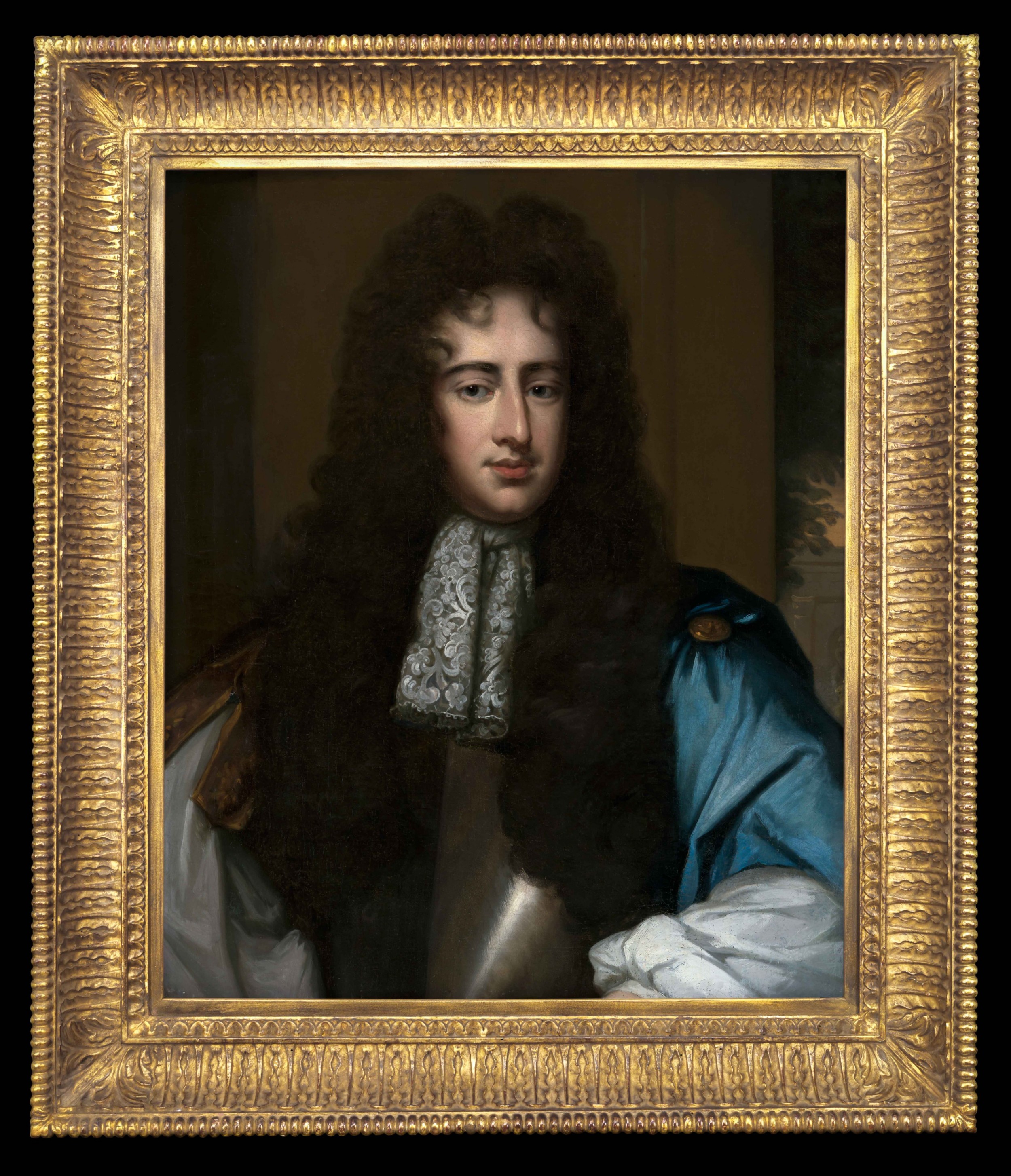
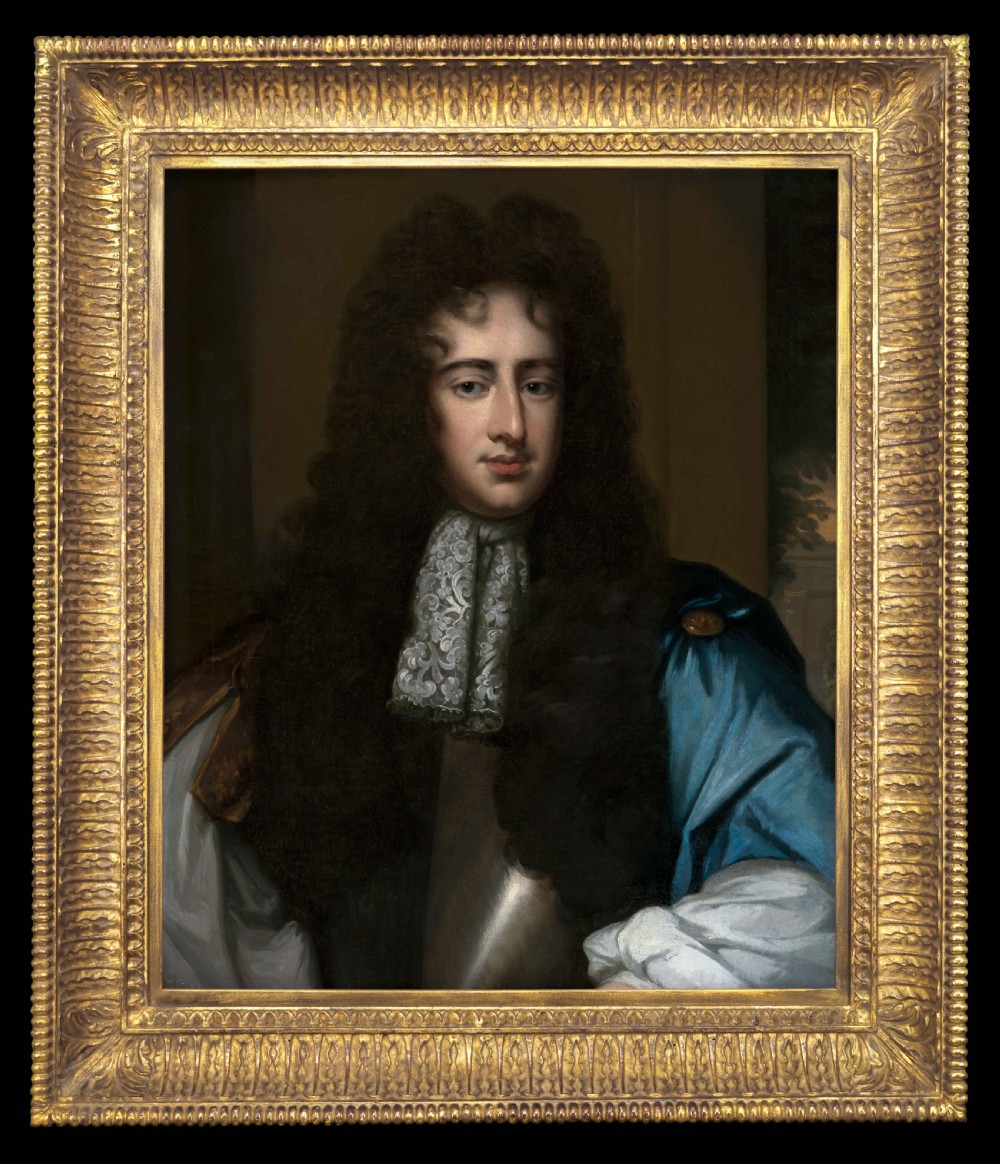
Portrait of a Gentleman, Sir Henry Hobart Blue Cloak & Cravat C.1683-1684; Attributed to Willem Wissing (1656-1687), Oil on Canvas
Titan Fine Art
reserved SA1210899
RESERVED
Titan Fine Art

Titan Fine Art

Sellingantiques Verified Since Jul 2016
View Dealers Stock Page
  • About Us
    Specialist in 17th & 18thc portraits. Highly curated selection, museum-level research & pro conservation. Exceptional art, expertly vetted.
Id #SA1210899
PDF SHARE
SAVE

Portrait of a Gentleman, Sir Henry Hobart Blue Cloak & Cravat C.1683-1684; Attributed to Willem Wissing (1656-1687), Oil on Canvas

17th century
For Sale by Titan Fine Art (Reserved for a buyer)
Description

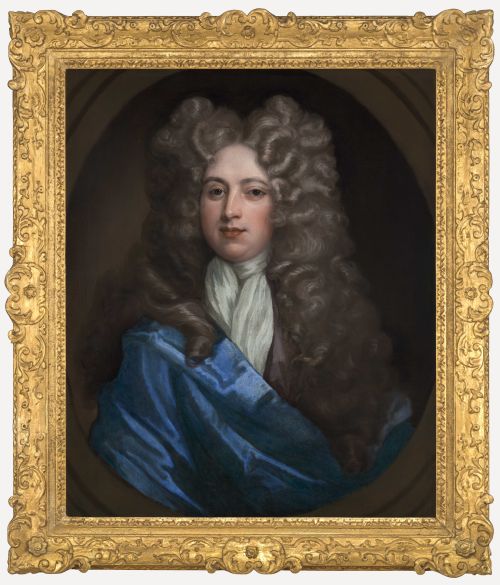
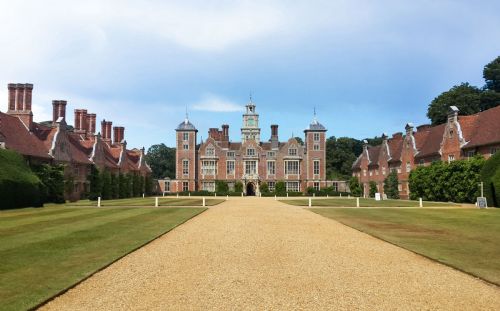
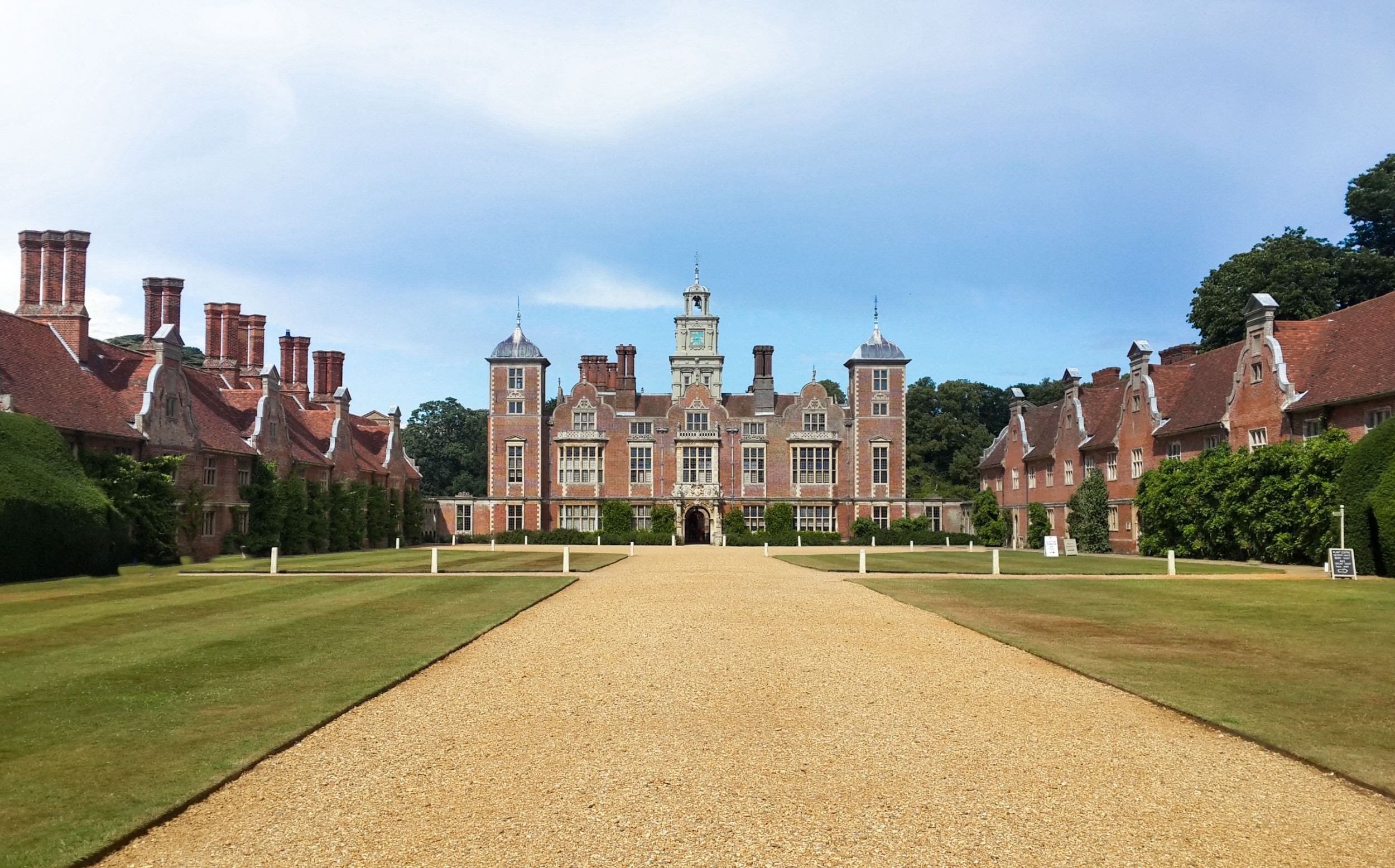
This impressive portrait depicts the English nobleman and politician, Sir Henry Hobart (pronounced “Hubbard”), 4th Baronet of Blickling Hall, one of England's greatest Jacobean houses and the supposed birthplace of Henry VII’s second queen, Anne Boleyn. It was painted by William Wissing, whose polished and elegant portraits ensured his meteoric rise from studio assistant in 1680 to royal painter in all but name to King Charles II and his wife Queen Catherine of Braganza in 1683; he had only but one real rival in England, Godfrey Kneller.

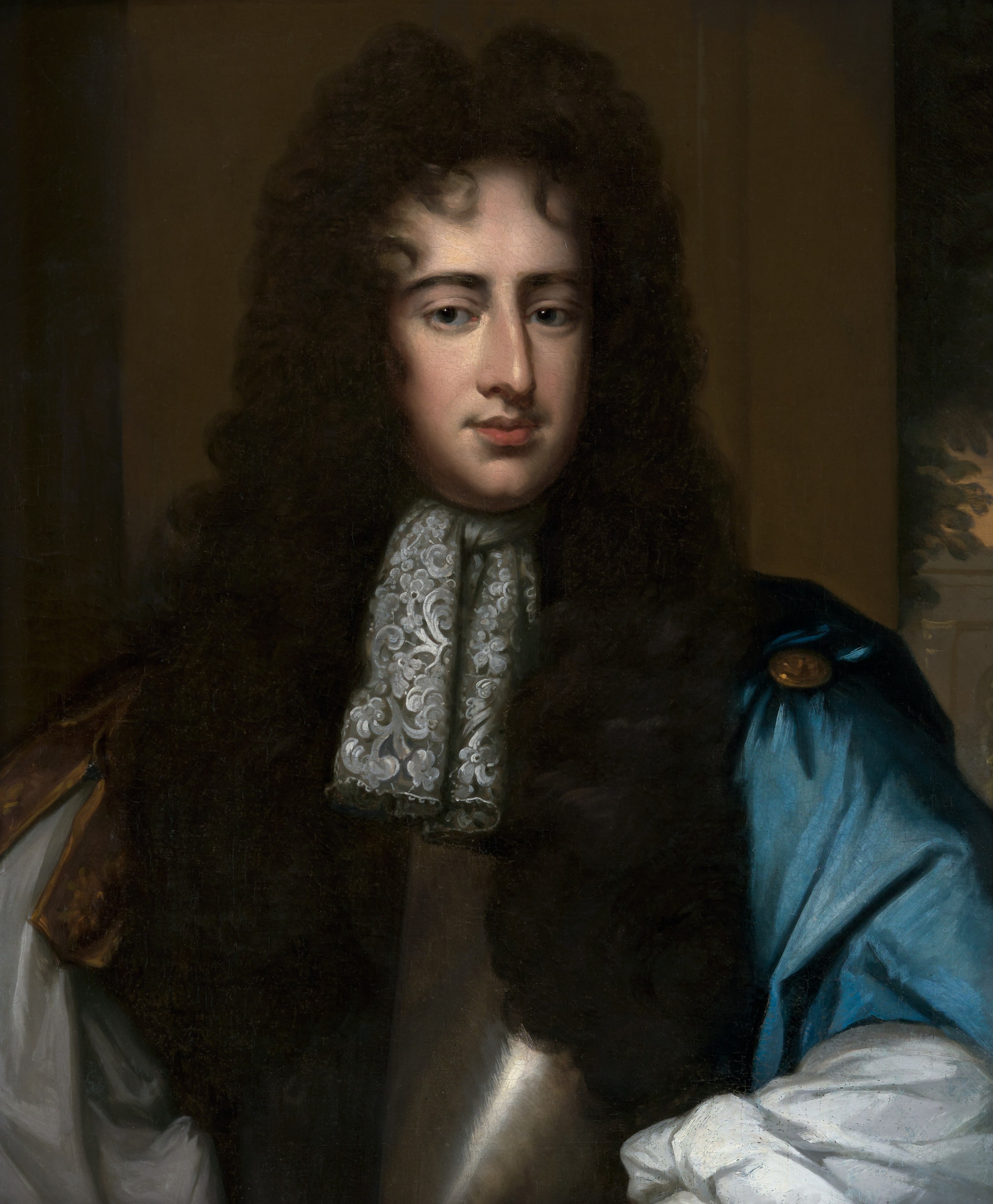
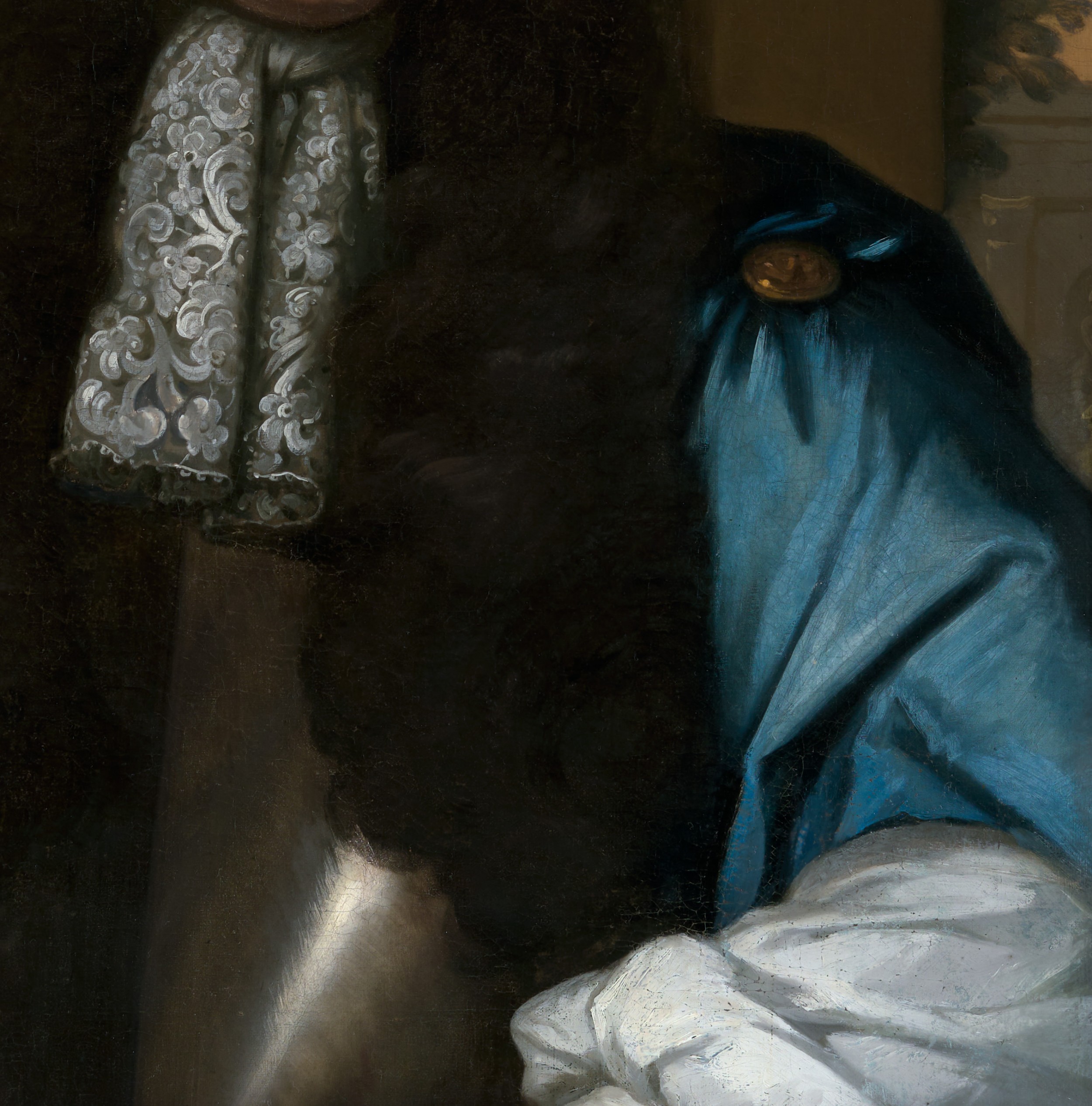
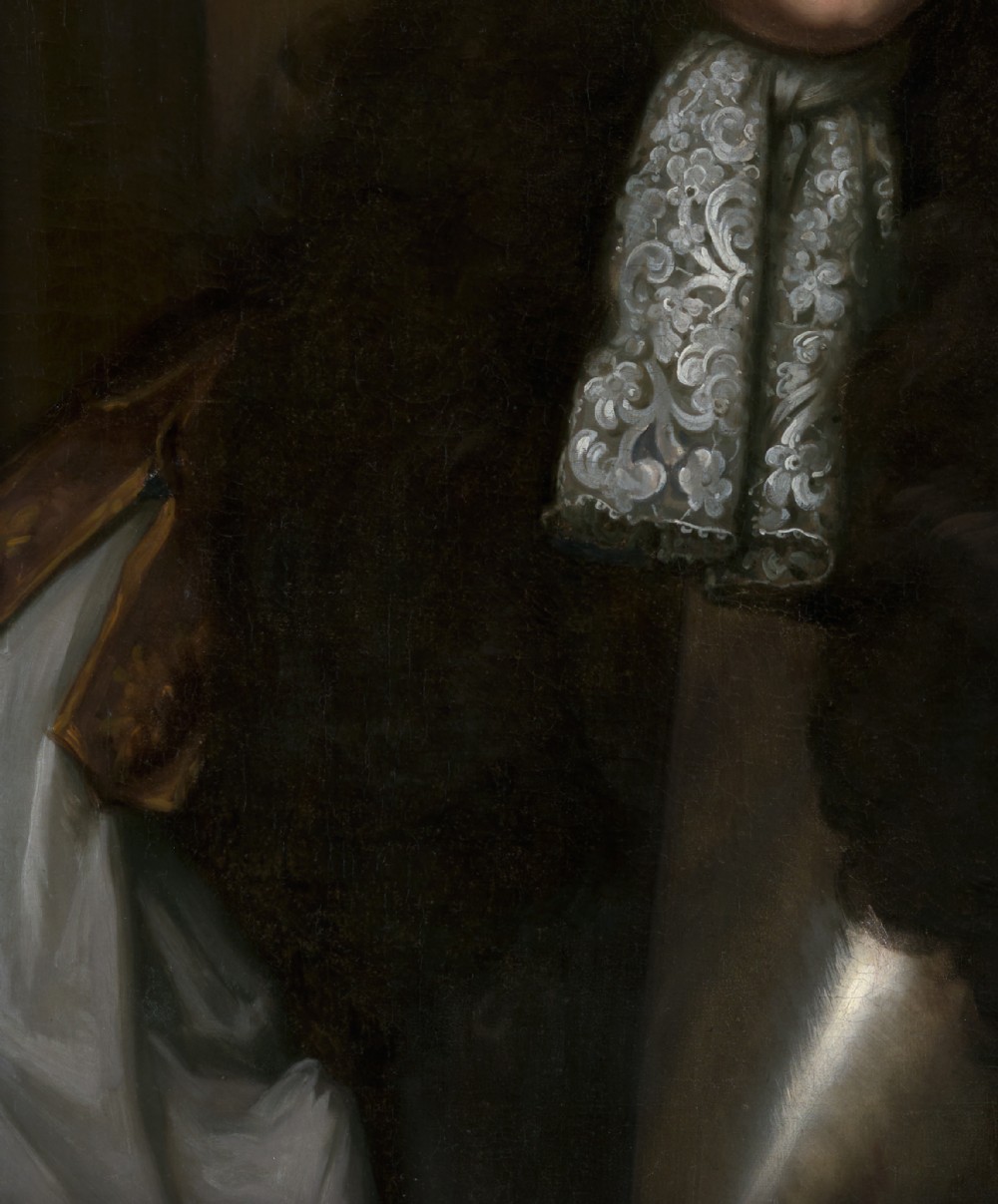
The young Sir Henry has been depicted wearing a very long full bottomed wig, a highly polished glistening breastplate under a blue cloak tied at the shoulder with a medallion, brown lappets, white shirt sleeves, and a cross over lace cravat. These immensely expensive items convey wealth and the sitter’s rank in society, for he was a paragon of the wealthy and privileged society that he belonged to.

Henry Hobart was born in 1657; he was the eldest son to Sir John Hobart, 3rd Baronet and Mary Hampden. He graduated in 1675, some four years after he was knighted at Blickling by King Charles II in 1671. When he succeeded his father as the 4th Baronet in 1683, the family was desperately in debt and Blickling mortgaged to John Pollexfen, a merchant who was evidently used to dealing with the problems of impoverished baronets, who suggested that Sir Henry should find a lady who has between six and seven thousand a year and offered to “recommend such a one”. In the following year, on 9 July 1684, Hobart married Elizabeth Maynard (c.1663-1701), co-heir to Sir Joseph Maynard. A dowry of £10,000 released Blickling from its mortgage. The couple had at least four children, including Henrietta who became the mistress of the Prince of Wales.

The most likely date in which our portrait was painted is 1683 when Hobart succeeded his father as baronet, or in 1684 the year of his marriage.

In 1689 he was appointed an equerry to King William III and also Gentleman of the Horse fought under the King in the Battle of the Boyne. In 1698, incensed by rumours that Hobart’s decisive defeat in the elections that year had been brought about by allegations of discreditable conduct at the Battle of the Boyne, Hobart accused Oliver Le Neve of circulating the stories. Although Le Neve denied the accusation, they met in a duel on Cawston Heath - Hobart was mortally wounded. The duel, one of the last to have been fought with swords in England, is commemorated on the spot by a plinth with an urn. His only son, succeeded him and was eventually created 1st Earl of Buckinghamshire (1673-1756).

The family’s seat is at Blickling Hall, Norfolk, England, where King Charles II and Queen Catherine of Braganza were probably guests here in 1671. The house contains a fascinating collection including of furniture, pictures, books, and tapestries of which particularly noteworthy is the huge "Battle of Poltava" tapestry of 1764, probably given to the 2nd Earl of Buckinghamshire by Catherine the Great when he was the British Ambassador to her Court.

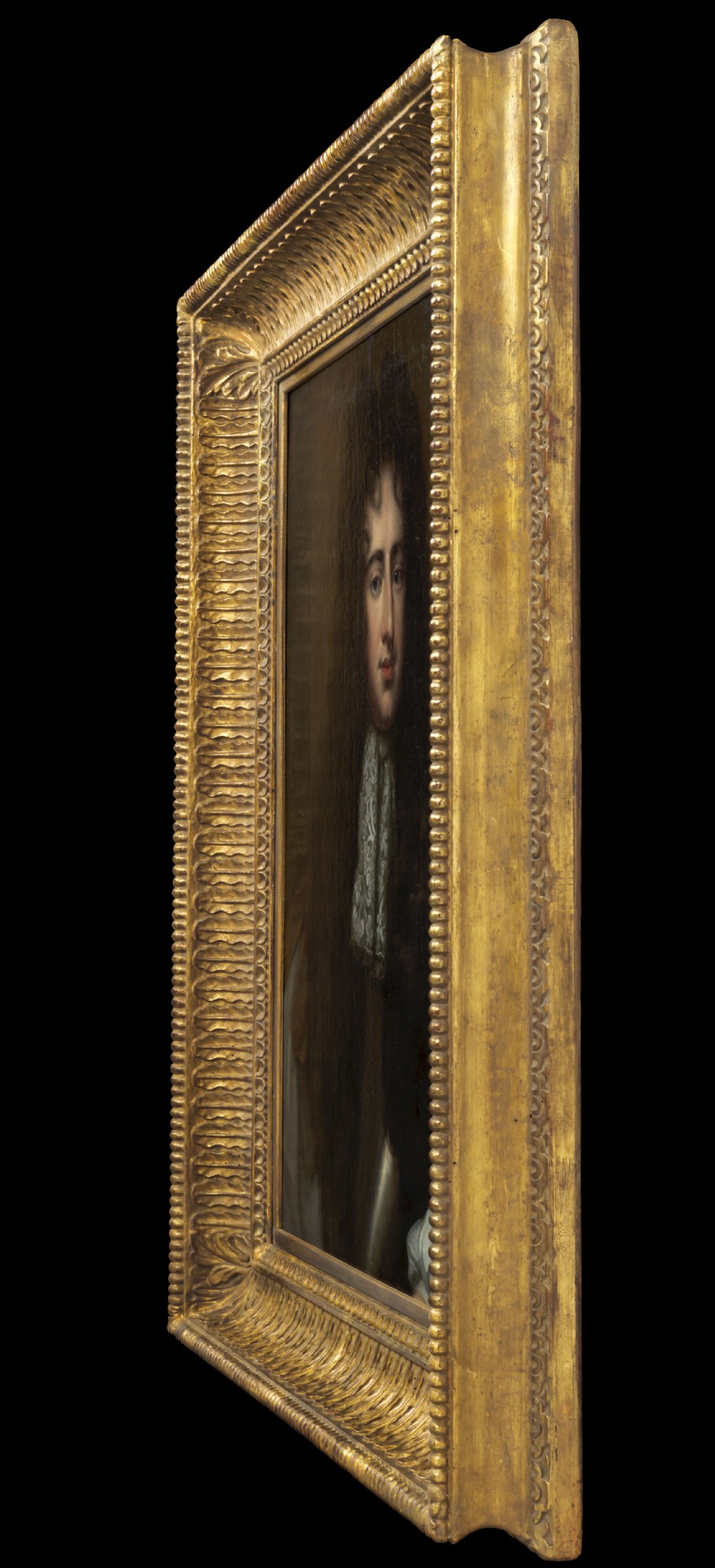
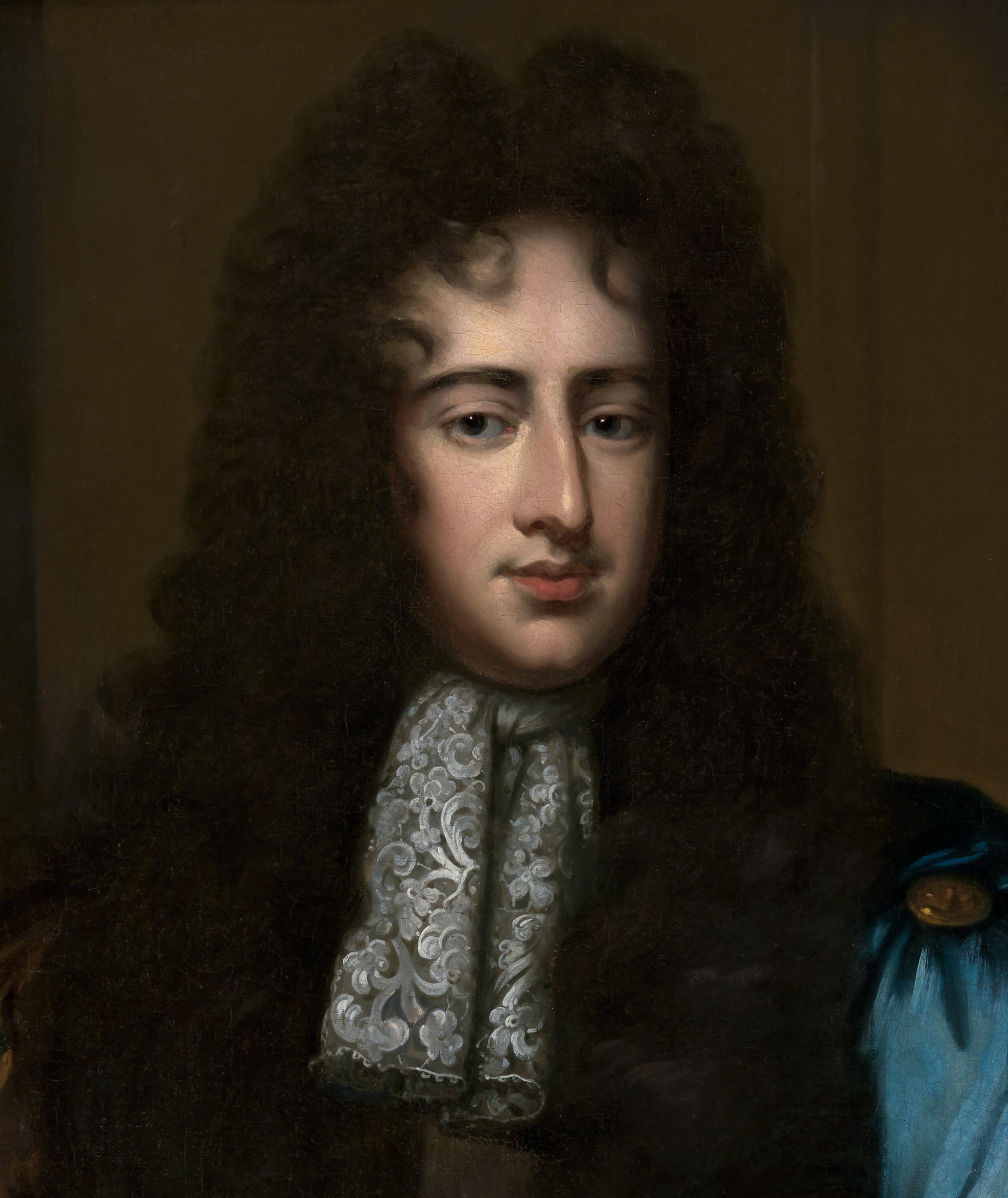
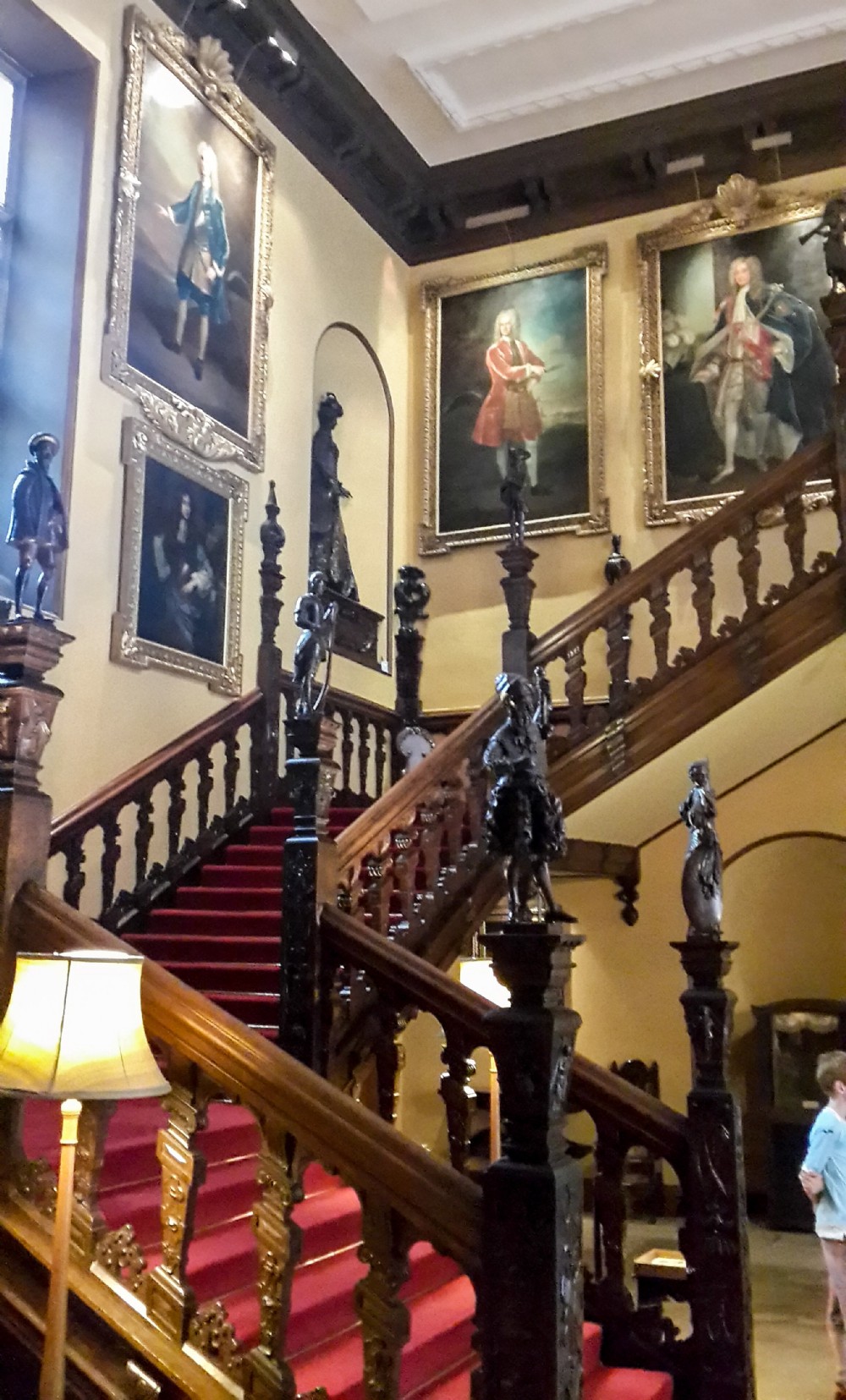
A portrait of the sitter, also by Wissing, is in the Great Hall at Blickling (see photo), and in 1927 another was recorded at Heydon Hall in Norfolk. The treatment of the facial features, the armour, and the gross point lace, which has been painstakingly delineated, is very fine. Held in a good quality antique frame.

William (Willem) Wissing was trained at The Hague and came to London in 1676 and most probably joined the studio or Sir Peter Lely. After Lely’s death in 1680 he effectively took over his business and he scaled the heights of patronage with extraordinary ease, and painted for very important aristocratic patrons.

Full description at: www.titanfineart.com

Physical Dimensions
Height
94cm (37.01")
Width
80cm (31.50")
Depth
10cm (3.94")
Declaration

Titan Fine Art has dated this 17th Century Portrait Painting to the 17th Century.

Reference Numbers
Sellingantiques Reference
SA1210899
Dealers Notes

Much more info about this item at: www.titanfineart.com

In a market saturated with available paintings, Titan Fine Art offers a distinct advantage: we sift through thousands of works to provide a specially curated selection. Each piece is meticulously chosen based on technical merit, provenance, and decorative appeal, ensuring our clients view only the finest examples of British and European art.

With over 20 years of expertise and 1,000+ works placed with collectors and institutions, we are one of the most prolific specialists in 17th and 18th-century portraiture. We combine a scholarly approach with museum-level rigor to replace the uncertainty of the open market with absolute confidence.

Why Buy From Titan Fine Art?

• Expertly Curated Selection

We act as your expert eye, selecting only high-quality works that offer genuine historical and artistic value.

• Museum-Level Research

Each portrait is supported by extensive academic research, often exceeding 40 hours, to establish attribution, sitter identity, and historical context.

• Professional Conservation

All paintings are carefully cleaned and stabilised by professional conservators, and are presented ready to hang.

• Transparent Pricing

No buyer’s premium or hidden fees—unlike auction houses, where additional costs can add 25–35%.

• Export Pricing Advantage

Reduced pricing is available for works exported outside the UK.

• Specialist Global Shipping

We manage the entire process, including custom crating, export documentation, and fully tracked delivery worldwide.

• Buy with Confidence

A 7-day return policy and the option to pay in GBP, USD, or EUR for convenience and transparency.

• Original Period Frames

Many works retain their original carved and gilded frames, which are works of art in their own right and enhance both historical authenticity and decorative impact.

• Personal Advisory Service

We work directly with collectors and interior designers, offering guidance on selection, scale, and placement—including bespoke room mock-ups on request.

Subscribe to our monthly 'new item alert' to be the first to hear about new works

Description
This impressive portrait depicts the English nobleman and politician, Sir Henry Hobart (pronounced “Hubbard”), 4th Baronet of Blickling Hall, one of England's greatest Jacobean houses and the supposed birthplace of Henry VII’s second queen, Anne Boleyn. It was painted by William Wissing, whose polished and elegant portraits ensured his meteoric rise from studio assistant in 1680 to royal painter in all but name to King Charles II and his wife Queen Catherine of Braganza in 1683; he had only but one real rival in England, Godfrey Kneller.

The young Sir Henry has been depicted wearing a very long full bottomed wig, a highly polished glistening breastplate under a blue cloak tied at the shoulder with a medallion, brown lappets, white shirt sleeves, and a cross over lace cravat.
These immensely expensive items convey wealth and the sitter’s rank in society, for he was a paragon of the wealthy and privileged society that he belonged to.
Titan Fine Art
fig 1. An oil portrait depicting a gentleman in a long dark wig, lace cravat, and blue cloak, presented within an ornate carved giltwood frame.
fig 1. Portrait of a Gentleman, Sir Henry Hobart Blue Cloak & Cravat C.1683-1684; Attributed to Willem Wissing (1656-1687), Oil on Canvas

Henry Hobart was born in 1657; he was the eldest son to Sir John Hobart, 3rd Baronet and Mary Hampden. He graduated in 1675, some four years after he was knighted at Blickling by King Charles II in 1671. When he succeeded his father as the 4th Baronet in 1683, the family was desperately in debt and Blickling mortgaged to John Pollexfen, a merchant who was evidently used to dealing with the problems of impoverished baronets, who suggested that Sir Henry should find a lady who has between six and seven thousand a year and offered to “recommend such a one”. In the following year, on 9 July 1684, Hobart married Elizabeth Maynard (c.1663-1701), co-heir to Sir Joseph Maynard. A dowry of £10,000 released Blickling from its mortgage. The couple had at least four children, including Henrietta who became the mistress of the Prince of Wales.
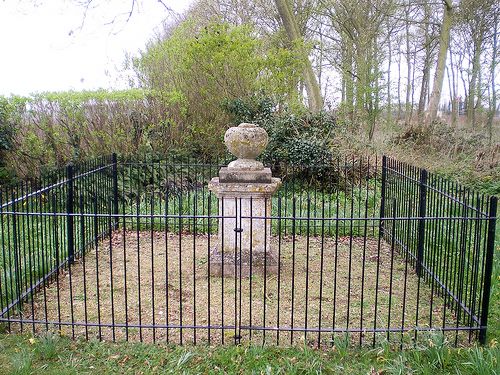
fig 2. An oil portrait depicting a gentleman in a long dark wig, lace cravat, and blue cloak, presented within an ornate carved giltwood frame.
fig 2. Portrait of a Gentleman, Sir Henry Hobart Blue Cloak & Cravat C.1683-1684; Attributed to Willem Wissing (1656-1687), Oil on Canvas

The most likely date in which our portrait was painted is 1683 when Hobart succeeded his father as baronet, or in 1684 the year of his marriage.

In 1689 he was appointed an equerry to King William III and also Gentleman of the Horse fought under the King in the Battle of the Boyne. In 1698, incensed by rumours that Hobart’s decisive defeat in the elections that year had been brought about by allegations of discreditable conduct at the Battle of the Boyne, Hobart accused Oliver Le Neve of circulating the stories. Although Le Neve denied the accusation, they met in a duel on Cawston Heath - Hobart was mortally wounded. The duel, one of the last to have been fought with swords in England, is commemorated on the spot by a plinth with an urn. His only son, succeeded him and was eventually created 1st Earl of Buckinghamshire (1673-1756).
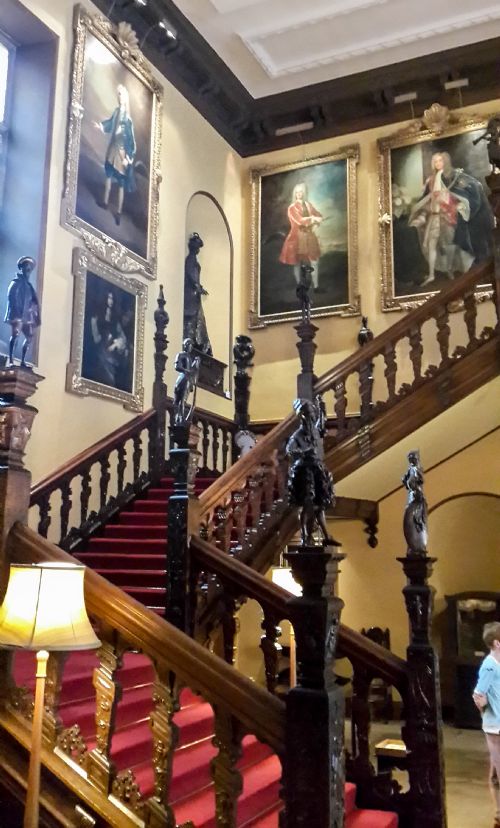
fig 3. An oil portrait depicting a gentleman in a long dark wig, lace cravat, and blue cloak, presented within an ornate carved giltwood frame.
fig 3. Portrait of a Gentleman, Sir Henry Hobart Blue Cloak & Cravat C.1683-1684; Attributed to Willem Wissing (1656-1687), Oil on Canvas

The family’s seat is at Blickling Hall, Norfolk, England, where King Charles II and Queen Catherine of Braganza were probably guests here in 1671. The house contains a fascinating collection including of furniture, pictures, books, and tapestries of which particularly noteworthy is the huge "Battle of Poltava" tapestry of 1764, probably given to the 2nd Earl of Buckinghamshire by Catherine the Great when he was the British Ambassador to her Court.
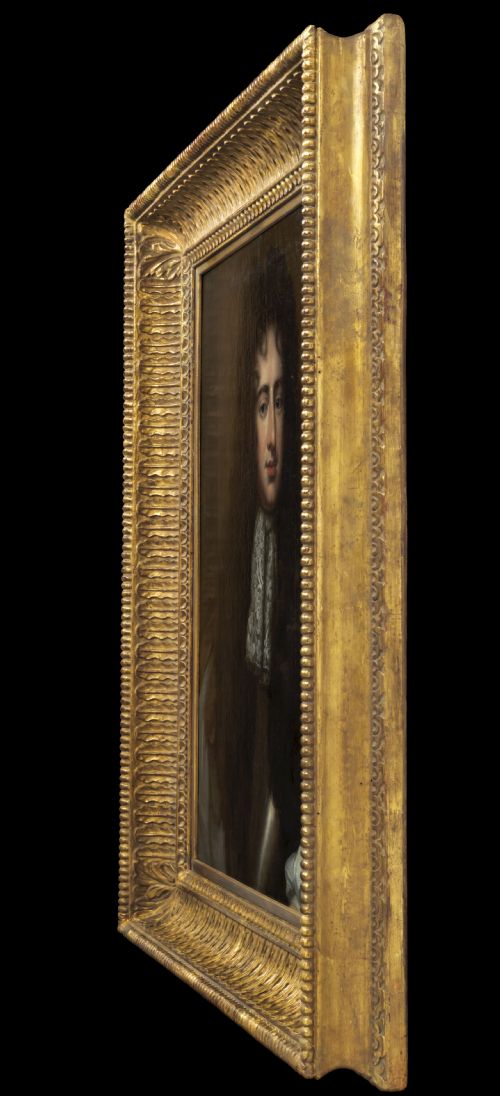
fig 4. An oil portrait depicting a gentleman in a long dark wig, lace cravat, and blue cloak, presented within an ornate carved giltwood frame.
fig 4. Portrait of a Gentleman, Sir Henry Hobart Blue Cloak & Cravat C.1683-1684; Attributed to Willem Wissing (1656-1687), Oil on Canvas

A portrait of the sitter, also by Wissing, is in the Great Hall at Blickling (see photo), and in 1927 another was recorded at Heydon Hall in Norfolk. The treatment of the facial features, the armour, and the gross point lace, which has been painstakingly delineated, is very fine. Held in a good quality antique frame.
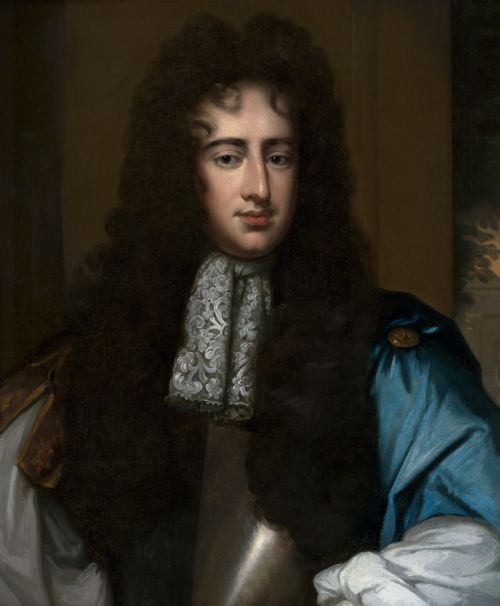
fig 5. An oil portrait depicting a gentleman in a long dark wig, lace cravat, and blue cloak, presented within an ornate carved giltwood frame.
fig 5. Portrait of a Gentleman, Sir Henry Hobart Blue Cloak & Cravat C.1683-1684; Attributed to Willem Wissing (1656-1687), Oil on Canvas

William (Willem) Wissing was trained at The Hague and came to London in 1676 and most probably joined the studio or Sir Peter Lely. After Lely’s death in 1680 he effectively took over his business and he scaled the heights of patronage with extraordinary ease, and painted for very important aristocratic patrons.

Full description at: www.titanfineart.com

Height
94cm (37.01")
Width
80cm (31.50")
Depth
10cm (3.94")
Date of Manufacture

Titan Fine Art has dated this 17th Century Portrait Painting to the 17th Century.

Reference Numbers
Sellingantiques Ref
SA1210899
Titan Fine Art
Titan Fine Art
Sellingantiques verified Since Jul 2016

Specialist in 17th & 18thc portraits. Highly curated selection, museum-level research & pro conservation. Exceptional art, expertly vetted.

Dealer Profile

You can view the stock and full dealer information on the Titan Fine Art Profile Page
PDF SHARE
SAVE
An oil portrait depicting a gentleman in a long dark wig, lace cravat, and blue cloak, presented within an ornate carved giltwood frame.
1 / 9
Archive I An oil portrait depicting a gentleman in a long dark wig, lace cravat, and blue cloak, presented within an ornate carved giltwood frame.

Portrait of a Gentleman, Sir Henry Hobart Blue Cloak & Cravat C.1683-1684; Attributed to Willem Wissing (1656-1687), Oil on Canvas
Archive II An oil portrait depicting a gentleman in a long dark wig, lace cravat, and blue cloak, presented within an ornate carved giltwood frame. View II
Archive III An oil portrait depicting a gentleman in a long dark wig, lace cravat, and blue cloak, presented within an ornate carved giltwood frame. View III
Archive IV An oil portrait depicting a gentleman in a long dark wig, lace cravat, and blue cloak, presented within an ornate carved giltwood frame. View IV
Archive V An oil portrait depicting a gentleman in a long dark wig, lace cravat, and blue cloak, presented within an ornate carved giltwood frame. View V
Archive VI An oil portrait depicting a gentleman in a long dark wig, lace cravat, and blue cloak, presented within an ornate carved giltwood frame. View VI
Archive VII An oil portrait depicting a gentleman in a long dark wig, lace cravat, and blue cloak, presented within an ornate carved giltwood frame. View VII
Archive VIII An oil portrait depicting a gentleman in a long dark wig, lace cravat, and blue cloak, presented within an ornate carved giltwood frame. View VIII
Archive IX An oil portrait depicting a gentleman in a long dark wig, lace cravat, and blue cloak, presented within an ornate carved giltwood frame. View IX
FURTHER BROWSING

Visitors also looked at these ⇣

Enlarged Archival View
Telephone 07875 412 111
Location
London
United Kingdom
Dealer Profile Page sellingantiques.co.uk/titan
Verified Since Jul 2016
Items For Sale 17
Items Sold 400
Titan Fine Art
Titan Fine Art
Verified Since Jul 2016
View Dealer Info
Location: London, United Kingdom
Verified
Jul 2016
For Sale
17
Sold
400
An oil portrait depicting a gentleman in a long dark wig, lace cravat, and blue cloak, presented within an ornate carved giltwood frame.
Portrait of a Gentleman, Sir Henry Hobart Blue Cloak & cravat c.1683-1684; Attributed to Willem Wissing (1656-1687), Oil on canvas
Ref: SA1210899
An oil portrait depicting a gentleman in a long dark wig, lace cravat, and blue cloak, presented within an ornate carved giltwood frame.
Detail View 1
Detail View 2
Detail View 3
Detail View 4
Detail View 5
Detail View 6
Detail View 7
Detail View 8
Archival Detail
Every single antique dealer on our platform is individually approved by our internal team. We verify their professional trade history, ethical standards, and photographic quality to ensure a secure, high-standard buying environment. Upon joining, every dealer agrees to a strict 9-point code of conduct. While issues can occasionally arise, our dealers typically resolve them swiftly and directly with the buyer. In fact, since our founding in 2002, Sellingantiques has only had to step in to help resolve an issue on roughly five occasions—a true testament to the quality of our dealers and their dedication to your happiness.
Our dealers are highly experienced in packing and shipping fragile, high-value antiques. Because you are in direct contact with the dealer, you will be able to easily go through all available shipping and insurance options together to ensure your item arrives safely.
Antiques are the ultimate green purchase. By choosing historical pieces over newly manufactured goods, you completely eliminate the carbon footprint of modern mass production while preserving exceptional, timeless craftsmanship.

Late seventeenth-century portraiture is defined by dramatic lighting, rich colour palettes, and formal poses designed to convey social status. Sitters were frequently depicted wearing elaborate periwigs, intricate lace cravats, and luxurious silk drapery set against darkened neutral backgrounds.

Artworks from this period were painted using hand-ground mineral pigments bound with linseed or walnut oil, applied directly onto woven linen canvas stretched over wooden frames. Decorative outer frames were crafted from hand-carved wood covered in gesso and gold leaf.

Authenticity is evaluated through examination of naturally occurring craquelure patterns across the paint film, age-appropriate oxidation on the canvas reverse, period-correct wood joinery in the stretcher, and non-destructive material analysis of pigment chemistry.

A historical oil portrait creates a striking focal point when hung individually above a mantelpiece or sideboard, particularly in rooms with rich wall colours. Combining classical portraiture with modern architectural lines provides an engaging visual contrast in modern settings.

Canvas paintings require a stable environment away from direct sunlight, heating radiators, and fluctuating humidity levels. Surface dust should only be removed using a very soft, dry brush, and any necessary restoration work must be performed by a qualified conservator.
items
Add keywords to the filter
Price
£100
£250000
Era
Movements
Material
Origin
Stock Location
Freshness
Online Payments
Categories