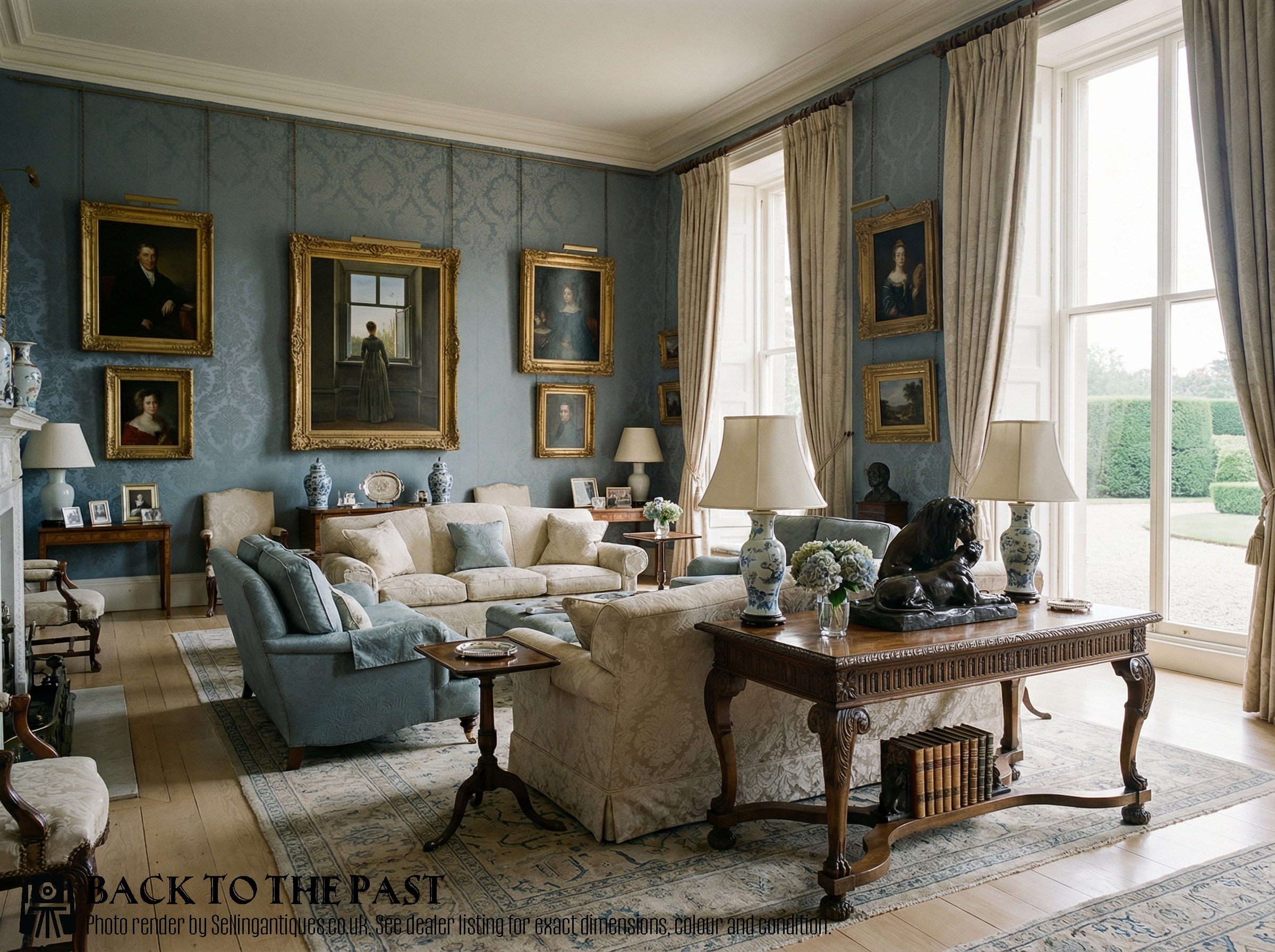
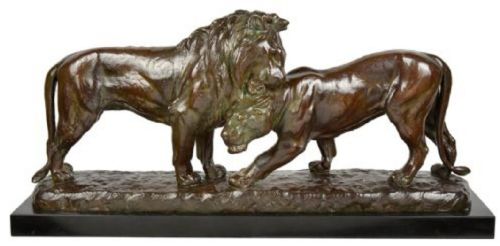
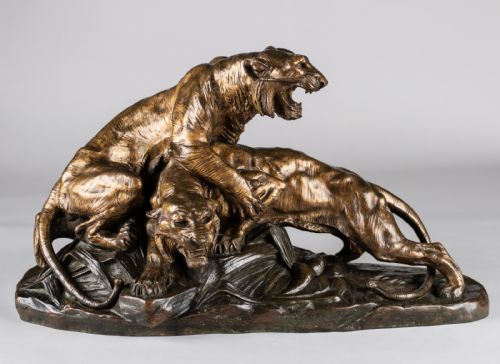
Burgett Langfield Decorative Antiques has dated this French Bronze Lion Sculpture to the 1880s.
This bronze is in fantastic condition, wonderful quality and with a lovely rich patination.
Both his father and his brother, Antoine, were talented and noteworthy sculptors, though neither would achieve his level of ability or commercial success. His early studies were later under the famous Aimé Millet and he was later accepted for study into the École des Beaux-Arts. It was there that he studied under the famed animalier Emmanuel Fremiet. His tutelage under Fremiet heavily influenced the direction of his work. He began to exhibit at the age of twenty at the Salon des Artistes Français where he won many prizes and honors, including the 1887 third-class medal, the 1888 second-glass medal, a medal at the Exposition Universelle of 1889 and ultimately the Grand Prix in the Exposition Universelle of 1900. He was a member of the Society of French Artists as well as the Académie des Beaux-Arts, having been appointed to the Legion d'Honneur with a position of Chevalier in 1896 and finally Officer in 1900. He was tutor to numerous sculptors, including Paris Réné and Thomas-François Cartier. He continued to exhibit at Salon with great regularity through 1914, continuing then to exhibit after the first World War until 1931.

Primarily a sculptor in marble, most of Georges Gardet's work was produced subsequently in bronze in reduced dimensions by the foundries of Siot-Decauville, Thiebaut Freres and Ferdinand Barbedienne; he also worked with a few other foundries, though in less volume. His work was tremendously popular, even in his lifetime, and he is regarded as one of the more outstanding of the late 19th century Animaliers. His deep fascination with big game animals, particularly the wild cats, led him to produce the many studies of these creatures. These scarce works are some of his most prized pieces and many remain in the permanent collections of museums around the world. It was his skill and passion for translating the fierce and muscular strength of these predators that remains so completely moving in his work. His work is always passionate, depicting his animals as proud and romantic, but he was equally skilled with the technical aspects of the sculpture - his work is always exquisitely patinated and finished with very careful attention to detail, placing his work in the upper echelons of his contemporaries.
Burgett Langfield Decorative Antiques has dated this French Bronze Lion Sculpture to the 1880s.
Specialising in art deco and art nouveau sculpture, french and english mirrors and french decorative furniture
You can view the stock and full dealer information on the Burgett Langfield Decorative Antiques Profile Page

Large 19th Century French Bronze Sculpture Depicting a Lion and Lioness by G.gardet