11,274  PAGES BROWSED TODAY PAGES TODAY 36  ANTIQUES UPLOADED TODAY NEW ARRIVALS
ID #SA1065212
FOR SALE
£4,900
Email
Save
Welsh Landscape Oil Painting of Cattle Near the River Llugwy, North Wales by Walter J Watson
Benton Fine Art
for sale €5,733     $6,223
£4,900
Benton Fine Art

Benton Fine Art

Sellingantiques Verified Since Sep 2012
View Dealers Stock Page
  • About Us
    Specialists in 19th & early 20th century original oil paintings by listed artists
  • Trade Associations
    Benton Fine Art is a registered member of LAPADA  BADA  CINOA
Id #SA1065212
PDF SHARE
SAVE

Welsh Landscape Oil Painting of Cattle Near the River Llugwy, North Wales by Walter J Watson

1900 - 1920
For Sale by Benton Fine Art
Description

Walter J Watson

British, (1877-1963)

On the Llugwy, North Wales

Oil on canvas, signed & dated 1922, further inscribed verso

Image size: 15.5 inches x 25.5 inches

Size including frame: 27 inches x 37 inches

Provenance: George Hughes, Fine Art Dealer, 50 & 52, Pilgrim Street, Newcastle on Tyne

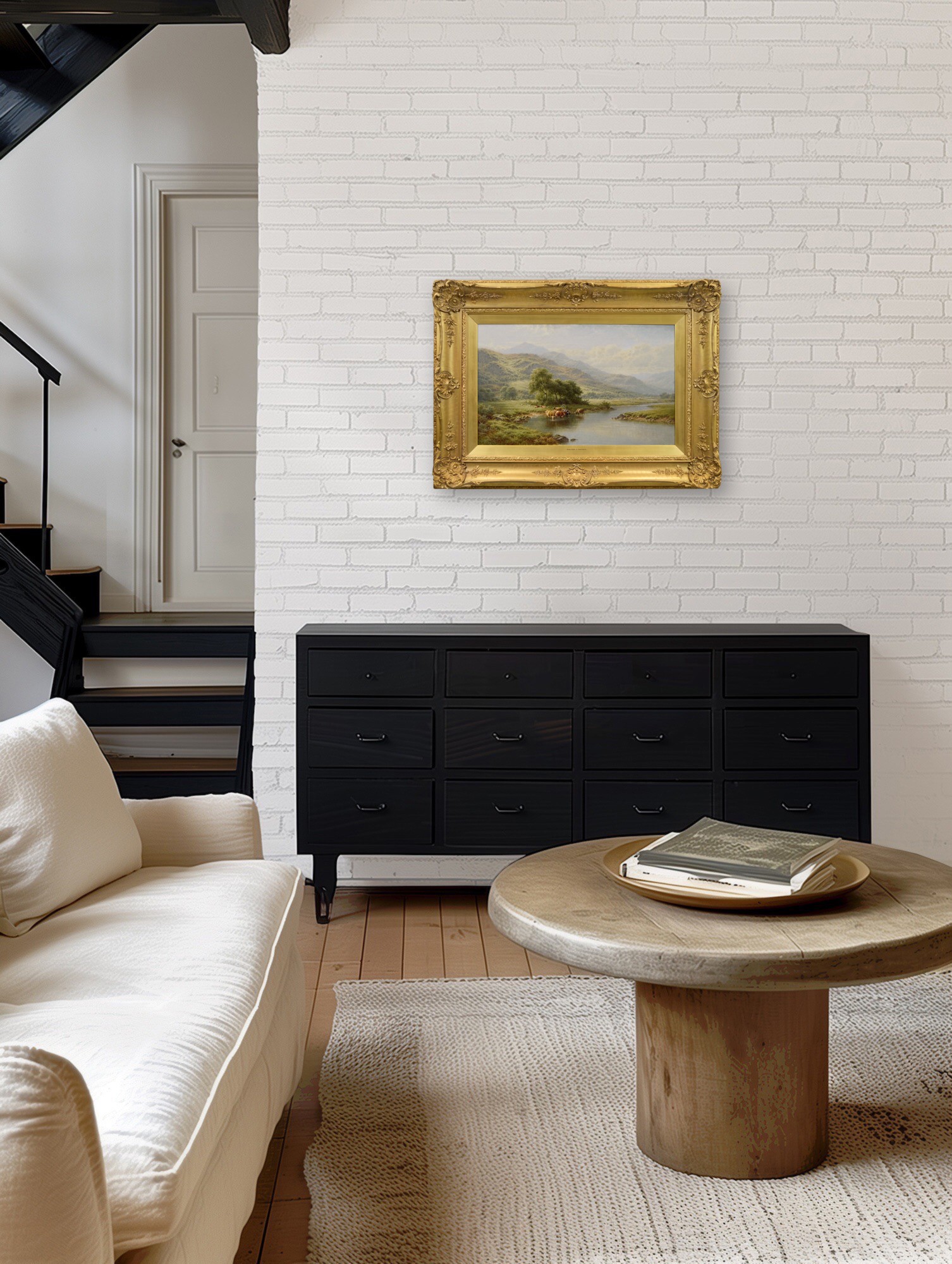
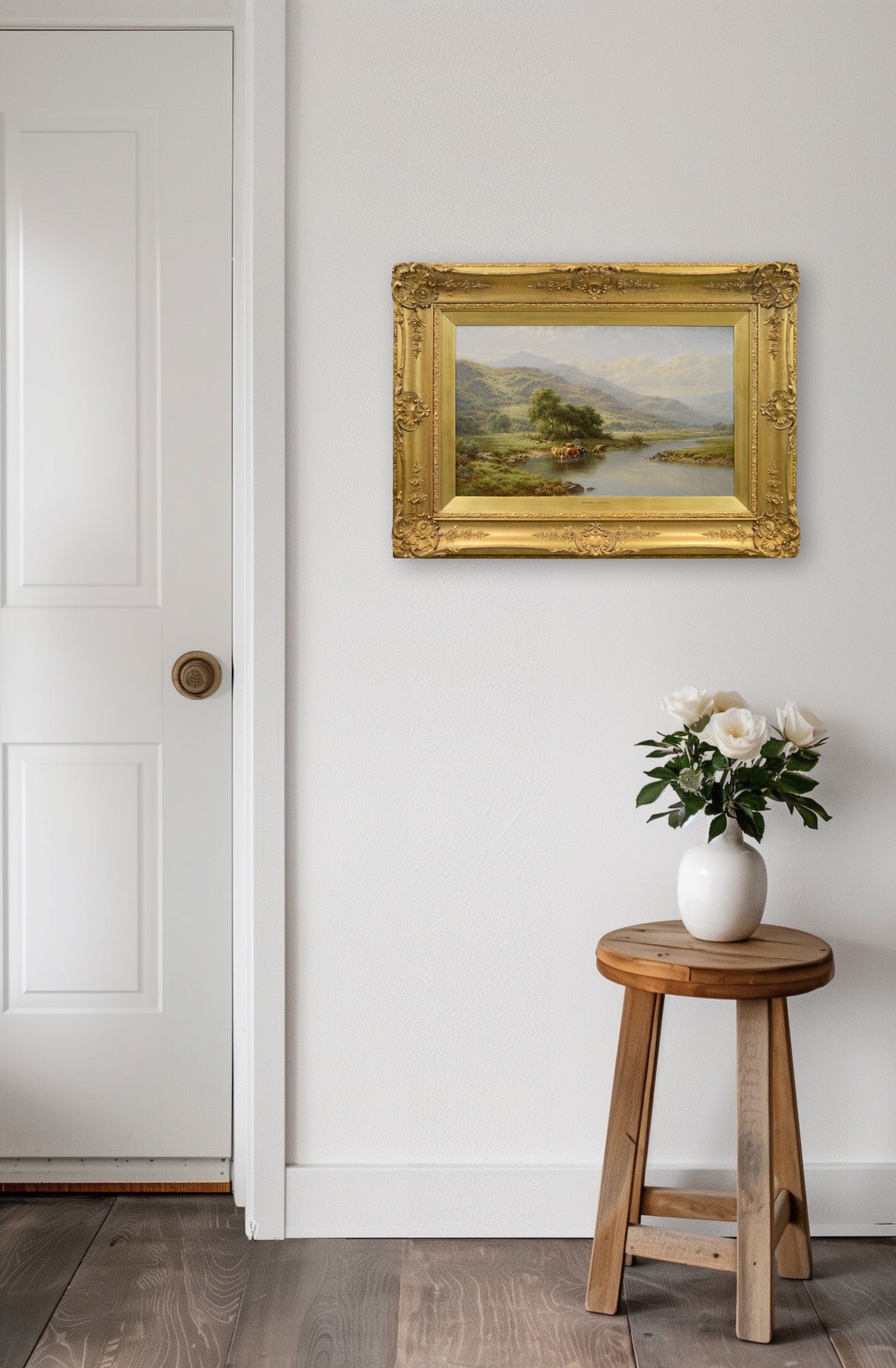
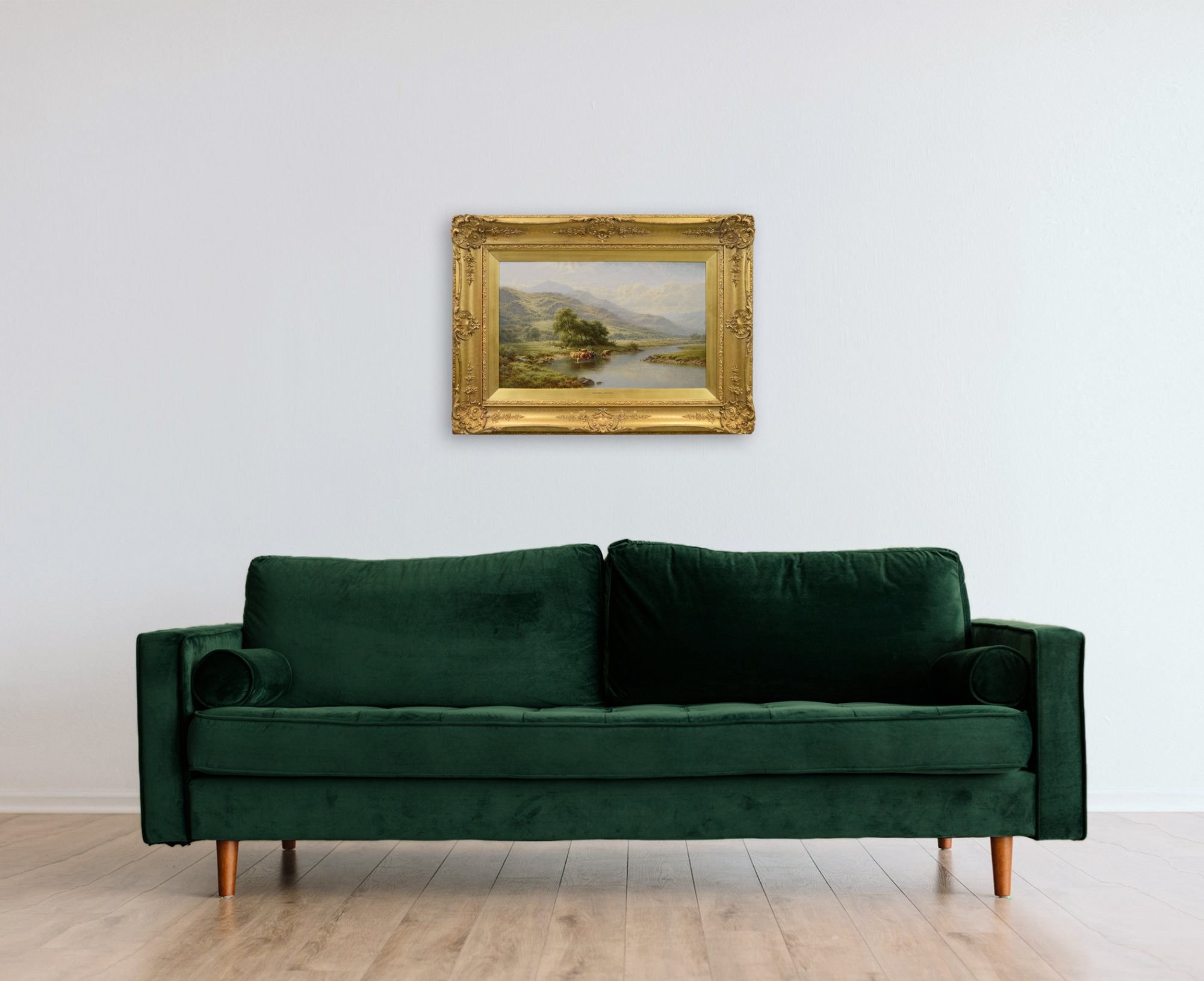
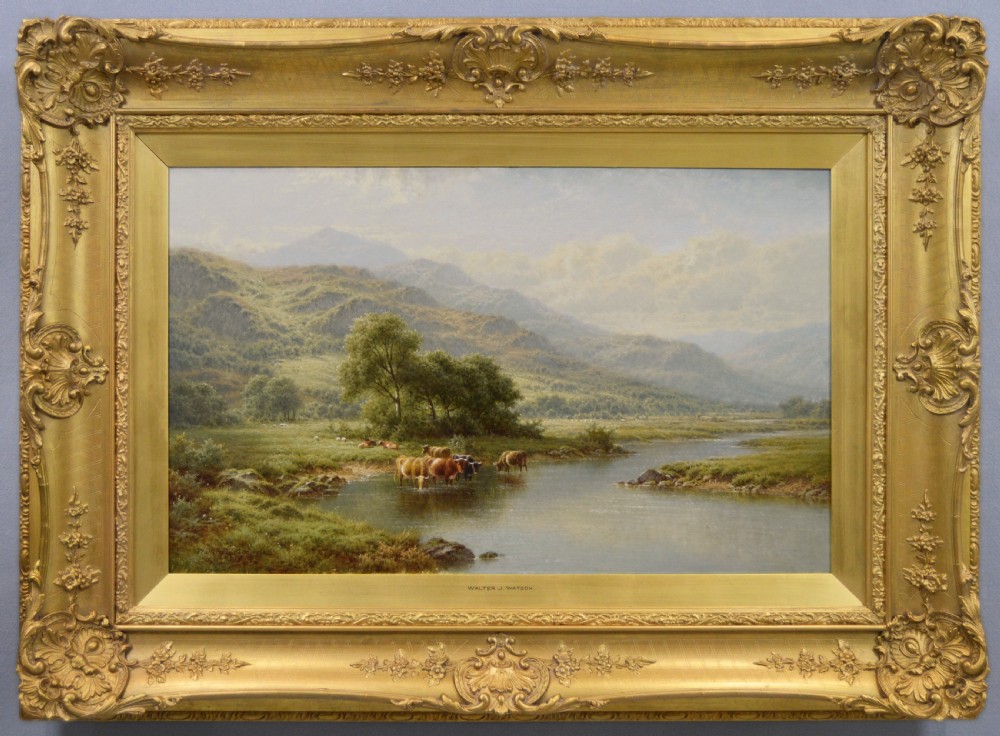
An atmospheric river landscape painting of the Llugwy in North Wales. Cattle are shown watering by the river in the foreground, whilst sheep graze in the distant meadow. Beyond, can be seen the awe inspiring peaks of the Snowdonia mountain range.

Walter James Watson was born 21 Aug, 1877 in Seacombe, Cheshire, England the son of the artist William Watson Jnr (1847-1921) and his wife Ellenor Davies. He was part of the Watson family of artists which included his grandfather William Watson Snr 1809-1871 and his uncles Charles Watson (1837-1900) and Robert Watson (1855-1921). His siblings, Caroline Ellen Watson (1871-1947), William Robert Charles Watson (1873-1928) and Sidney Watson (1881-1931) also became artists.

Watson spent his first year living in Cheshire before the family moved to Station Road, Maghull in Liverpool around 1878. He was initially taught art by his father, most likely alongside his siblings before studying at the Wallasey School of Art in Liverpool. Although he was influenced by his father in both style and subject matter, his paintings have a softer and more subtle palette. Whilst many of his works are pastoral featuring cattle or sheep, it is the landscape that is the main focus.

After graduating in 1896 he began working as a full time artist and often accompanied his father and brothers on painting trips to Wales and the Scottish Highlands. He started exhibiting locally at the Walker Art Gallery, Liverpool and in 1899 exhibited at Rodman & Co’s annual exhibition in Belfast. He made his debut at the Royal Cambrian Academy in 1903 and his works were also exhibited at Frost and Reed in 1905. He remained unmarried and lived with his parents in Birkenhead staying with his parents until his father’s death in 1921 and his mother’s in 1923.

He was made an associate of the Royal Cambrian Academy in 1923 and continued to paint and exhibit throughout his life. He spent his final years living at Roslyn, Oswestry where he died on 23 July, 1963.

Presentation: The painting is housed in its original gilt frame which is in excellent condition. The reverse bears an old label for the fine art dealer George Hughes of Newcastle on Tyne. Hughes worked as a carver and gilder for a number of years before establishing a fine art gallery at 50 and 52, Pilgrim Street in Newcastle in 1907. His gallery was based at Bewick House and his workshop at Wellington Place. The dealership remained in business at Pilgrim Street until around 1939.

Condition: As with all of our original antique oil paintings, this work is offered in ready to hang gallery condition, having been professionally cleaned, restored and revarnished.

© Benton Fine Art

Physical Dimensions
Height
68.5cm (26.97")
Width
94cm (37.01")
Depth
9cm (3.54")
Declaration

Benton Fine Art has dated this Welsh Landscape Oil Painting to the 1920s.

Reference Numbers
Sellingantiques Reference
SA1065212
Dealers Notes

Members of the British Antique Dealers Association (BADA) the London and Provincial Antique Dealers Association (LAPADA).

We use a professional, fully insured and tracked door to door service for our UK and international deliveries. Please contact us for further information and shipping quotes.

Viewing is by APPOINTMENT ONLY. However, we can also arrange for you to view the item in your home, depending on the location.

For a wider range of stock please visit www.bentonfineart.com.

If you would like to purchase this item or have any questions, please email us at pictures@bentonfineart.com or call 07710 540549.

© Benton Fine Art

Description
Walter J Watson

British, (1877-1963)

On the Llugwy, North Wales

Oil on canvas, signed & dated 1922, further inscribed verso

Image size: 15.5 inches x 25.5 inches

Size including frame: 27 inches x 37 inches

fig 1. An oil painting depicting cattle watering in the River Llugwy with Welsh mountains in the background, housed in an elaborate gold gilt frame.
fig 1. Welsh Landscape Oil Painting of Cattle Near the River Llugwy, North Wales by Walter J Watson

Provenance: George Hughes, Fine Art Dealer, 50 & 52, Pilgrim Street, Newcastle on Tyne

An atmospheric river landscape painting of the Llugwy in North Wales. Cattle are shown watering by the river in the foreground, whilst sheep graze in the distant meadow. Beyond, can be seen the awe inspiring peaks of the Snowdonia mountain range.

Walter James Watson was born 21 Aug, 1877 in Seacombe, Cheshire, England the son of the artist William Watson Jnr (1847-1921) and his wife Ellenor Davies.
Benton Fine Art

He was part of the Watson family of artists which included his grandfather William Watson Snr 1809-1871 and his uncles Charles Watson (1837-1900) and Robert Watson (1855-1921). His siblings, Caroline Ellen Watson (1871-1947), William Robert Charles Watson (1873-1928) and Sidney Watson (1881-1931) also became artists.

fig 2. An oil painting depicting cattle watering in the River Llugwy with Welsh mountains in the background, housed in an elaborate gold gilt frame.
fig 2. Welsh Landscape Oil Painting of Cattle Near the River Llugwy, North Wales by Walter J Watson

Watson spent his first year living in Cheshire before the family moved to Station Road, Maghull in Liverpool around 1878. He was initially taught art by his father, most likely alongside his siblings before studying at the Wallasey School of Art in Liverpool. Although he was influenced by his father in both style and subject matter, his paintings have a softer and more subtle palette. Whilst many of his works are pastoral featuring cattle or sheep, it is the landscape that is the main focus.

fig 3. An oil painting depicting cattle watering in the River Llugwy with Welsh mountains in the background, housed in an elaborate gold gilt frame.
fig 3. Welsh Landscape Oil Painting of Cattle Near the River Llugwy, North Wales by Walter J Watson

After graduating in 1896 he began working as a full time artist and often accompanied his father and brothers on painting trips to Wales and the Scottish Highlands. He started exhibiting locally at the Walker Art Gallery, Liverpool and in 1899 exhibited at Rodman & Co’s annual exhibition in Belfast. He made his debut at the Royal Cambrian Academy in 1903 and his works were also exhibited at Frost and Reed in 1905. He remained unmarried and lived with his parents in Birkenhead staying with his parents until his father’s death in 1921 and his mother’s in 1923.

fig 4. An oil painting depicting cattle watering in the River Llugwy with Welsh mountains in the background, housed in an elaborate gold gilt frame.
fig 4. Welsh Landscape Oil Painting of Cattle Near the River Llugwy, North Wales by Walter J Watson

He was made an associate of the Royal Cambrian Academy in 1923 and continued to paint and exhibit throughout his life. He spent his final years living at Roslyn, Oswestry where he died on 23 July, 1963.

fig 5. An oil painting depicting cattle watering in the River Llugwy with Welsh mountains in the background, housed in an elaborate gold gilt frame.
fig 5. Welsh Landscape Oil Painting of Cattle Near the River Llugwy, North Wales by Walter J Watson

Presentation: The painting is housed in its original gilt frame which is in excellent condition. The reverse bears an old label for the fine art dealer George Hughes of Newcastle on Tyne. Hughes worked as a carver and gilder for a number of years before establishing a fine art gallery at 50 and 52, Pilgrim Street in Newcastle in 1907. His gallery was based at Bewick House and his workshop at Wellington Place. The dealership remained in business at Pilgrim Street until around 1939.

Condition: As with all of our original antique oil paintings, this work is offered in ready to hang gallery condition, having been professionally cleaned, restored and revarnished.

© Benton Fine Art

Height
68.5cm (26.97")
Width
94cm (37.01")
Depth
9cm (3.54")
Date of Manufacture

Benton Fine Art has dated this Welsh Landscape Oil Painting to the 1920s.

Reference Numbers
Sellingantiques Ref
SA1065212
Benton Fine Art
Benton Fine Art
Sellingantiques verified Since Sep 2012

Specialists in 19th & early 20th century original oil paintings by listed artists

Dealer Profile

You can view the stock and full dealer information on the Benton Fine Art Profile Page

Trade Associations

Benton Fine Art is a registered member of LAPADA  BADA  CINOA
PDF SHARE
SAVE
An oil painting depicting cattle watering in the River Llugwy with Welsh mountains in the background, housed in an elaborate gold gilt frame.
1 / 12
Archive I An oil painting depicting cattle watering in the River Llugwy with Welsh mountains in the background, housed in an elaborate gold gilt frame.

Welsh Landscape Oil Painting of Cattle Near the River Llugwy, North Wales by Walter J Watson

Archive II An oil painting depicting cattle watering in the River Llugwy with Welsh mountains in the background, housed in an elaborate gold gilt frame. View II
Archive III An oil painting depicting cattle watering in the River Llugwy with Welsh mountains in the background, housed in an elaborate gold gilt frame. View III
Archive IV An oil painting depicting cattle watering in the River Llugwy with Welsh mountains in the background, housed in an elaborate gold gilt frame. View IV
Archive V An oil painting depicting cattle watering in the River Llugwy with Welsh mountains in the background, housed in an elaborate gold gilt frame. View V
Archive VI An oil painting depicting cattle watering in the River Llugwy with Welsh mountains in the background, housed in an elaborate gold gilt frame. View VI
Archive VII An oil painting depicting cattle watering in the River Llugwy with Welsh mountains in the background, housed in an elaborate gold gilt frame. View VII
Archive VIII An oil painting depicting cattle watering in the River Llugwy with Welsh mountains in the background, housed in an elaborate gold gilt frame. View VIII
Archive IX An oil painting depicting cattle watering in the River Llugwy with Welsh mountains in the background, housed in an elaborate gold gilt frame. View IX
Archive X An oil painting depicting cattle watering in the River Llugwy with Welsh mountains in the background, housed in an elaborate gold gilt frame. View X
Archive XI An oil painting depicting cattle watering in the River Llugwy with Welsh mountains in the background, housed in an elaborate gold gilt frame. View XI
Archive XII An oil painting depicting cattle watering in the River Llugwy with Welsh mountains in the background, housed in an elaborate gold gilt frame. View XII
FURTHER BROWSING

Visitors also looked at these ⇣

Enlarged Archival View
Telephone 07710 540 549
Location
Near Broadway
Worcestershire
United Kingdom

By appointment only.
Verified Since Sep 2012
Items For Sale 210
Benton Fine Art
Benton Fine Art
Verified Since Sep 2012
View Dealer Info
Location: Near Broadway, Worcestershire, United Kingdom, , By appointment only.
Verified
Sep 2012
For Sale
210
An oil painting depicting cattle watering in the River Llugwy with Welsh mountains in the background, housed in an elaborate gold gilt frame.
Welsh landscape oil painting of cattle near the river Llugwy, North Wales by Walter J Watson
Ref: SA1065212
An oil painting depicting cattle watering in the River Llugwy with Welsh mountains in the background, housed in an elaborate gold gilt frame.
Detail View 1
Detail View 2
Detail View 3
Detail View 4
Detail View 5
Detail View 6
Detail View 7
Detail View 8
Detail View 9
Detail View 10
Detail View 11
Archival Detail
Every single antique dealer on our platform is individually approved by our internal team. We verify their professional trade history, ethical standards, and photographic quality to ensure a secure, high-standard buying environment. Upon joining, every dealer agrees to a strict 9-point code of conduct. While issues can occasionally arise, our dealers typically resolve them swiftly and directly with the buyer. In fact, since our founding in 2002, Sellingantiques has only had to step in to help resolve an issue on roughly five occasions—a true testament to the quality of our dealers and their dedication to your happiness.
Our dealers are highly experienced in packing and shipping fragile, high-value antiques. Because you are in direct contact with the dealer, you will be able to easily go through all available shipping and insurance options together to ensure your item arrives safely.
Antiques are the ultimate green purchase. By choosing historical pieces over newly manufactured goods, you completely eliminate the carbon footprint of modern mass production while preserving exceptional, timeless craftsmanship.

Victorian pastoral landscape painting emerged in 19th-century Britain, focusing on naturalistic countryside scenes, rivers, livestock, and changing weather conditions. Artists emphasized romanticised rural life and natural topography, often inspired by regions like North Wales, the Lake District, and the Scottish Highlands.

Paintings from this era were rendered in oil pigments on stretched linen or cotton canvas, sometimes mounted on wood panels. Frames were typically crafted from softwood timber coated with carved plaster or moulded composition ornament, finished with gold leaf gilded surfaces.

Authentic period paintings display age-appropriate craquelure patterns across the paint surface, natural yellowing of historical varnishes, and oxidisation on the reverse of the canvas and wooden stretcher keys. Period gilt frames often show red bole underlying the gold leaf where wear has occurred.

Position the painting as a focal point above a fireplace mantelpiece, sideboard, or console table to anchor the room. Pairing gilt-framed artwork with neutral walls or contemporary furniture creates an effective contrast between historical traditional art and modern design.

Keep the painting away from direct sunlight, working radiators, and high humidity to prevent canvas warping and paint flaking. Dust the surface and ornate frame gently using a soft, dry camel-hair brush, avoiding water, chemical cleaners, or abrasive cloths.
items
Add keywords to the filter
Price
£100
£250000
Era
Movements
Material
Origin
Stock Location
Freshness
Online Payments
Categories