
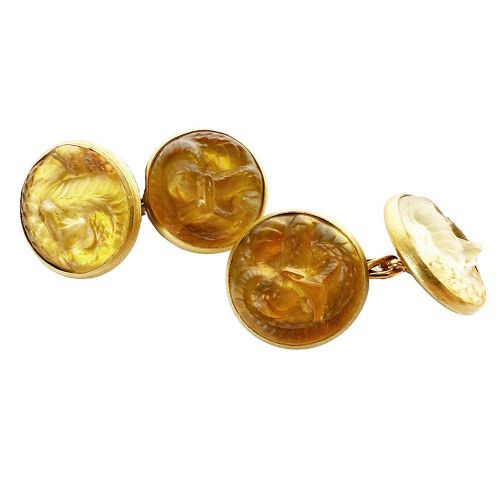


Yellow Gold Sleeve Links
Yellow gold sleeve links bring quiet distinction to a cuff, offering substantial weight and warmth across Victorian, Edwardian, and mid-century designs.
Yellow Gold Sleeve Links
Yellow gold sleeve links encompass gentlemen's fastenings fashioned primarily in nine-carat, fifteen-carat, and eighteen-carat gold, frequently incorporating precious stones, enamel, or moulded glass. These pieces span from the late nineteenth century through the Victorian, Edwardian, Art Nouveau, and Art Deco eras into mid-century British designs.
The most common examples on this page feature geometric enamel work from the 1930s or organic motifs executed in yellow gold during the early twentieth century. Buyers encounter double-sided variations with belt motif engravings alongside simpler chain-linked configurations meant for formal or daily wear.
Materials and construction methods
These items rely on solid yellow gold alloys combined with decorative additions such as vitreous enamel, cabochon banded agate, and moulded glass. Artisans shaped the metal through casting, stamping, and detailed hand engraving to produce motifs like mistletoe leaves and serpentine forms.
Makers utilised chain links and rigid bars to connect the faces of the fastenings, ensuring secure placement through standard buttonholes. Surface decoration often involved flush-setting multi-gem stones or fusing coloured glass and enamel directly into recessed metal channels.
The listings span eight distinct decades of production, ranging from Victorian belt motif engravings to mid-century British designs.
Factors determining quality
The distinction between ordinary and superior pieces rests on the weight of the gold alloy and the precision of the hand-applied enamel or gemstone setting. Pieces featuring intact vitreous enamel without chips or extensive surface scratching demonstrate better preservation and superior original craftsmanship.
Makers such as R Lalique, Payton Pepper & Co, and Toye Kenning & Spencer introduced specific artistic merit through sculptural glass and registered company hallmarks. Clear stamps denoting maker marks and metal purity elevate an item beyond unmarked commercial production.
R Lalique·Payton Pepper & Co
The Yellow Gold Sleeve Links Glossary
- Cufflinks
- Fastenings for shirt cuffs, historically termed sleeve links, consisting of two decorative faces joined by a rigid bar or flexible chain. They became standard gentlemen's accessories during the nineteenth century.
- Vitreous Enamel
- A material made by fusing powdered glass to a metallic substrate at high temperatures. This technique creates a durable, glossy coloured surface popular in Art Deco and earlier jewellery.
- Cabochon
- A gemstone shaped and polished with a smooth, rounded top rather than faceted edges. This cut highlights the natural banding of stones like agate.
- Double Sided
- A construction style where both ends of the fastening feature an ornamental face rather than a simple T-bar or plain toggle. This format shows decorative detail from every angle.
Yellow Gold Sleeve Links: Frequently Asked Questions
How do I date yellow gold sleeve links?
Dating relies heavily on hallmarks, closure types, and stylistic indicators such as geometric Art Deco patterns or flowing Art Nouveau plant motifs. Comparing the construction against known manufacturing periods helps narrow down the decade of origin.
Makers' marks and metal purity stamps registered with assay offices provide the most reliable chronological markers for pieces produced from the Victorian era onwards.
Are these sleeve links suitable for daily wear?
Solid gold fastenings designed with sturdy chain links or fixed bars withstand regular use when handled with reasonable care. Enamelled and glass variations require slightly more attention to prevent impact damage to the decorative surfaces.
Storing them individually prevents scratching against other metal items in a collection.
What is the difference between nine-carat and eighteen-carat gold?
Eighteen-carat gold contains a higher proportion of pure gold combined with alloy metals, resulting in a richer colour and heavier feel. Nine-carat gold offers increased durability and hardness due to the higher ratio of strengthening alloys.
Both purities appear frequently across antique and vintage gentleman's accessories.
How should I clean antique sleeve links?
Cleaning requires warm water, mild soap, and a soft cloth to remove everyday oils without disturbing delicate enamel or gemstone settings. Ultrasonic cleaners should be avoided if the piece contains glass inserts or vulnerable adhesives.
Professional assessment is recommended before attempting to clean items with historic patination or intricate multi-gem layouts.