



Wooden Scroll Sofa
A wooden scroll sofa brings architectural dignity and sweeping scrolled timberwork to a traditional interior.
Wooden Scroll Sofa
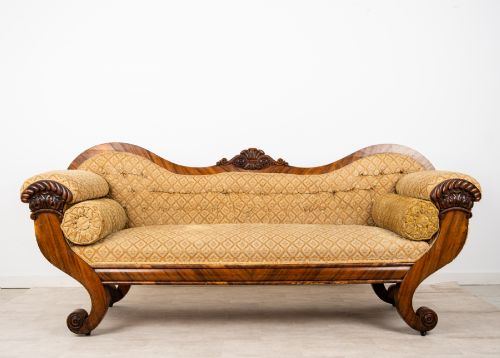
A wooden scroll sofa is a substantial seating piece defined by curved wooden terminals at the arms or back. The pieces found here span the Regency, Victorian, and William IV periods, alongside specific regional interpretations.
Most examples rely on dense timbers like rosewood, mahogany, and walnut, often featuring carved scroll ends and exposed wooden frames. Forms range from classical day beds and French-influenced récambiers to country house settees and Anglo-Indian carved benches.
Buyers meet variations that include simulated rosewood finishes, ebonised surfaces, and upholstered backs paired with turned legs and brass castors. These forms reflect design shifts from the grand Regency era through to the late Victorian period.
How they were made
Construction relies on solid hardwoods such as mahogany, walnut, and rosewood, chosen for their strength and grain pattern. Cabinet makers shaped these dense materials into sweeping scroll arms and structural frames using traditional joinery.
Surface finish is integral, utilising polished wood, ebonisation, or simulated grain effects to mimic exotic timbers. Upholstery fabrics, Hessian support layers, and carved wooden detailing complete the construction of each frame.
Wooden Scroll Sofa Retail Price Guide 2026
Typical asking prices for wooden scroll sofa among the pieces listed under this phrase on Sellingantiques today, from the lower quarter to the upper quarter. They describe what is for sale here now, not the wider market.
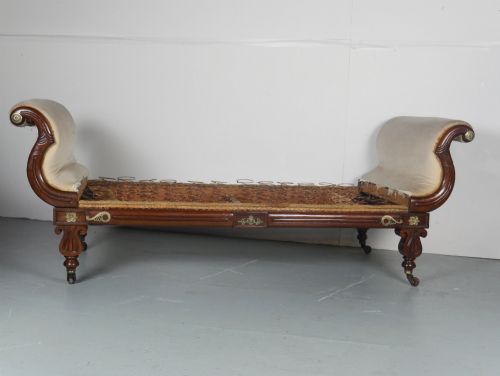
Original castors on late Victorian day beds reveal that even nineteenth-century furniture required easy rearrangement for afternoon tea.
What varies in quality
Quality rests upon the crispness of the timber carving on the scroll ends and the selection of figured wood veneers or solid stock. Superior pieces exhibit deeply sculpted woodwork and stable frame construction that withstands centuries of use.
The sophistication of the period style dictates the visual merit, with refined Regency and William IV proportions standing apart from simpler regional or later vernacular interpretations.
James Mein of Kelso·Thomas Hope
The Wooden Scroll Sofa Glossary
- Scroll end
- A wooden terminal shaped into a tight or sweeping spiral curve, forming the arm or back support of the sofa. This defining feature is often carved from solid mahogany, walnut, or rosewood.
- Récamier
- A type of day bed or sofa with two raised ends, one typically higher than the other, named after the portrait of Madame Récamier. It appears in Regency and William IV furniture design.
- Simulated rosewood
- A painted or stained wood finish designed to imitate the rich dark grain and figuring of genuine rosewood. It was utilised during the nineteenth century as an alternative to expensive imported timber.
- Ebonised
- Wood treated with a chemical stain or finish to achieve the deep black appearance of ebony. This technique highlights carved scroll details on nineteenth-century seating.
- Hessian
- A coarse woven fabric utilised as a traditional foundation layer beneath upholstery. It provides internal support and breathability for the horsehair or stuffing inside period seats.
Wooden Scroll Sofa: Frequently Asked Questions
What is a wooden scroll sofa?
A wooden scroll sofa is a nineteenth-century seating form characterised by prominent curved wooden terminals at the arms or back. These pieces utilise dense timbers like mahogany, walnut, and rosewood.
They serve as both functional seating and architectural focal points, reflecting design movements from the Regency to the late Victorian era.
How do I identify a Regency scroll sofa?
Regency examples display classical proportions, often incorporating rolled scroll ends, polished mahogany or rosewood, and restrained carved details. The overall silhouette draws on ancient Greek and Roman furniture archetypes.
Cabinet makers of this period favoured clean architectural lines combined with dramatic timber grain and subtle brass mounts.
Where should I place a scroll sofa?
These sofas suit large reception rooms, libraries, or central hallway spaces where the carved timber back and scroll ends remain visible. Their architectural presence benefits from placement away from walls.
Pairing the sofa with period tables or complementary seating helps integrate the piece into a traditional interior scheme.
What is the difference between a day bed and a settee?
A day bed is designed primarily for reclining, featuring a single raised headrest or asymmetrical scroll ends intended for resting. Settees offer formal upright seating with symmetrical backrests and arm supports.
Both forms utilise exposed wooden scrollwork, but their internal framing and intended domestic uses diverge.