





Wooden Savonarola Chair
A wooden savonarola chair offers a folding X-frame structure with striking historical character, making it a distinctive accent piece for any interior.
Wooden Savonarola Chair
A wooden savonarola chair is an X-frame folding seat rooted in Renaissance design, taking several stylistic routes on this page. These pieces appear most frequently as 19th century revival items, drawing on Renaissance, Victorian, and Edwardian tastes.
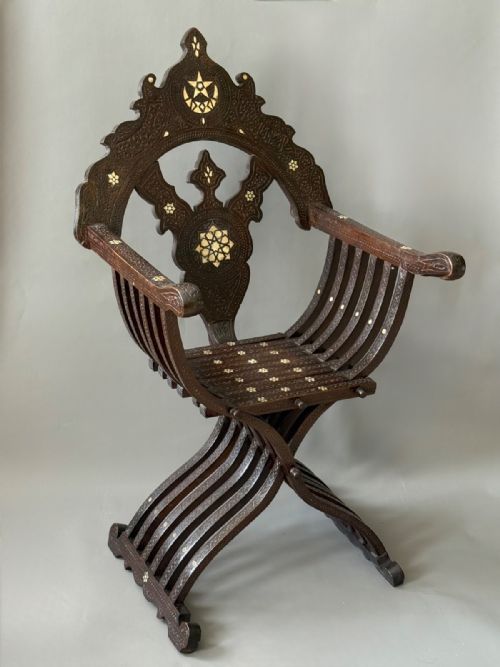
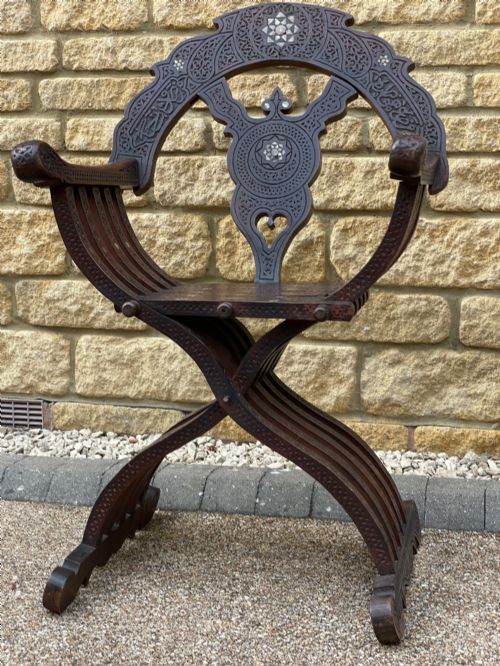
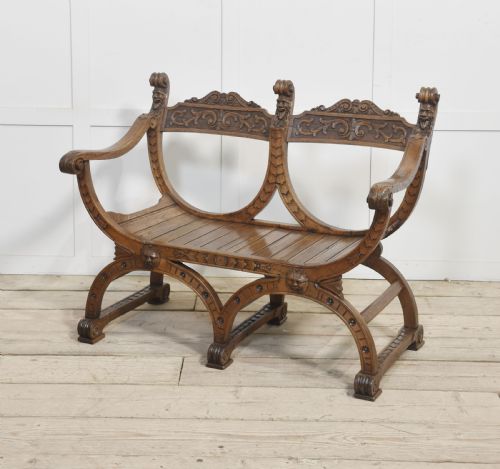
The selections on this page encompass various regional interpretations including Syrian, Ottoman, Islamic, Moorish, and Anglo-Indian designs. Alongside traditional armchairs, the inventory includes benches and accent chairs sharing the characteristic X-frame silhouette.
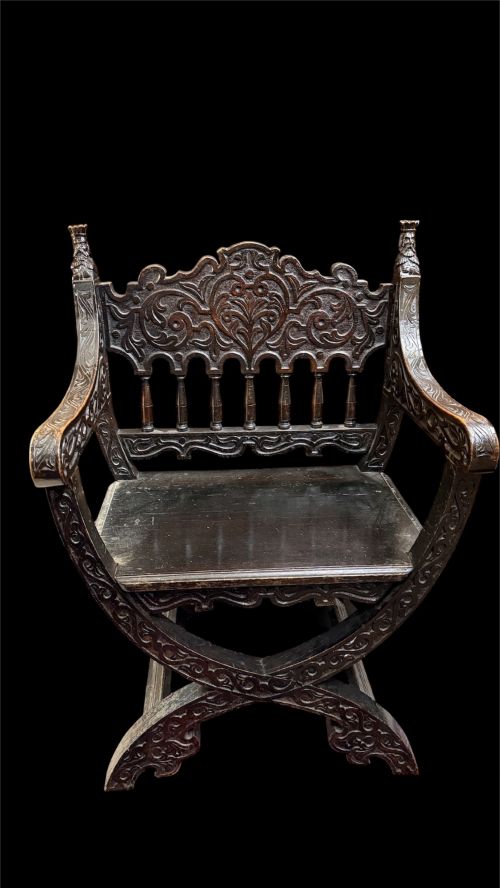
Makers such as White, Allom & Co. produced notable examples during the 19th century, while other pieces emerge from anonymous workshops in oak, walnut, and mahogany. Buyers encounter both carved wooden surfaces and elaborately inlaid variants featuring mother-of-pearl.
How they were made
Makers constructed these X-frame seats using hardwoods like walnut, oak, and mahogany, shaped through traditional joinery and turning techniques. Structural elements often rely on interlocking curved slats that allow the chair to fold or assemble securely.
Surface decoration defines many examples on this page, employing intricate hand-carving alongside detailed inlay work using mother-of-pearl. Some regional interpretations incorporate textile elements to soften the wooden frame.
Wooden Savonarola Chair Retail Price Guide 2026
Typical asking prices for wooden savonarola chair among the pieces listed under this phrase on Sellingantiques today, from the lower quarter to the upper quarter. They describe what is for sale here now, not the wider market.
Listings feature periods spanning the mid-19th century through the Edwardian era, incorporating oak, walnut, mahogany, and mother-of-pearl.
What varies in quality
Quality in a wooden savonarola chair rests on the precision of the joinery and the integrity of the folding mechanism. Superior pieces maintain structural stability without excessive looseness in the intersecting X-frame pivots.
The depth and execution of the carving or mother-of-pearl inlay separate standard production from finer cabinetmaking. Distinctive regional detailing and choice of timber further elevate the character of individual examples.
White Allom & Co
The Wooden Savonarola Chair Glossary
- X-frame
- A structural chair design formed by intersecting curved wooden members that create a scissors-like support. This ancient configuration allows the furniture piece to fold flat.
- Inlay
- A decorative technique where contrasting materials such as mother-of-pearl are embedded into recesses within the wooden surface. This method creates flat, ornate patterns across the backrests and frames.
- Renaissance Revival
- A 19th-century aesthetic movement that reinterprets 15th and 16th-century European art and architecture. Furniture in this style adopts classical motifs and heavy wooden proportions.
- Moorish Revival
- An architectural and decorative style incorporating elements of traditional Islamic design from North Africa and Spain. Pieces often feature intricate geometric patterns and lattice carving.
Wooden Savonarola Chair: Frequently Asked Questions
Did these chairs actually fold?
Many traditional wooden savonarola chairs use an interlocking X-frame construction designed to collapse or disassemble easily. This portable heritage dates back to periods when furniture needed to move between rooms or residences.
However, centuries of use mean some surviving examples have fixed joints or reinforced pivots. Buyers should examine the specific framing if folding functionality is desired.
How do I style a savonarola chair?
These distinctive X-frame seats work effectively as accent chairs in studies, hallways, or living rooms where their silhouette stands out. Their compact footprint allows them to occupy awkward corners without overwhelming the space.
Pairing the chair with neutral surroundings lets the carved woodwork or mother-of-pearl inlay take visual precedence. They also serve well alongside larger traditional seating arrangements.
How are different regional styles distinguished?
Regional variations appear primarily through surface ornament and material treatment rather than basic frame geometry. Syrian and Ottoman interpretations frequently employ dense mother-of-pearl inlay and geometric Islamic motifs.
By contrast, European revival pieces tend to emphasise deep relief carving, classical strapwork, and exposed oak or walnut grain. Anglo-Indian examples introduce distinct colonial turning and carving traditions to the standard X-frame.
What woods were used for these chairs?
Cabinetmakers utilised dense hardwoods capable of supporting the stress placed on intersecting X-frames. Walnut, oak, and mahogany appear regularly across the listed pieces, providing durability and stable grain for carving.
Some regional workshops utilised native timbers supplemented by exotic contrasting woods for inlay work. The choice of material often reflects the period and geographic origin of the maker.