
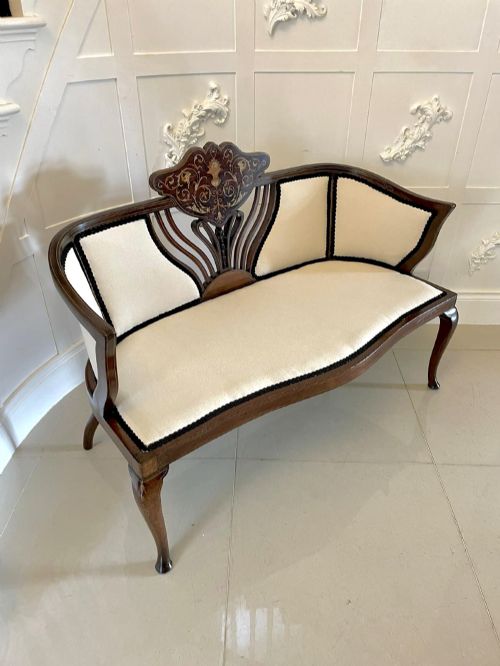


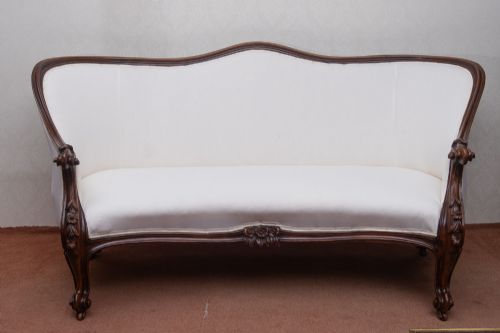


Wooden Parlour Settee
A wooden parlour settee brings domestic seating from the nineteenth and early twentieth centuries into modern rooms with timeless grace.
Wooden Parlour Settee
A wooden parlour settee is a communal seat designed for reception rooms, drawing upon periods ranging from the Regency era through to the early twentieth century. When you search for a wooden parlour settee, you encounter two-seater sofas, salon benches, and multi-piece parlour suites intended for formal entertaining.
The most common versions on this page date from the Victorian and Edwardian periods, constructed predominantly in mahogany with varied upholstery. These pieces reflect the evolving domestic comfort of the nineteenth century, shifting from rigid formal frames towards lighter salon arrangements.
Makers and manufacturers produced these settees in distinct stylistic revivals, including Rococo, Louis XVI, and French Empire styles. Alongside standard settees, buyers will find related forms such as canapes and twin-seat bedroom sofas.
What varies in quality
Quality in a wooden parlour settee rests upon the crispness of the timber carving and the precision of the cabinetwork. Finer examples display deeply carved mouldings and tight, seamless joints that demonstrate skilled joinery.
The sophistication of the surface decoration differentiates standard production from exceptional pieces. Superior settees incorporate detailed satinwood and boxwood inlay alongside carefully selected mahogany grain rather than plain painted surfaces.
Proportion and structural integrity define the upper tier of these items. A well-balanced frame retains its original rigidity and elegant silhouette, whether executed in a restrained Edwardian style or a more elaborate Victorian revival form.
Listings feature mahogany predominantly, alongside walnut, satinwood, and mixed textile upholstery across Victorian and Edwardian periods.
The Wooden Parlour Settee Glossary
- Inlay
- A decorative technique where small pieces of contrasting wood, such as satinwood or boxwood, are fitted into recesses within the primary mahogany surface to form patterns.
- Parlour suite
- A matching set of seating furniture, often comprising a settee and matching armchairs, designed for formal reception rooms.
- Canape
- An ornate, upholstered French-style sofa featuring an exposed wooden frame, popular during revival periods.
- Marquetry
- Elaborate wood veneer arranged in detailed pictorial or geometric designs across the surface of the furniture.
- Cabriole leg
- A furniture leg that curves outward in a convex arc and then bends inward in a concave arc, terminating in a pad or scroll foot.
Wooden Parlour Settee: Frequently Asked Questions
What is a wooden parlour settee?
A wooden parlour settee is an upholstered seat with a visible timber frame, designed during the nineteenth and early twentieth centuries for formal rooms.
These pieces typically seat two people and reflect various historical design movements, from Victorian revival styles to lighter Edwardian aesthetics.
How do I date a parlour settee?
Dating relies on identifying the stylistic markers, timber choices, and construction methods characteristic of specific periods like the Victorian or Edwardian eras.
Earlier nineteenth-century pieces often feature heavier carved mahogany, whereas Edwardian examples tend to display delicate satinwood inlay and lighter proportions.
Where were parlour settees used?
These settees were placed in the formal reception rooms, drawing rooms, and parlours of substantial homes for entertaining guests.
They served as decorative seating for social gatherings, conversation, and musical recitals during the Victorian and Edwardian periods.
Are parlour settees comfortable?
Comfort varies depending on the original design, the depth of the seat, and the style of the upholstered back.
Many salon settees were built primarily for upright sitting during formal visits, though upholstered variants and later Edwardian models offered softer padded support.
What woods were used for settees?
Mahogany is the predominant timber found in these listings, complemented by walnut, satinwood, and various decorative veneers.
Cabinetmakers selected these hardwoods for their strength, rich grain patterns, and suitability for detailed carving and inlay work.