

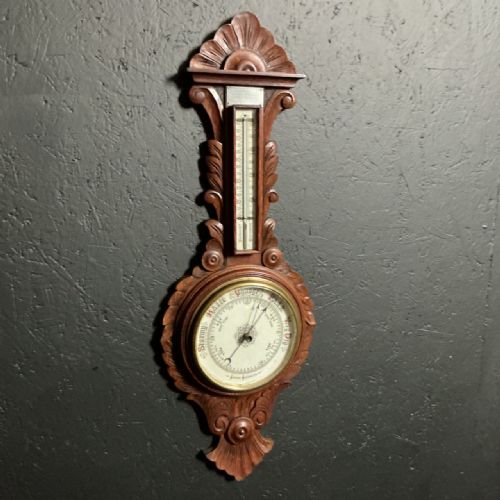

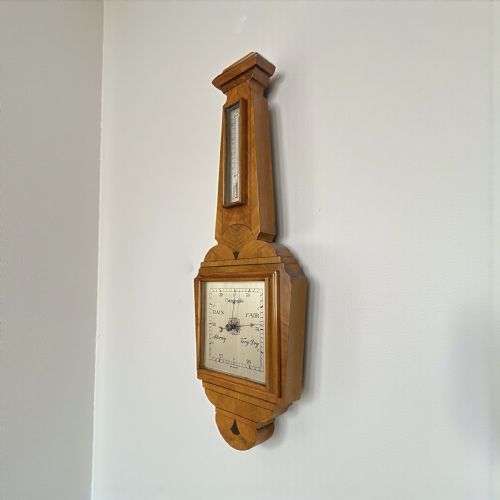
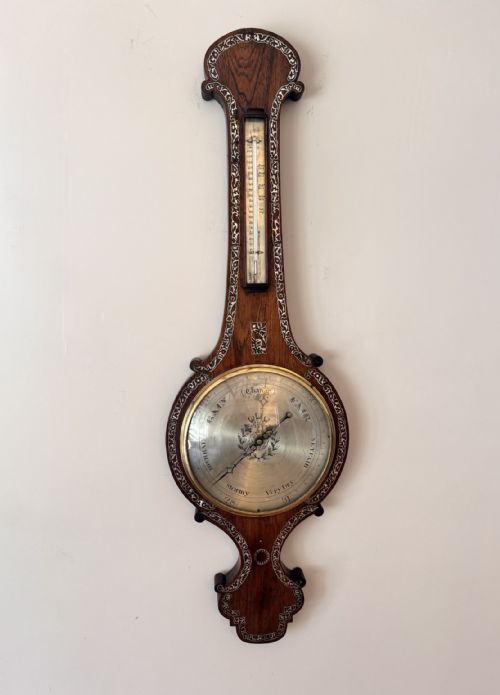
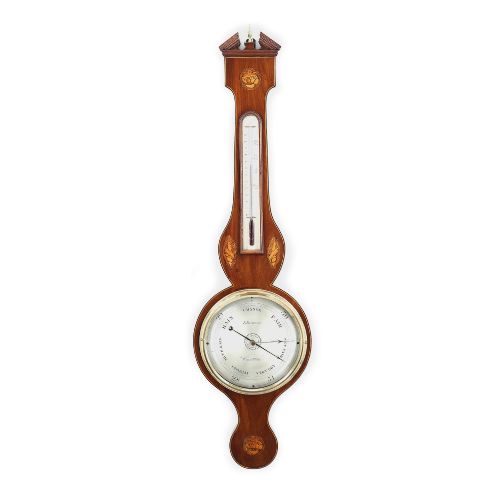
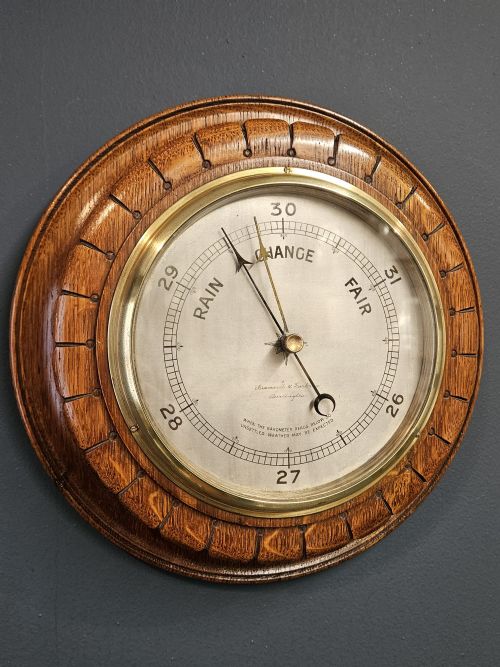




Wooden Dial Barometer
These wooden dial barometers measure atmospheric pressure with practical precision while anchoring a room with rich timber grain.
Wooden Dial Barometer
A wooden dial barometer combines scientific measurement with domestic decoration, housed in timbers such as mahogany, oak, walnut, and rosewood. These instruments record barometric changes using mercury or aneroid movements behind protective glass faces.
The selection here spans from the Regency period through Victorian designs into the Art Deco era of the nineteen-thirties. Wall-hanging banjo styles and wheel barometers predominate, alongside stick barometers and smaller desk accessories.
Makers ranged from provincial towns across Britain to London workshops, producing both domestic hall instruments and specialised marine barometers. Dial faces often feature silvered metal inscribed with weather forecasts and maker signatures.
Materials and construction
Cabinetmakers utilised solid hardwoods like mahogany and oak, frequently shaping them into sweeping banjo frames or architectural cases. Finer examples incorporate decorative wood veneers, bird's eye maple, and delicate mother-of-pearl inlay.
Dials were commonly constructed from silvered metal, engraved with legible graduations and calibrated scales to display atmospheric shifts. Brass bezels, mercury tubes, and glass covers completed the mechanical and visual assembly.
Wooden Dial Barometer Retail Price Guide 2026
Typical asking prices for wooden dial barometer among the pieces listed under this phrase on Sellingantiques today, from the lower quarter to the upper quarter. They describe what is for sale here now, not the wider market.
The listings span multiple eras, encompassing Georgian, Regency, Victorian, Edwardian, and Art Deco periods.
Distinguishing quality in construction
Quality rests in the crispness of the timber carving, the choice of figured wood veneers, and the condition of the silvered brass dial. Elaborate casework featuring birds or classical motifs indicates higher ambition from the maker.
The integrity of the internal movement and the preservation of the original glass and brass bezels separate standard examples from superior survivals. Signed dials by recorded makers provide stronger provenance than unsigned workshop pieces.
B. Besozzi of Weymouth·Bramwell and Harbron of Darlington·Molton of Norwich·Jenkins of Old Swindon·Pillischer London·A. Rivolta·F Salteri and Co., Nottingham·Malacrida of Dublin
The Wooden Dial Barometer Glossary
- Banjo barometer
- A wall barometer housed in a case shaped like a banjo, typically featuring a large circular dial at the base and a thermometer or hygrometer along the stem.
- Aneroid barometer
- An instrument that measures air pressure through the expansion and contraction of a sealed metal box, avoiding the use of liquid mercury.
- Silvered metal
- A brass or copper dial treated with a silver solution to create a matte white surface for engraved weather lettering.
- Stick barometer
- A tall, narrow wall instrument where a long vertical tube displays mercury levels directly against a fixed scale.
- Bezel
- The metal ring that holds the protective glass face securely over the barometer dial.
Wooden Dial Barometer: Frequently Asked Questions
How do I read a wooden dial barometer?
The needle points to graduated markings on the silvered dial, indicating rising or falling atmospheric pressure that corresponds to expected weather conditions.
Secondary indicators, such as a manual pointer set by hand, allow you to track whether pressure has increased or decreased since your last check.
Where should I hang a wooden dial barometer?
Mount the instrument on an interior wall away from direct sunlight, heating vents, and damp areas to protect the timber case and internal mechanism.
Ensure the wall is stable and capable of supporting the weight of the hardwood frame securely.
Can these barometers still be calibrated?
Most aneroid and mercury barometers can be adjusted using a small screw mechanism linked to the internal movement, matching local barometric readings.
Consult a professional restorer if the instrument requires mercury replenishment or internal spring adjustments.
How do I date a wooden dial barometer?
Examine the timber species, case silhouette, and dial typography, as Regency, Victorian, and Art Deco periods employed distinct aesthetic styles.
Maker signatures inscribed on the silvered dial often provide specific trade dates through historical records.