



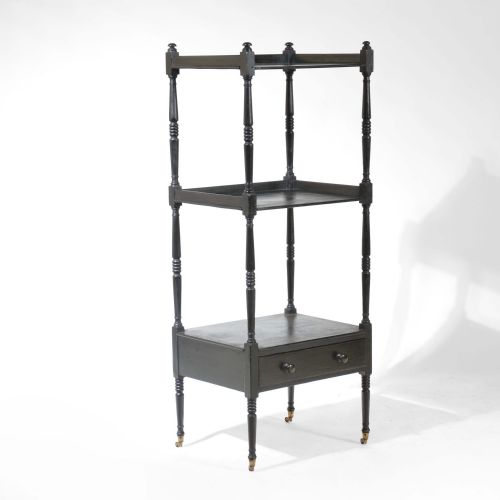

Wooden Corner Etagere
A wooden corner etagere makes the most of awkward angles, offering tiered open shelving crafted from timbers like mahogany and burr walnut.
Wooden Corner Etagere
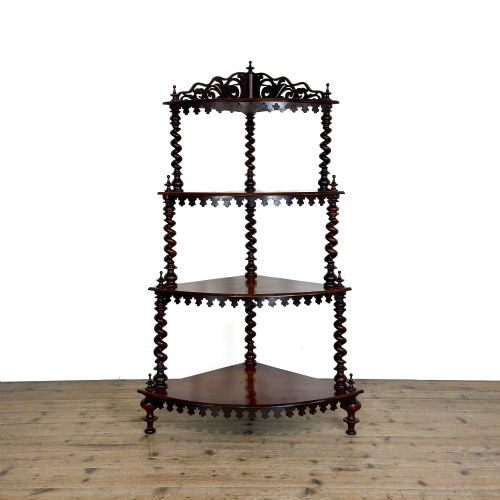
A wooden corner etagere is designed to fit snugly into room angles, providing multiple tiers for display and storage. Buyers searching for a wooden corner etagere encounter varied forms, including multi-tiered whatnots, bow-fronted corner units, and compact shelving stands.
The pieces listed on this page span the Georgian, Regency, and Victorian periods, alongside items from the nineteenth century. These items manifest as corner shelves, display stands, and whatnots with turned supports or mirrored backs.
Most examples found here utilise traditional timbers such as mahogany and burr walnut, occasionally featuring ebonised wood or birdseye maple. The forms range from simple four-tier open shelves to sophisticated designs incorporating lower cupboards.
How they were made
Cabinet makers constructed these etageres predominantly from solid timbers and veneers, relying upon mahogany, walnut, and rosewood for durability and visual depth. Sections are joined with traditional cabinet-making methods, supporting tiered shelving systems secured by turned columns or vertical uprights.
Surface treatments involve polishing the wood to highlight natural grains, particularly in burr walnut and birdseye maple variants. Some pieces integrate brass fixtures, glass panels, or ebonised details to accent the structural framework of the shelves.
Wooden Corner Etagere Retail Price Guide 2026
Typical asking prices for wooden corner etagere among the pieces listed under this phrase on Sellingantiques today, from the lower quarter to the upper quarter. They describe what is for sale here now, not the wider market.
Listings feature pieces from the Georgian, Regency, and Victorian eras, alongside general nineteenth-century examples.
What varies in quality
The standard of a wooden corner etagere depends upon the selection of timber figures, such as the richness of the mahogany grain or the complexity of burr walnut veneers. Superior examples display refined turning on the upright supports and precise joinery at the wall angles.
Proportion and scale dictate the visual success of each piece, with smaller or unusually configured items demonstrating greater cabinet-making skill. Additional elements like integrated mirrors, carved details, or lower cupboards elevate the sophistication of the design.
The Wooden Corner Etagere Glossary
- Etagere
- A piece of furniture consisting of a set of open shelves for displaying small objects or ornaments. It gained popularity during the eighteenth and nineteenth centuries.
- Whatnot
- A multi-tiered shelving unit used for books, ornaments, or display, frequently found in corner configurations. The term reflects its utility for holding whatever was placed upon it.
- Burr walnut
- Wood taken from the burl growth of a walnut tree, producing intricate and swirling grain patterns. Cabinet makers prized it for decorative veneering on high-status furniture.
- Ebonised
- Wood treated with a dark finish to imitate ebony. This technique was frequently utilised during the Victorian era for decorative contrast.
- Birdseye maple
- Timber featuring small, circular markings resembling bird eyes within the grain. It provides a pale, highly decorative surface for nineteenth-century pieces.
Wooden Corner Etagere: Frequently Asked Questions
Where should I place a wooden corner etagere?
These units suit empty room angles, narrow hallways, or dining spaces where floor area is limited. They utilise vertical space efficiently without obstructing movement.
Position them away from direct heat sources to protect the timber and veneers from drying out or splitting over time.
How do I clean and care for the wood?
Dust the tiers regularly with a soft, dry cloth to prevent particulate accumulation in carved or turned areas. Avoid silicone-based sprays, opting instead for traditional beeswax applied sparingly to nourish the polish.
Keep the etagere out of direct sunlight to prevent the mahogany or walnut tones from fading unevenly.
Can these shelves hold heavy items?
Most antique etageres and whatnots were built for display rather than heavy storage. They suit ceramics, small books, and decorative ornaments rather than dense collections.
Ensure the unit sits level in the corner, as uneven floors place strain on the tiered joints and upright supports.
How do I distinguish Georgian pieces from Victorian ones?
Georgian examples often display restrained lines, linear mahogany construction, and simpler architectural proportions. They prioritise functional elegance over excessive ornamentation.
Victorian pieces tend to incorporate heavier timbers, burr walnut veneers, mirrored backs, or revival styles like the Rococo Revival, showing a more exuberant decorative vocabulary.