


White Pottery Mantel Dogs
White pottery mantel dogs bring Victorian hearths to life, offering buyers charming ceramic companions modelled as spaniels, poodles, and terriers.
White Pottery Mantel Dogs
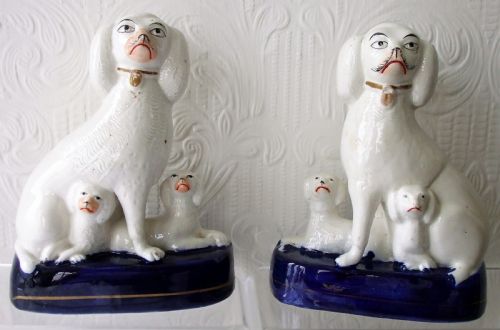
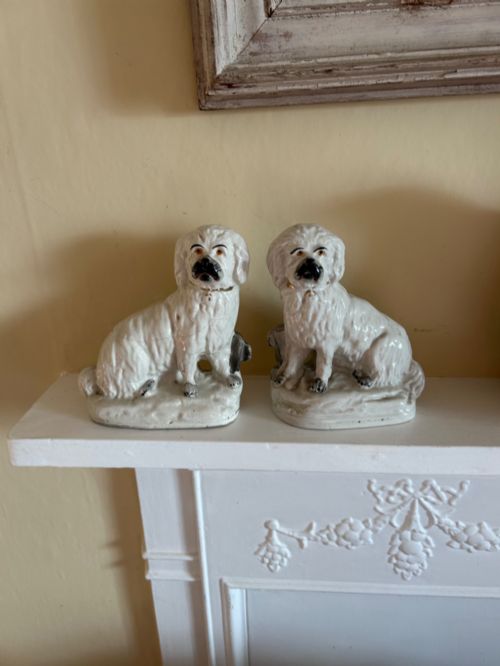
When searching for white pottery mantel dogs, buyers encounter traditional nineteenth century Staffordshire figures designed to sit proudly on fireplace surrounds. These decorative ornaments typically appear in symmetrical pairs, watching over the room from their perch.
The selections span various breeds, featuring seated spaniels, poodles with pups, Maltese terriers, and greyhounds. Most examples date from the Victorian era, particularly around eighteen sixty, eighteen eighty, and nineteen hundred.
Beyond standalone pairs, certain figures incorporate clock groups, musicians, or copper lustre and gilt accents. These ceramic figures capture domestic Victorian sentiment, reflecting the era's fondness for animal companions.
What varies in quality
Scale and complexity also influence the standing of a figure, with grand pairs and elaborate groupings like clock faces or seated poodles with pups demonstrating greater modelling ambition than simpler single figures.
Object types include decorative ornaments, figurines, pottery figures, and clock groups originating from the Victorian period.
Thomas Parr·Beswick
The White Pottery Mantel Dogs Glossary
- Earthenware
- A porous type of pottery fired at lower temperatures, commonly used for nineteenth century Staffordshire figurines before being glazed.
- Lead glaze
- A shiny coating applied to pottery to create a smooth, waterproof surface that enhances the underlying ceramic body and painted decoration.
- Gilt
- A thin layer of gold or gold-coloured material applied to highlight specific areas of the pottery figures, such as collars and chains.
- Copper lustre
- A metallic glaze finish producing a reflective, coppery sheen often found on nineteenth century Staffordshire dog pairs.
- Comforter spaniels
- A popular term for Victorian Staffordshire spaniels traditionally placed on mantelpieces to guard the hearth.
White Pottery Mantel Dogs: Frequently Asked Questions
Where did mantel dogs sit?
These ceramic figures traditionally occupied prominent positions on the mantelpiece above the fireplace in Victorian homes.
Pairs were arranged facing inwards toward each other, keeping watch over the hearth and living space.
Which dog breeds appear most?
Spaniels dominate the selections, alongside poodles, greyhounds, and Maltese terriers.
Some pieces include puppies or feature as part of larger figure groups with musicians.
How do I date these figures?
Dating relies on stylistic details, glazing methods, and recorded production periods from the nineteenth century.
Most surviving examples date from the Victorian era, spanning from the eighteen forties through to nineteen hundred.
Are they always found in pairs?
Symmetrical pairs represent the standard format for mantel display, intended to anchor both ends of a fireplace.
Single figures and smaller groupings do occasionally appear among the earthenware ornaments.