
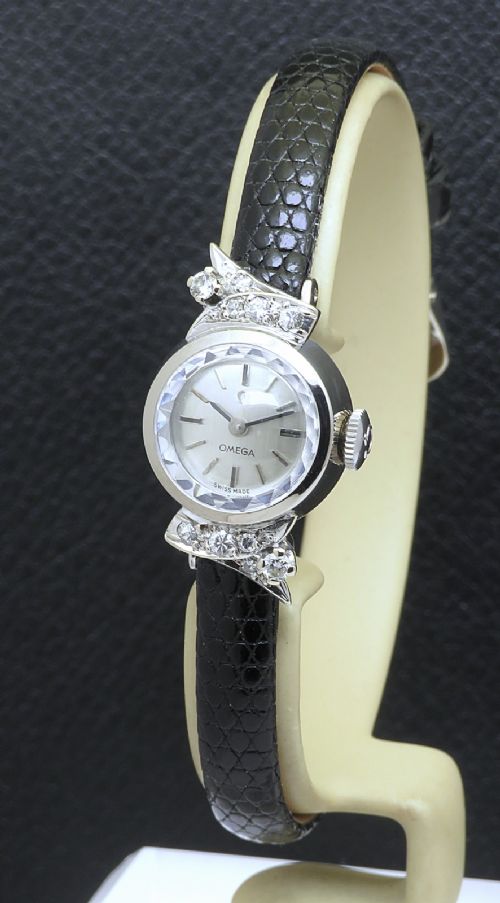


White Gold Ladies Watch
A white gold ladies watch brings together mid-century cocktail glamour and precision horology, offering buyers a delicate timepiece set with diamonds.
White Gold Ladies Watch
A white gold ladies watch spans several decades of design, appearing most frequently as an ornate cocktail watch from the Art Deco period through to the nineteen sixties. These pieces function primarily as refined wristwear where the dial is often concealed or minimised to emphasise precious metal and gemstone settings.
The selections originate from notable Swiss and international makers, showcasing forms such as bracelet watches and manual wind wristwatches. Buyers encounter robust eighteen carat and fourteen carat white gold cases frequently paired with diamond pavé or single stone accents.
The overarching category includes geometric Art Deco geometry from the nineteen twenties and thirties alongside cleaner mid-century modern lines from the nineteen fifties and sixties. Each iteration balances functional timekeeping with the intricate aesthetics of high-end jewellery.
How they were made
Watchmakers utilised precious metals including eighteen carat white gold, fourteen carat white gold, and platinum to construct durable yet delicate cases and mesh bracelets. These metallic structures often incorporate leather or fabric straps depending on the specific decade of production.
Gemstone setting required meticulous hand craftsmanship, embedding diamonds, sapphires, and emeralds securely into the metal bezel and lugs. Manual wind mechanical movements were then fitted internally to drive the hands behind glass crystals.
Some mid-century designs hid the watch face beneath a sliding diamond lid, ensuring the wearer looked at jewels instead of the time.
What varies in quality
The standard of a timepiece is determined by the purity of the metal and the precision of the gem setting, with higher tier examples using eighteen carat white gold alongside platinum and superior cut diamonds. The complexity and reputation of the internal movement, from makers such as Omega and Rolex, further distinguish the tier of the piece.
Original condition elements, such as matching mesh bracelets, signed dials, and the inclusion of original boxes, separate exceptional survivors from standard modified or later repaired items.
Omega·Rolex·Bucherer·Movado·Vertex·Tissot·Longines·Benrus·Elgin·Bulova·Chopard
The White Gold Ladies Watch Glossary
- Cocktail watch
- A small, highly decorative ladies timepiece designed for evening wear rather than daily timekeeping. These watches frequently feature diamond and gemstone embellishments.
- Art Deco
- A design style spanning the nineteen twenties and thirties characterised by geometric symmetry, stylised motifs, and sharp lines. It heavily influences the architecture of these watch cases.
- Manual wind
- A mechanical watch movement that requires the owner to turn the crown periodically to tension the mainspring. This mechanism powers the watch without the use of a battery.
- Mesh bracelet
- A flexible strap woven from fine metal wire, offering a smooth and conforming fit around the wrist. This form is common on mid-century cocktail designs.
- Backwinder
- A specialised watch design where the winding and setting crown is positioned on the case back. This layout preserves the uninterrupted decorative appearance of the bezel.
White Gold Ladies Watch: Frequently Asked Questions
How do I wind a vintage watch?
Turn the crown gently between your thumb and forefinger in a clockwise direction until you feel slight resistance. Stop immediately at that point to avoid overwinding and damaging the delicate internal mechanism.
Perform this action at a consistent time each day if you wear the piece regularly. Keep the watch away from moisture while winding to protect the vintage movement.
Can I wear a cocktail watch daily?
These delicate timepieces were engineered primarily for evening occasions rather than rigorous daily wear. Their intricate gemstone settings and smaller components require careful handling during use.
Reserve the watch for special outings to preserve the precious metal mesh and original dial condition. Regular servicing by a specialist helps maintain their operational reliability over time.
What is the difference between white gold and platinum?
White gold is an alloy of yellow gold mixed with white metals like palladium or nickel, plated with rhodium for a bright finish. Platinum is a naturally white, denser, and heavier precious metal requiring no plating.
Both materials provide a durable silvery backdrop for diamonds, but platinum generally commands a heavier feel on the wrist.
How can I tell an Art Deco watch apart?
Art Deco pieces display distinct geometric shapes, stepped cases, and sharp rectangular or tonneau silhouettes. The dial typography and bezel engravings often reflect industrial symmetry and roaring twenties aesthetics.
Later mid-century models tend toward softer contours, rounder dials, and integrated mesh bracelets rather than strict geometric rigidity.