




White Globe Pendant
White globe pendant lights combine diffusing glass with metal suspension, offering diffuse illumination suited to period and industrial interiors.
White Globe Pendant
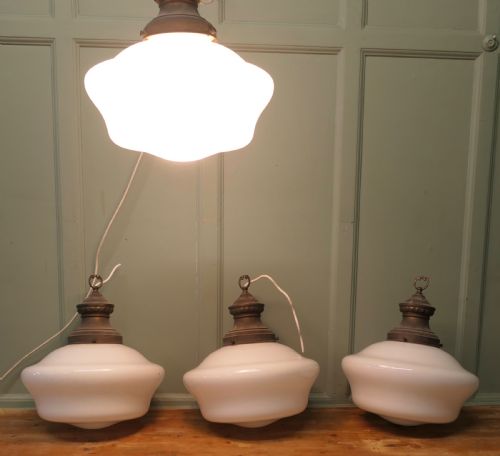
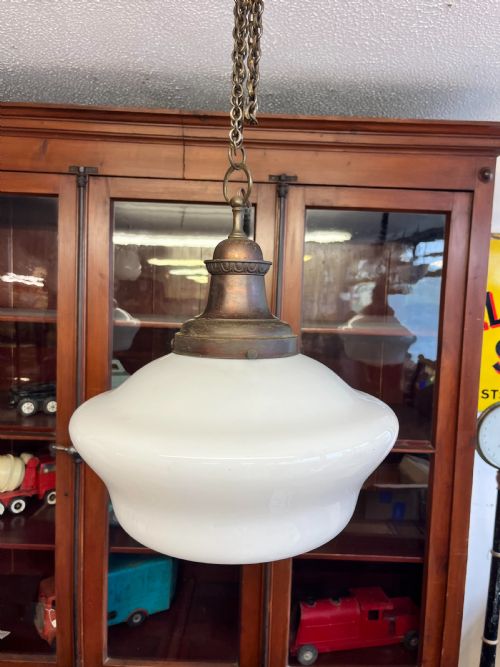
When searching for a white globe pendant, you encounter ceiling lights and pendant light shades originating from the Edwardian period, 1920, and 1930. These fittings include large industrial ceiling lights, pharmacy moonstone glass, opaline chapel lights, and Art Deco hallway pendants.
The styles span Edwardian, Art Deco, Industrial, Early 20th Century, Mid-Century Modern, and Gothic Revival. French and English origins appear alongside architectural installations like chapel and pharmacy fixtures.
Most examples utilise spherical or domed diffusers paired with hanging mechanisms, ranging from single diminutive shades to large sets and multi-light configurations.
How they were made
Glass production relies on opaline, opal, frosted, etched crystal, and moonstone variants to achieve the signature milk-white translucency that softens point-source light. These diffusers take the form of smooth spheres, fish scale patterns, and domed shades.
Metal components utilise brass, chrome, steel, and mixed metals to form the galleries, fitments, and suspension hardware that secure the glass globes to ceilings.
White Globe Pendant Retail Price Guide 2026
Typical asking prices for white globe pendant among the pieces listed under this phrase on Sellingantiques today, from the lower quarter to the upper quarter. They describe what is for sale here now, not the wider market.
Some chapel lights spent a century listening to sermons before trading hymns for hallway illumination.
What varies in quality
Quality rests in the depth and consistency of the glass, where heavier opaline or moonstone formulas create a richer diffusion than standard frosted panes. The weight and finish of the metalwork, whether polished brass or industrial steel, dictate the structural integrity.
Scale and proportion also define the piece, as unusually large pharmacy and chapel installations demand more complex manufacturing than smaller domestic shades.
The White Globe Pendant Glossary
- Opaline glass
- A milky-white translucent glass developed to diffuse light evenly while reducing glare. It appears frequently in 1920 and 1930 pendant lighting.
- Gallery
- The metal collar or ring that grips the top of a glass shade and connects it to the suspension rod or chain. It provides both structural support and decorative framing.
- Pendant light
- A hanging ceiling fixture suspended by a cord, chain, or metal rod. These units project illumination downwards in domestic and institutional spaces.
White Globe Pendant: Frequently Asked Questions
Where do white globe pendant lights work best?
These fixtures suit hallways, kitchens, and high-ceilinged rooms where diffused overhead illumination is required. Their historical forms complement both period properties and modern industrial schemes.
Larger variations function effectively as central ceiling lights, while smaller shades fit narrow corridors or multi-point hanging arrangements.
How do I identify the period of a light?
Dating relies on the combination of materials, construction methods, and stylistic cues present in the metal and glass. Edwardian and early twentieth-century examples often feature brass fittings and Gothic or traditional detailing.
Later 1930s pieces lean towards Art Deco geometries, streamlined chrome hardware, and specialised opaline or fish scale glass textures.
Are these lights suitable for modern electrical systems?
Most vintage pendants require rewiring by a qualified electrician to meet current safety standards and voltage requirements. The original metal galleries and suspension hardware can typically be retained during this process.
Globe shades accommodate standard modern LED bulbs, provided the wattage matches the thermal tolerances of the enclosed glass shade.
What is the difference between opaline and frosted glass?
Opaline glass incorporates chemical agents during manufacturing to create a solid, milky-white body that diffuses light through its entire thickness. Frosted glass is typically clear glass treated on the surface by acid etching or sandblasting to obscure vision.
Opaline yields a softer, warmer glow compared to the starker white finish of standard frosted varieties.