



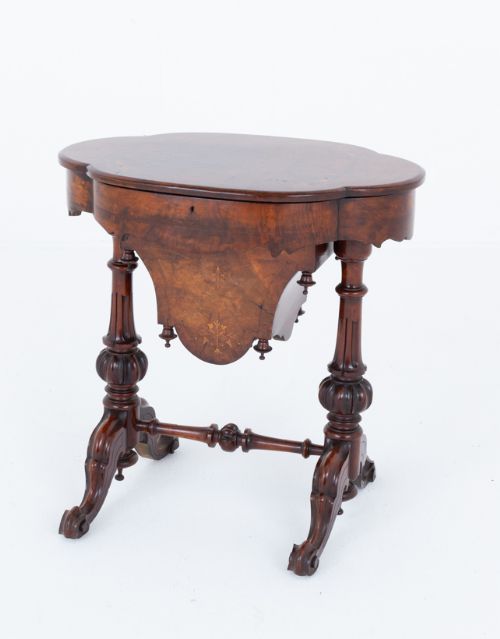
Walnut Trumpet Table
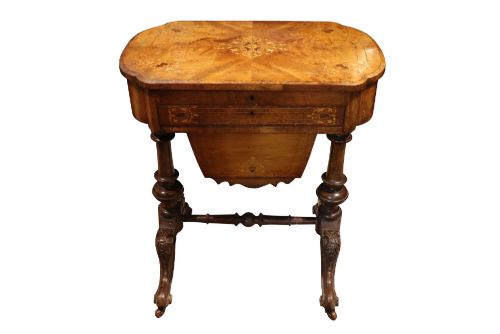
A walnut trumpet table stands as a clever Victorian multi-tasker, combining a display surface with a concealed sewing or games interior.
Walnut Trumpet Table
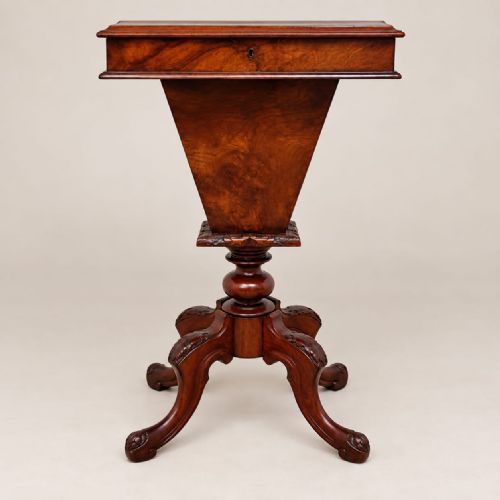
A walnut trumpet table takes its name from the characteristic flared pedestal base that widens gracefully from a tripod or circular foot toward an octagonal or round top. When buyers search for a walnut trumpet table, they encounter Victorian pieces dating primarily from the mid-to-late nineteenth century, spanning decades such as the 1850s, 1860s, 1870s and 1880s.
These multi-functional furnishings appear predominantly as work tables, sewing tables, and occasional tables, often incorporating fitted interiors with compartments for needlework and small accessories. Some variations feature reversible or folding tops designed for chess and other games, merging domestic utility with parlor entertainment.
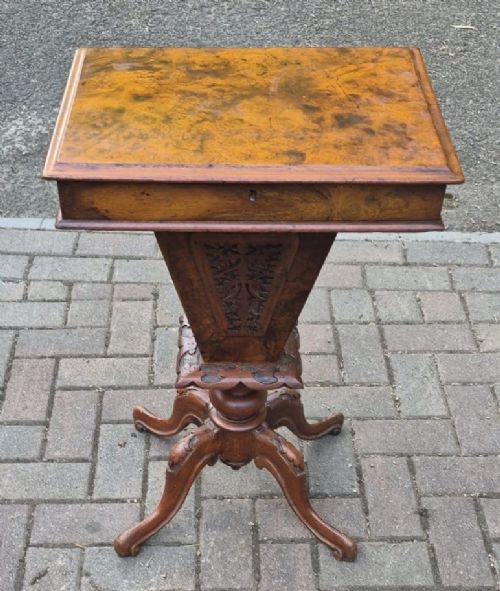
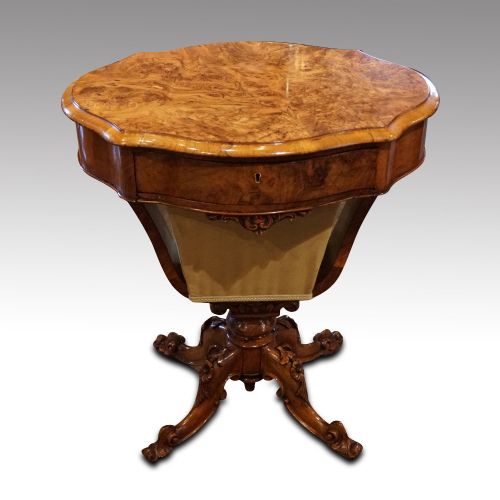
The standard form utilises a central pillar rising from carved or scrolled legs, supporting an enclosed box with a hinged lid. The overall silhouette remains consistent across the period, though surface geometries shift between octagonal and curved contours.
Materials and construction
Cabinetmakers constructed these tables using solid timber frames faced with burr walnut veneers, selected for the swirling, knotty grain patterns that create rich optical movement across the lid and sides. Tunbridge ware, boxwood, and general wood inlay frequently embellish the surfaces in geometric or floral motifs.
The flared pedestal stems require specialist turning and joinery to support the weight of the upper compartment without destabilising the tripod base. Brass hinges, locks, and fitted interior trays complete the construction, demonstrating precise internal carpentry designed for daily domestic use.
Walnut Trumpet Table Retail Price Guide 2026
Typical asking prices for walnut trumpet table among the pieces listed under this phrase on Sellingantiques today, from the lower quarter to the upper quarter. They describe what is for sale here now, not the wider market.
Listings demonstrate that burr walnut remains the dominant surface material, paired with inlaid boxwood and marquetry details.
Evaluating quality and execution
Quality rests upon the selection and placement of the burr walnut veneer, where symmetrical grain matching across the octagonal or circular lid distinguishes superior examples from plain timber versions. The crispness of inlaid banding, such as boxwood or Tunbridge details, further separates standard production pieces from finer cabinetwork.
Structural integrity of the flared trumpet stem and the rigidity of the tripod base dictate long-term durability. Interiors featuring intact fitted compartments and original brass fittings retain higher degrees of historical completeness.
The Walnut Trumpet Table Glossary
- Burr walnut
- A prized timber cut from the wart-like growths on walnut trees, yielding highly figured patterns with dense swirling grain. It provides the primary decorative veneer for Victorian table tops.
- Trumpet table
- A nineteenth-century pedestal table featuring a characteristic flared shaft resembling a musical horn. This shape widens from the base to support an enclosed work box.
- Tunbridge inlay
- A meticulous mosaic woodworking technique originating in Kent, forming tiny geometric or pictorial scenes from contrasting woods. It appears as decorative banding on select Victorian table lids.
- Occasional table
- A small, movable piece designed for specific, intermittent tasks around the parlor or drawing room. These items balance decorative presence with light utility.
- Fitted interior
- A compartment system built beneath the table lid, segmented with small wooden boxes and lids for sewing tools or gaming pieces.
Walnut Trumpet Table: Frequently Asked Questions
What was a trumpet table used for?
These pieces served as domestic work stations where Victorian women kept needlework, threads, and sewing implements organised inside the top compartment.
Many examples also doubled as games tables, featuring chess boards or specialised surfaces incorporated into the lid for evening parlor entertainment.
How do I date a walnut trumpet table?
Dating relies on stylistic shifts visible across the nineteenth century, with pieces spanning the 1850s through the 1880s.
Earlier examples often display simpler turned pedestals, while later Victorian models frequently incorporate more complex marquetry inlay, octagonal box shapes, and elaborate tripod carving.
Are these tables sturdy enough for daily use?
The tripod base and central pedestal provide a stable footprint for normal placement in a living space.
However, the internal weight distribution and hinged lids mean they function best as side, lamp, or occasional tables rather than heavy-duty support furniture.
What is the difference between a work table and a sewing table?
In nineteenth-century terminology, the names were largely interchangeable for furniture designed to house textile crafts and small personal items.
Both types utilise the same enclosed trumpet box structure and internal compartment layouts regardless of whether the listings emphasise sewing or general work.