

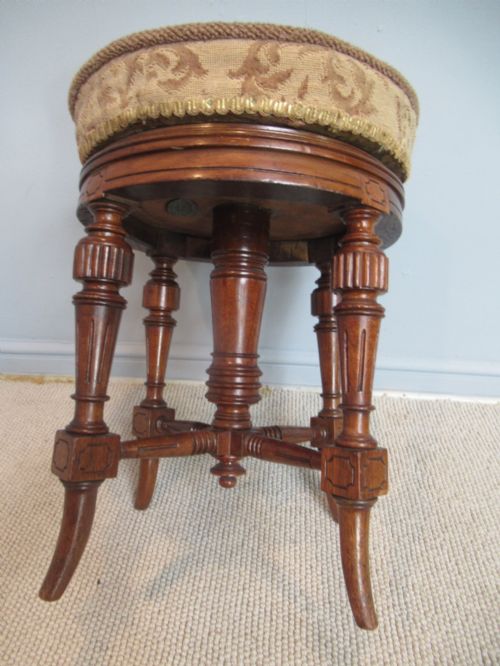
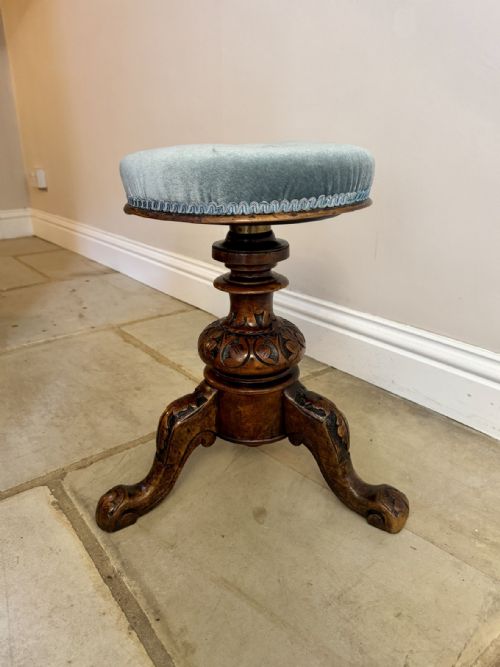
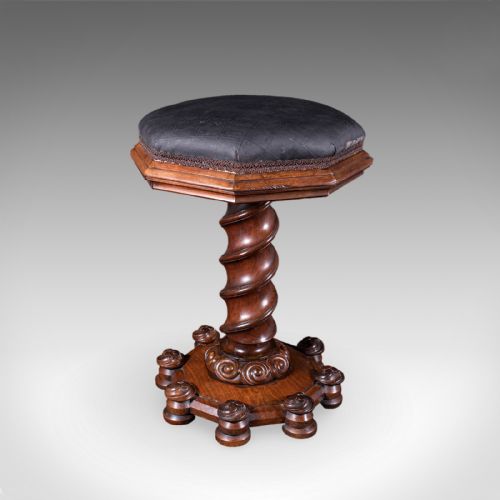


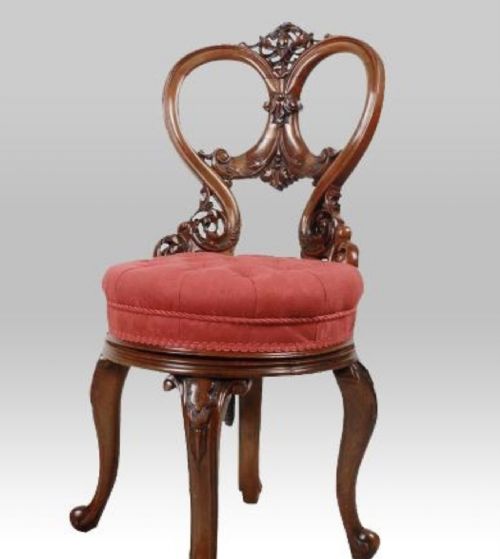


Walnut Swivel Stool
A walnut swivel stool is a practical seat offering adjustable height and steady rotation, valued for both music rooms and dressing tables.
Walnut Swivel Stool
A walnut swivel stool serves primarily as a piano or music seat, alongside occasional roles at dressing tables and bars. These pieces appear most frequently in Victorian forms, spanning the mid to late nineteenth century with occasional William IV and Georgian roots.
The dominant formats include revolving music stools, adjustable piano stools, and tripod pedestal designs. Buyers encounter everything from simple carved hardwood examples to French chateau pieces and Art Deco leather bar stools.
Makers designed these walnut swivel stool variants for functionality, incorporating rise and fall mechanisms or revolving tops for musicians and organists. The selection ranges from plain hardwood frames to intricately carved Victorian seating.
How they were made
The primary structure relies upon solid walnut and carved hardwood, shaped into tripod bases, pedestal columns, and four-legged frames. Joinery typically combines traditional woodturning with sturdy central screws or wooden rise and fall mechanisms.
Upholstery forms a key component of construction, utilising leather, fabric, velvet, and standard textile padding across the revolving seats. Metal and iron components frequently support the internal adjustment mechanisms hidden beneath the upholstered tops.
Walnut Swivel Stool Retail Price Guide 2026
Typical asking prices for walnut swivel stool among the pieces listed under this phrase on Sellingantiques today, from the lower quarter to the upper quarter. They describe what is for sale here now, not the wider market.
Chapel organists required steady seating too, leaving behind wonderfully specific eighteenth- and nineteenth-century musical chapel stools.
What varies in quality
The refinement of the carving on the walnut pedestal and legs dictates much of the visual distinction between standard and superior pieces. Heavier framing and deeply articulated Victorian ornamentation separate the finer examples from simpler utilitarian stools.
The engineering of the swivel and adjustment mechanism determines mechanical reliability, where smooth rotation and secure height regulation reflect superior original manufacturing. The choice of covering, from plain fabric to quality tan leather, also marks the grade of the piece.
The Walnut Swivel Stool Glossary
- Revolving stool
- A seat featuring a top that turns completely around on a central pivot or screw mechanism. This allows the user to rotate freely while seated.
- Rise and fall
- A mechanical system enabling the seat height to be adjusted upward or downward. It is commonly operated by turning the stool top.
- Tripod base
- A three-legged support structure often utilised on pedestal piano stools for stability on uneven floors. These legs frequently display carved detailing.
- Pedestal stool
- A seating form supported by a single central column rising from a branched base. This design is typical of nineteenth-century music furniture.
- Music riser
- An internal or attached mechanism designed to adjust the height of a seat for musicians and organists. It provides precise positioning during performances.
Walnut Swivel Stool: Frequently Asked Questions
How do I adjust the height?
Most pieces operate via a central screw thread hidden beneath the upholstery. Turning the seat clockwise or anti-clockwise raises or lowers the top.
Some examples utilise a side handle or lever to release and secure the internal riser mechanism.
Were these made exclusively for pianos?
While primarily designed for pianists, chapel organists, and harpists, many served multiple domestic functions. Examples were regularly deployed at dressing tables or utilised as music chairs.
Later twenty-century variations also appear in bar and counter formats.
How can I identify a Victorian piece?
Victorian models frequently display dense walnut timbers combined with characteristic motifs like floral carvings or tripod pedestal supports. Construction often involves traditional joinery alongside early metal swivel mechanisms.
Stylistic cues bridge earlier William IV heaviness and later nineteenth-century ornamentation.
Are these suitable for daily seating?
These pieces were built for functional domestic and musical use, offering sturdy hardwood frames and durable upholstery options like leather or velvet. Regular daily deployment at a desk or dressing table remains entirely practical.
Care should be taken not to over-extend the height adjustment screw during regular use.