
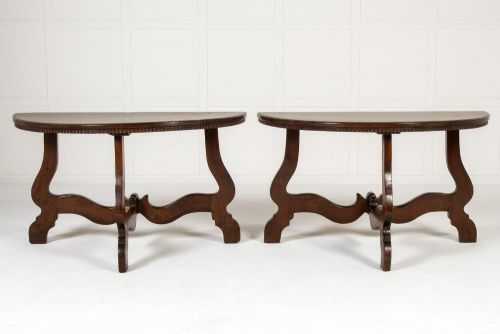


Walnut Demi Lune
These walnut demi lune tables and cabinets offer a curved profile and rich timber grain that bring elegance to hallways and reception rooms.
Walnut Demi Lune
A walnut demi lune takes its name from the French for half moon, presenting a flat back edge to sit flush against a wall and a curved front. When you search for walnut demi lune items, you encounter a variety of forms designed to maximise floor space while providing a decorative surface.
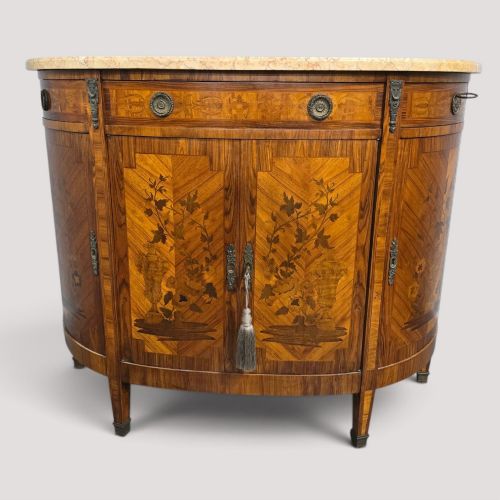
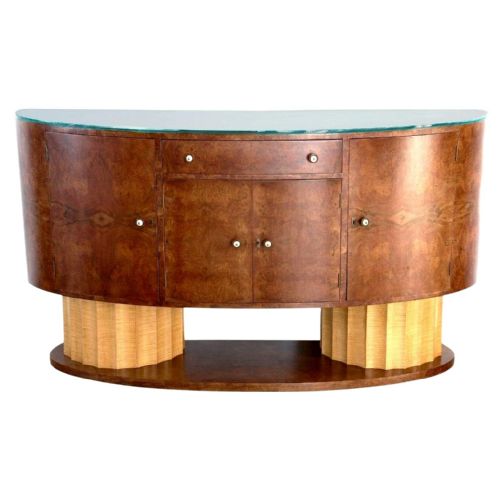
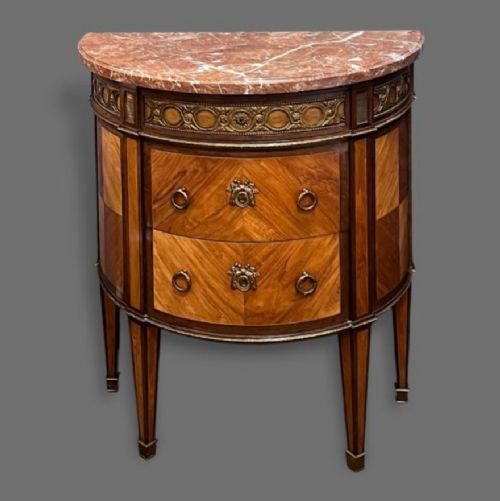
The selection ranges widely across periods, including 18th century Italian and English examples, Victorian pieces, and later 19th and 20th century iterations up to the 1930s. The most common survivors on this page are card and games tables featuring fold-over tops, alongside console tables, side cabinets, and commodes.
Makers and workshops utilised this half-round shape for versatile placement in both grand drawing rooms and compact hallways. Whether configured as a whatnot, a display console, or a tea table, the half-moon footprint remains a defining characteristic.
How they were made
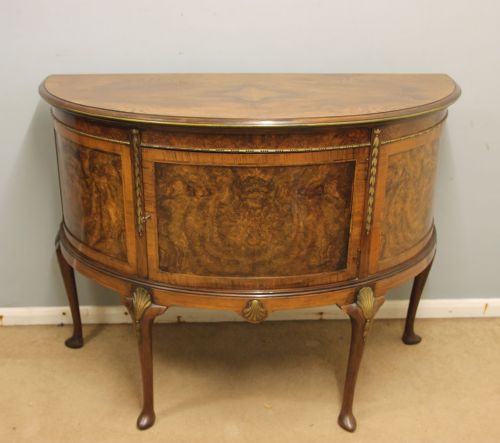
Cabinet makers relied primarily on walnut and burr walnut timber, often applied as fine veneers over secondary woods to showcase rich, swirling grain patterns. Marquetry inlay appears on select French and Continental items, adding intricate geometric or floral decoration into the wooden surface.
Structural embellishments frequently incorporate brass fittings, carved details, and occasional marble tops on console tables and cabinets. Folding mechanisms on card and games tables required precise joinery to allow the top leaf to swivel and open smoothly.
Listings feature items spanning the 18th century through to the 1930s, constructed predominantly from walnut, burr walnut, and marble.
What varies in quality
The distinction between standard examples and superior pieces rests largely on the choice and matching of the timber veneers. Selection of highly figured burr walnut across the curved top and frieze elevates an item significantly above plain timber alternatives.
Casting and integration of brass hardware, precision in marquetry inlay work, and the crispness of any carved wooden details separate workshop output. Construction integrity of the folding mechanism and the stability of the half-round frame further define the standard of the manufacture.
Hille·Maple and Co·Pietro Ferrario·W.F. Greenwood and Sons York
The Walnut Demi Lune Glossary
- Demi lune
- A half-moon shape characteristic of tables and cabinets designed to stand flat against a wall. This profile saves floor space while offering a curved display surface.
- Burr walnut
- Timber taken from a growth deformation on a walnut tree, producing highly prized swirling grain patterns. Cabinet makers sliced this wood into thin veneers for decorative surfaces.
- Marquetry inlay
- The art of applying pieces of veneer to a structure to form decorative patterns or pictures. It appears frequently on French and Continental pieces.
- Console table
- A table fixed to a wall or designed to stand against one, often supported by front legs or brackets. They frequently feature marble tops and decorative carving.
- Fold over card table
- A table with a hinged top that opens out to double the surface area, often lined with baize for playing games. The swivel action reveals a well for storage underneath.
Walnut Demi Lune: Frequently Asked Questions
What is a demi lune table?
A demi lune table is a half-circle piece of furniture designed to fit flat against a wall. Its shape makes it ideal for hallways and narrower spaces where rectangular tables protrude too far.
Most examples feature a flat back edge and a curved front, and they often include folding tops configured for card games or tea.
How do I date a walnut table?
Dating involves examining the construction methods, timber choice, and stylistic details such as cabriole legs or marquetry. Victorian and Edwardian pieces often display heavier burr veneers and specific hardware styles.
Earlier 18th century examples show different joinery techniques and proportions, reflecting the furniture fashions of the Georgian period.
Were these tables used for card games?
Many walnut demi lune tables function specifically as games or card tables. The hinged top folds open to reveal a baize-lined playing surface, sometimes with internal wells for counters and cards.
When closed, the table serves as a standard console or side table against a room's wall.
What is burr walnut veneer?
Burr walnut is derived from a tree growth that creates highly decorative, swirling grain patterns. Craftsmen sliced this wood thinly to veneer the prominent surfaces of tables and cabinets.
This technique allowed makers to display luxurious patterns across wide tabletops and cabinet doors without using solid burr timber.