



Walnut Bureau on Bun Feet
A walnut bureau on bun feet brings warmth and practicality to a room, offering rich timber figuring and sturdy turned supports.
Walnut Bureau on Bun Feet
A walnut bureau on bun feet combines a sloping fall-front writing surface with concealed drawers and pigeonholes above a set of lower drawers. These practical writing cabinets date from periods such as the 17th century, the 18th century, and the Victorian era, spanning styles like Queen Anne, George I, and William and Mary.
The form developed to serve as a private desk where correspondence could be locked away securely while displaying the rich grain of the wood. Buyers seek these pieces for their domestic utility and the deep, figured tones characteristic of early walnut furniture.
How they were made
Joiners built these bureaux using solid oak for internal carcases and drawer linings, applying figured walnut and burr walnut veneers to the visible exterior surfaces. Marquetry inlay occasionally decorates the primary panels, introducing contrasting floral or geometric patterns executed in various timbers.
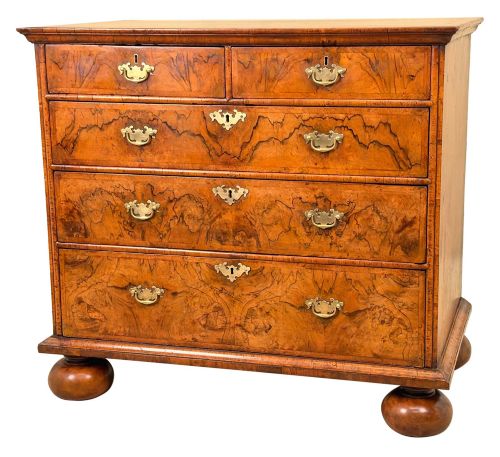
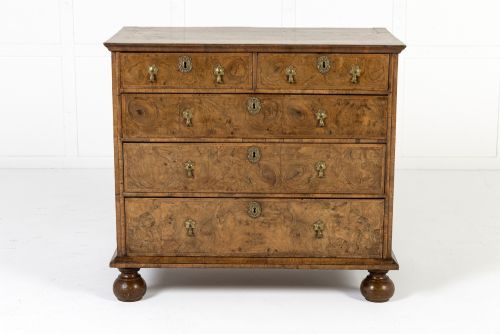
Makers set the carcases upon turned wooden bun feet to elevate the heavy timber frames clear of damp floors. Brass handles and escutcheons secure the drawers and fall-fronts, providing functional contrast to the warm brown tones of the wood.
Writing compartments often contain fitted baize writing surfaces inside the fall-front, offering a tactile surface for paperwork. Construction methods rely on traditional dovetailing for the drawer construction and precise veneering techniques to display the swirling grain patterns.
Walnut Bureau on Bun Feet Retail Price Guide 2026
Typical asking prices for walnut bureau on bun feet among the pieces listed under this phrase on Sellingantiques today, from the lower quarter to the upper quarter. They describe what is for sale here now, not the wider market.
Secret compartments hidden behind miniature pigeonhole drawers offered owners a private space for confidential letters and forgotten coins.
What varies in quality
The choice and arrangement of timber figure dictate the visual impact of each piece, with symmetrical burr walnut veneer representing the most ambitious cabinet work. Lesser examples utilise plainer grain cuts that lack the depth and movement seen in superior specimens.
Proportion and the integrity of the original turned bun feet govern the structural harmony of the bureau. Subtle differences in the execution of internal pigeonholes and small drawers distinguish standard workshop production from finer cabinet maker output.
The Walnut Bureau on Bun Feet Glossary
- Bun foot
- A spherical or slightly flattened wooden foot turned on a lathe, commonly found on furniture from the late 17th and early 18th centuries. It provides a solid visual anchor for heavy case pieces.
- Burr walnut
- A specialised timber veneer harvested from the irregular growth knots of the walnut tree, prized for its swirling, highly figured grain patterns. Cabinet makers used it on prominent exterior surfaces.
- Fall-front
- A hinged writing flap that drops down to create a horizontal desk surface and conceals internal compartments. It locks upright when not in use to secure the contents.
- Marquetry
- Decorative inlay work where thin pieces of various woods are fitted together to form pictorial or geometric designs. This technique embellished the surfaces of high-status pieces.
- Secretaire
- A cabinet or bureau containing a pull-out or drop-front writing drawer with internal stationery fittings. The term denotes a dedicated writing function within the furniture form.
Walnut Bureau on Bun Feet: Frequently Asked Questions
How do I date a walnut bureau?
Dating relies on observing construction methods, timber choices, and stylistic markers such as the shape of the feet and brass hardware. Early examples often feature feather banding and oak secondary timbers.
Later Victorian pieces display heavier carcase construction and different internal drawer configurations compared to their 18th-century precursors.
What is the difference between a bureau and a chest of drawers?
A bureau incorporates a sloping hinged writing flap that opens to reveal internal compartments and a writing surface. A standard chest of drawers provides only horizontal drawer storage without the writing facility.
Both forms appear frequently in early walnut furniture, often sharing similar proportions and bun feet.
How should I care for walnut veneer?
Walnut furniture requires a stable indoor environment away from direct sunlight and extreme humidity fluctuations to prevent veneer lifting. Regular dusting with a dry cloth maintains the finish.
Applying microcrystalline wax periodically helps nourish the wood and preserves the depth of the grain.
Did all these bureaux originally have bun feet?
Bun feet are characteristic of the late 17th and early 18th centuries, particularly under William and Mary and Queen Anne styles. Many pieces from this era were designed specifically with these turned supports.
Foot configurations can vary across different periods, with later Victorian interpretations drawing on earlier stylistic revivals.