





Vintage Surveying Transit
These vintage surveying transit instruments are brass and glass optical tools built for mapping and measurement, prized by collectors for their intricate mechanics and historic engineering.
Vintage Surveying Transit
When you search for vintage surveying transit, you encounter heavy scientific instruments designed for field measurement, navigation, and topographical mapping. These tools represent centuries of optical and mechanical development, originating from periods spanning the Georgian era through to the mid-twentieth century.
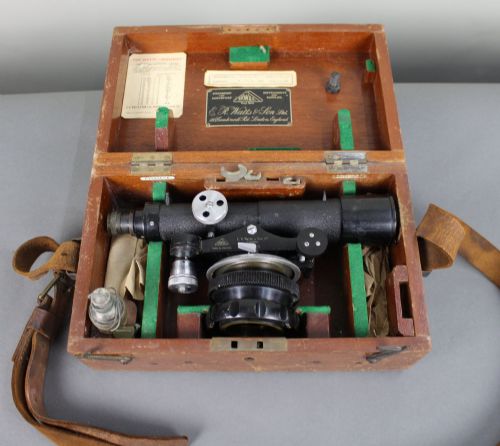
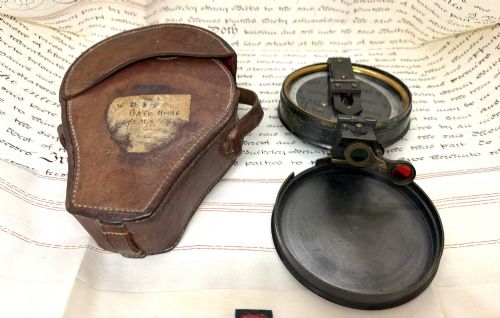
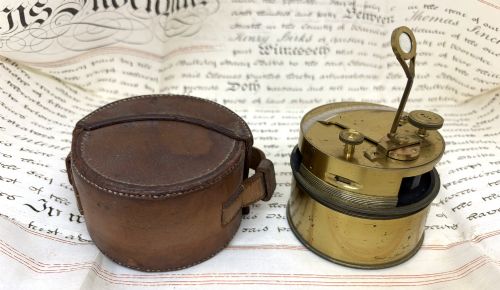
The versions most commonly met on this page include theodolites, levels, and prismatic compasses housed in fitted wooden cases. These instruments bear the signatures of notable makers and reflect the scientific requirements of their respective eras, from Victorian scientific advancements to Edwardian field gear.
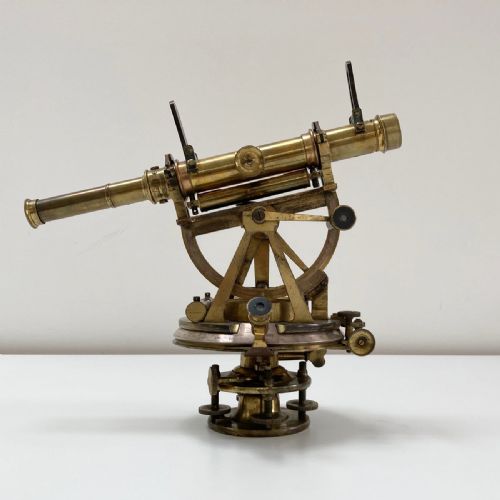
Makers utilised durable materials to ensure these instruments withstood demanding outdoor use while maintaining precise calibration. The physical forms range from full-sized brass theodolites mounted on tripods to compact, portable transit instruments and miniature altazimuth variants designed for specialised fieldwork.
Construction and Materials
The primary structural material across these pieces is polished brass, complemented by delicate silvered metal dials and clear glass optics. Makers combined these metals with fitted mahogany and wood cases, often lined with leather or velvet to protect the internal components during transport.
Workshops employed precision casting and manual engraving techniques to graduate the directional circles and mark the scales. Internal lenses and spirit levels were integrated into the metal frames to ensure accurate horizontal and vertical measurements in the field.
Vintage Surveying Transit Retail Price Guide 2026
Typical asking prices for vintage surveying transit among the pieces listed under this phrase on Sellingantiques today, from the lower quarter to the upper quarter. They describe what is for sale here now, not the wider market.
Listings feature instruments constructed primarily from brass, glass, and mahogany, spanning periods from the Georgian era through to the 1940s.
Quality and Distinction
Distinction across these instruments lies in the crispness of the engraved markings on the silvered metal dials and the clarity of the original glass optics. Instruments bearing clear signatures from prominent London and regional makers demonstrate superior workshop capability compared to unmarked examples.
The survival of the original fitted mahogany or wood case adds considerable merit to an instrument, particularly when the interior fittings and secondary lenses remain intact. The complexity of the mechanism, such as altazimuth designs or patent portable setups, further elevates the sophistication of the piece.
E.R. Watts & Son Ltd·P. Orr, Madras·Baker, London·W&S Jones·Negretti & Zambra·Elliott Bros. of London·Alexander Adie of Edinburgh·Cox of Devonport·WF Stanley
The Vintage Surveying Transit Glossary
- Theodolite
- A precision optical instrument for measuring horizontal and vertical angles, mounted on a base and heavily utilised in surveying and map-making. It typically incorporates telescoping sights and graduated silvered metal circles.
- Prismatic Compass
- A pocket-sized navigational instrument featuring an internal prism that allows the user to read the magnetic bearing while sighting a distant landmark. These units often feature protective metal and glass casing.
- Altazimuth
- An instrument mounting that allows rotation in both horizontal and vertical axes, enabling simultaneous measurement of altitude and azimuth. These are found on more complex nineteenth-century surveying equipment.
- Vernier
- A secondary sliding scale that provides sub-divisions of the main graduated scale on an instrument, allowing for highly precise angular readings. It remains a hallmark of accurate scientific measurement.
- Level
- A surveying instrument designed to determine relative height differences and establish horizontal lines of sight. These often incorporate built-in spirit vials to ensure correct orientation.
Vintage Surveying Transit: Frequently Asked Questions
What is a vintage surveying transit used for?
These instruments were utilised by surveyors, architects, and engineers to measure angles, establish elevations, and map terrain before digital technology existed.
They allowed field operators to calculate precise distances and boundaries for construction and cartography.
How do I identify the age of a transit?
Age is determined by stylistic cues in the brass work, the font used for maker signatures, and the materials of the fitted wooden cases.
Many pieces bear engraved dates or maker details that place them within specific nineteenth or early twentieth-century periods.
Are these instruments still accurate today?
While the optics and mechanical scales were engineered for extreme precision, centuries of handling mean they function primarily as historic objects.
Collectors appreciate them for their mechanical ingenuity rather than for modern field measurement.
How should I display a cased transit?
These pieces look best displayed on sturdy tables or shelves where the polished brass and fitted wooden cases can be examined closely.
Keeping them away from direct sunlight and excessive humidity helps preserve the timber cases and delicate silvered metal dials.